The Soviet space program: rival design bureaus, secret chief designers and an unflown Moon rocket
From Korolev’s missile bureau to Energia–Buran, the Soviet Union took most of the early firsts with a program run by competing design bureaus, hidden behind anonymous names, and built around a Moon rocket that never flew successfully.
Drawn from 33 sources: NASA (15), NASA History Office (4), Президентская библиотека имени Б. Н. Ельцина (Presidential Library) (4), NASA Science (3) and 6 others. About 13 minutes. Checked November 9, 2026.
On October 9, 1957, five days after the first satellite reached orbit, Pravda printed an article by the satellite’s designers. Its authors were not named. The designers’ identities were a state secret, and the man who had led the work, Sergei Korolev, began publishing in December 1957 under the pseudonym “Professor K. Sergeyev.”2 Soviet secrecy covered more than names. Until the late 1980s the Soviet Union never announced a mission that failed to reach Earth orbit, and from November 1963 it gave probes stranded in Earth orbit nondescript “Kosmos” numbers so that the failures would draw no attention.19
What the secrecy hid was not a space agency but an industry. American intelligence described the structure in 1969: Party Secretary D. F. Ustinov planned and allocated resources through government commissions, among them the Military-Industrial Commission; the Ministry of General Machine Building was the central authority for designing and producing space hardware; other ministries worked largely as contractors, with no responsibility for policy.18 Inside that system, design bureaus led by chief designers proposed programs, competed for government decrees and fought over engines.14 The story of the Soviet program from 1946 to 1991 is largely the story of those bureaus. How it looked from Washington, and how the two sides raced, is told in The Space Race.
A prisoner of Kolyma became chief designer of the first ICBM
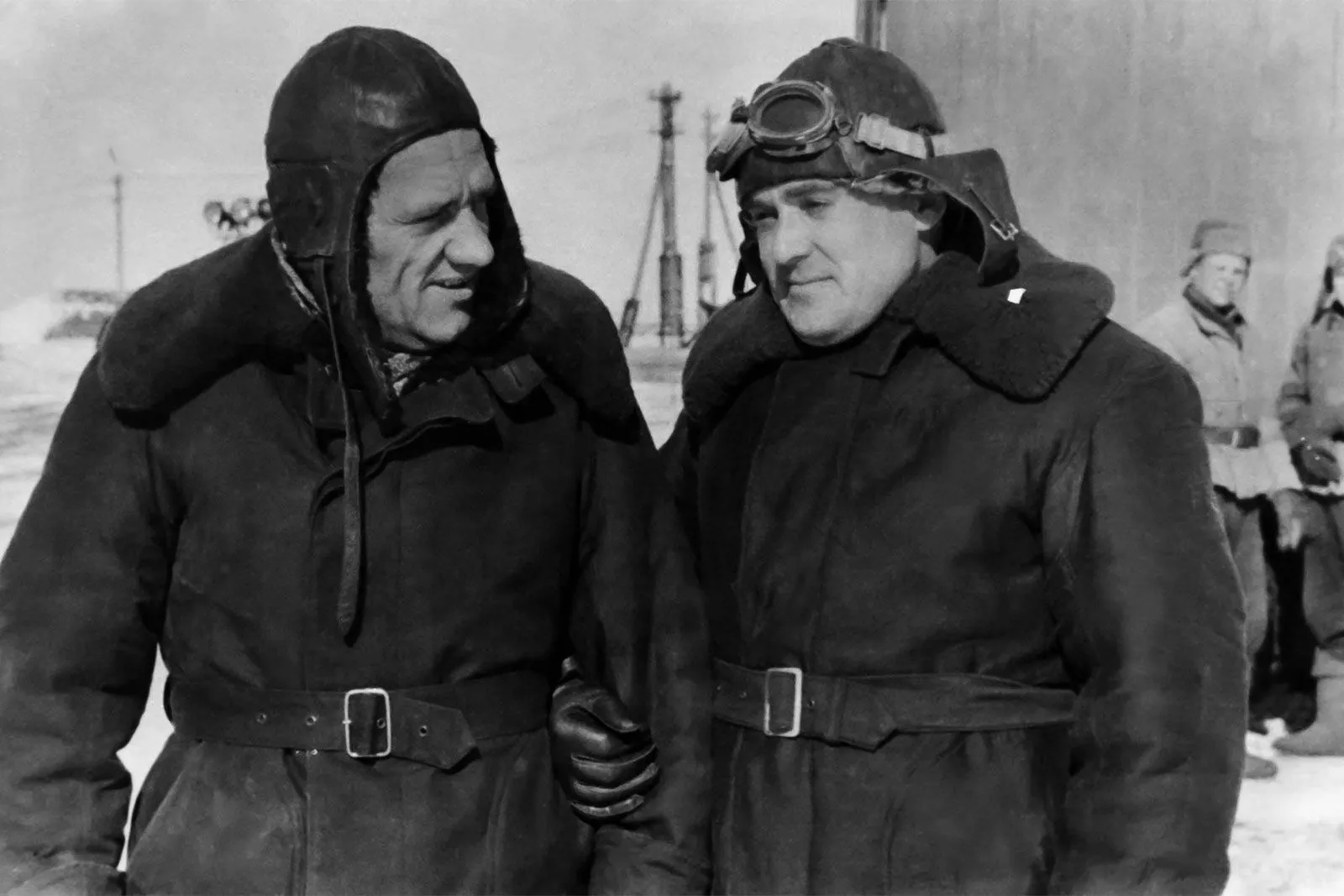
Sergei Korolev studied aeronautical engineering at the Kiev Polytechnic Institute and helped found GIRD, the Moscow group whose name stood for Group for Investigation of Reactive Motion. The military soon replaced GIRD with a rocket research institute, RNII, where Korolev worked on rocket-powered missiles and gliders.1,16 He was arrested on June 27, 1938, during Stalin’s purges, and sentenced to ten years in a labor camp. He arrived at the Kolyma gold mines in August 1939; that December he was put on a train back to Moscow, which he reached in March 1940, and from September 1940 he worked in a sharashka, a prison design bureau. The rocket-engine designer Valentin Glushko had been arrested in March 1938. Both were freed by an order dated July 27, 1944, and Korolev became Glushko’s deputy.11,16
In 1946 Stalin created NII-88 as the main engineering organization for long-range missiles. Korolev headed its Department No. 3, which later became OKB-1, Experimental Design Bureau No. 1.2,30 On May 20, 1954, the government assigned OKB-1 to develop the R-7, the world’s first intercontinental ballistic missile. To concentrate on it, Korolev handed his other projects to a new bureau in Dnepropetrovsk led by his assistant Mikhail Yangel. It was the first of several bureaus to split off from Korolev’s once a technology had been mastered, and some of them later competed with it.1,2
The R-7 failed three times, and Sputnik was the fallback satellite
On January 30, 1956, the Council of Ministers authorized “Object D,” a satellite of 1,000 to 1,400 kilograms carrying 200 to 300 kilograms of instruments, for launch in 1957. By late 1956 it was behind schedule because of subcontractor problems, the R-7’s engines were testing below their projected performance, and Korolev feared that the United States would launch first. On January 5, 1957, he proposed two small satellites of 40 to 50 kilograms instead, designed and built entirely within OKB-1. The design, PS-1, for “simple satellite,” was approved on January 25, and Object D was pushed back to April 1958.2
The first three R-7 launches, between May and July 1957, failed. The fourth, on August 21, flew about 6,500 kilometers to Kamchatka.2 After a second successful flight on September 7, Korolev moved the satellite launch up to October 4, partly from concern about an American launch. The R-7 lifted off from what is now the Baikonur Cosmodrome in Kazakhstan, carrying an aluminum-alloy sphere with two radio transmitters and four antennas. Its orbit was about 80 kilometers lower at apogee than planned.2,3 The rocket’s core stage also reached orbit and, because it reflected more light, was often easier to see than the satellite. Sputnik carried no scientific instruments; its batteries died on October 26, and it reentered on January 4, 1958.3
Nikita Khrushchev took the news calmly, by his own later account, and Pravda first ran it as a low-key report that was not the day’s headline.2 The world’s reaction changed that. Less than a month later, on November 3, Sputnik 2 carried the dog Laika into orbit. Development time was so short that there was no way to recover her, and the life support was not designed for a long mission; she likely survived only a few hours.3
Vostok: twenty pilots chosen in secret and one orbit for Gagarin
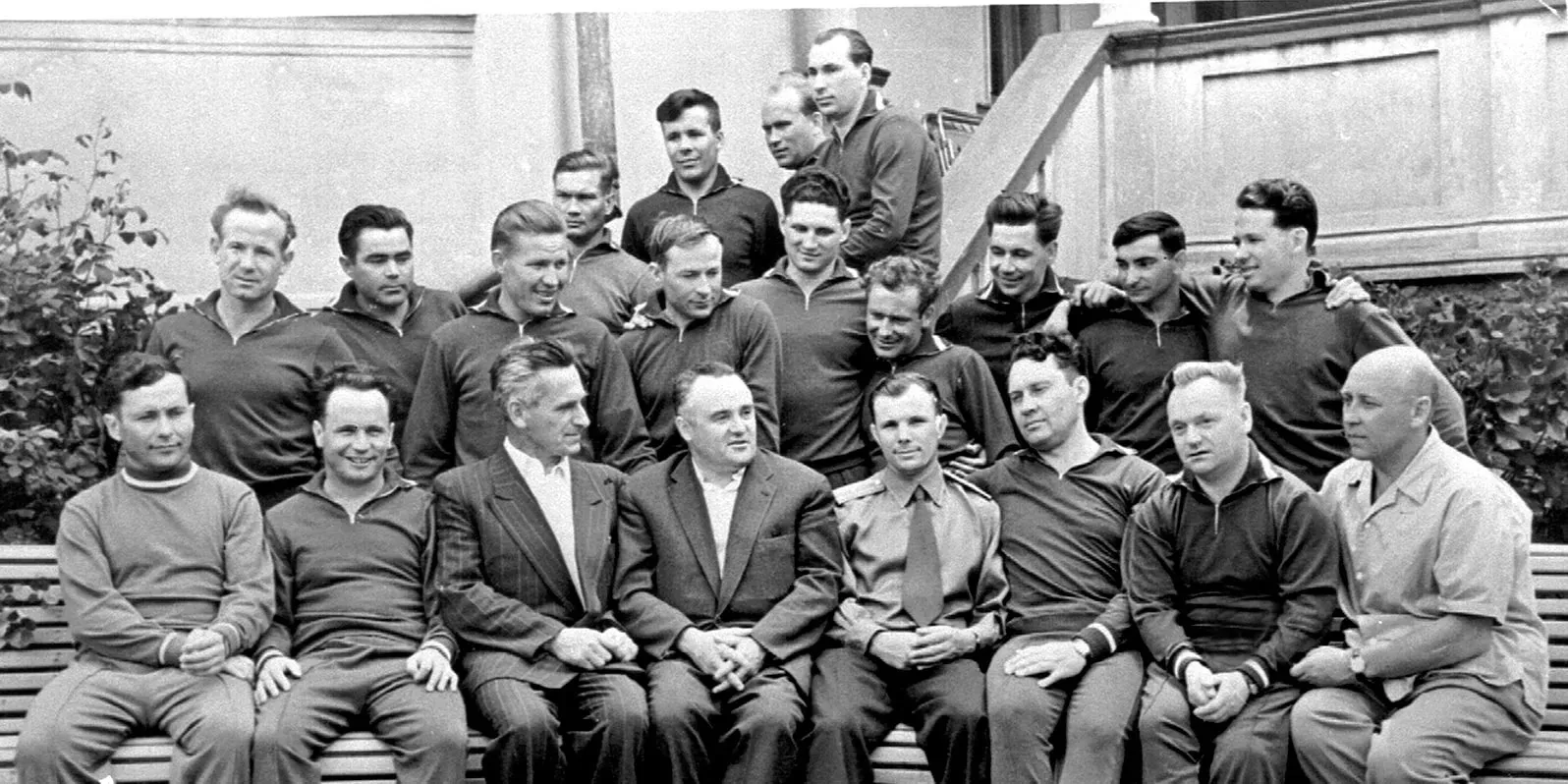
The Soviet selection of cosmonauts began in late 1959 with a review of Air Force pilots’ records. A military hospital in Moscow examined 154 candidates in groups of 20, and the top 20 were chosen. Unlike NASA’s public introduction of the Mercury astronauts, the selection was kept secret: cosmonauts were not named until they reached orbit, and the names of those who never flew stayed unknown until glasnost in the 1980s. From May 1960 six of them prepared in depth for the Vostok spacecraft. Dogs went first: on August 20, 1960, Belka and Strelka became the first living beings recovered safely from orbit, after about 24 hours.4
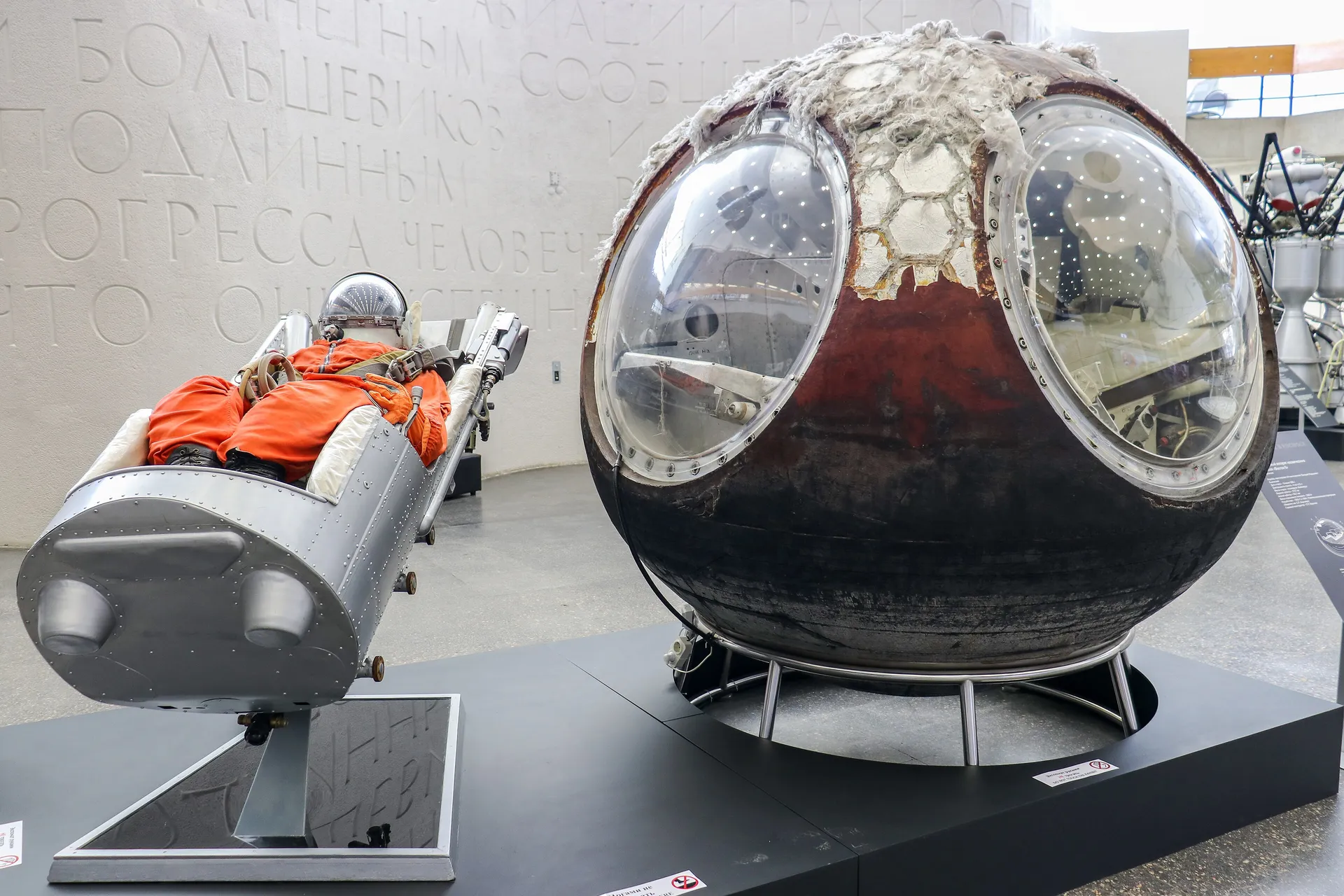
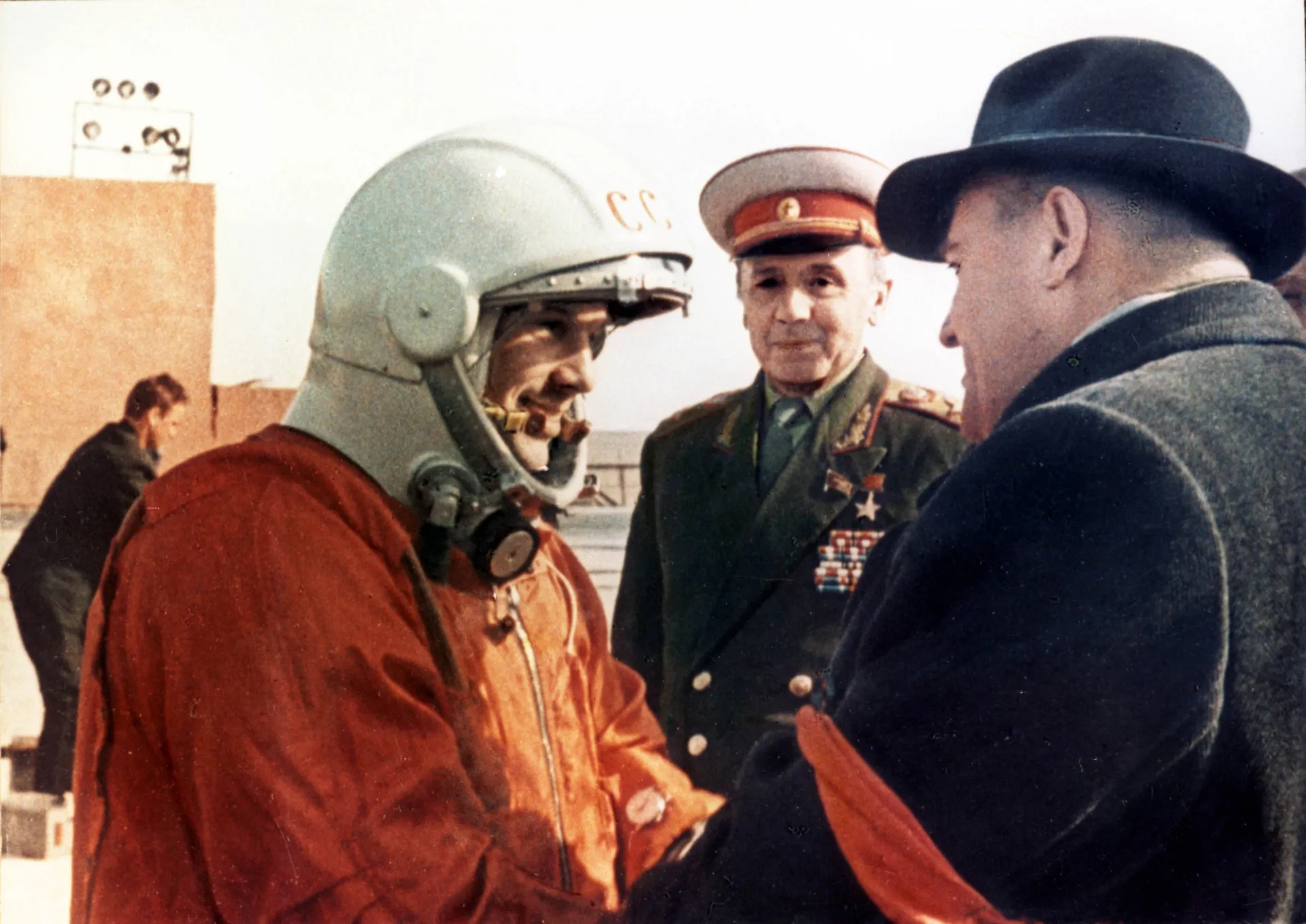
On April 12, 1961, Yuri Gagarin lifted off from Baikonur at 9:07 a.m. Moscow time on a single orbit of Earth.7 His call at launch was “Poyekhali!”—“Let’s go!”5 The Vostok, about 4.7 tonnes in its crewed version, circled the planet at about 27,400 kilometers per hour, and a computer controlled its reentry.6,11 The flight was announced as lasting 108 minutes; declassified documents later showed it was about two minutes shorter.17,33 Gagarin did not land inside the capsule: a few kilometers above the ground he ejected and came down by parachute near the descent module.6,7
Each later Vostok flight added one step. Gherman Titov flew for a full day in August 1961; Andriyan Nikolayev and Pavel Popovich made the first group flight in August 1962; Valery Bykovsky stayed up for five days in June 1963, still the longest solo mission.4
Five women chosen in 1962, and three days in orbit for Tereshkova
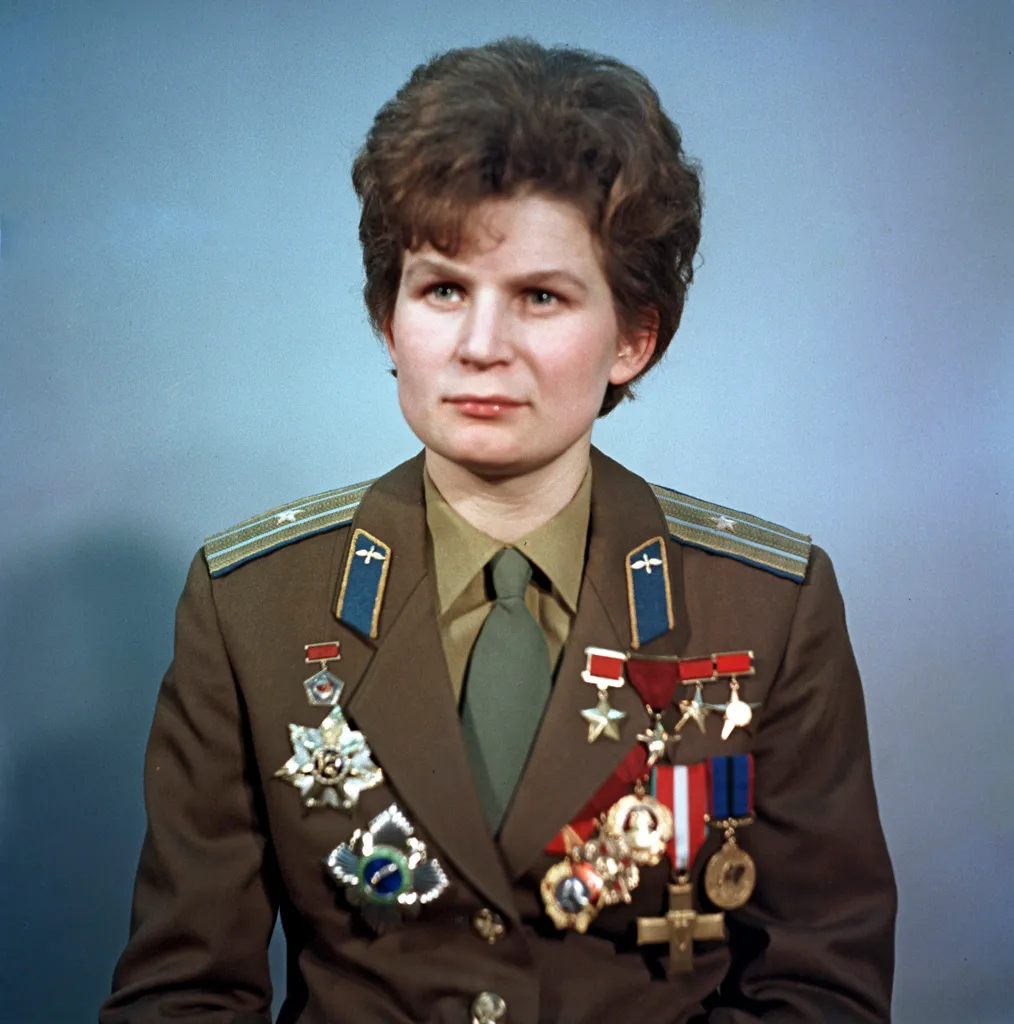
Five women were chosen as cosmonauts in April 1962. Nikolai Kamanin, the Air Force general in charge of cosmonaut training, favored Valentina Tereshkova, a textile worker and experienced parachutist born in 1937, who was active in the Young Communist League and later joined the Communist Party.8 Kamanin had a reason for haste. Accompanying Gherman Titov on a visit to the United States from April 29, 1962, he concluded wrongly that the Americans planned to select women astronauts and might fly one as early as the second half of that year; NASA’s historian John Uri traces the Soviet women’s flight to that assumption.9
Vostok 6 lifted off on June 16, 1963, and made 48 orbits of Earth in almost three days, while Bykovsky flew alongside.8,17 Tereshkova was the only one of the five women to fly, and she never flew again. The next woman in space was also Soviet: Svetlana Savitskaya, who flew to the Salyut 7 station in 1982.4,8
Voskhod: three seats and an inflatable airlock fitted to a Vostok
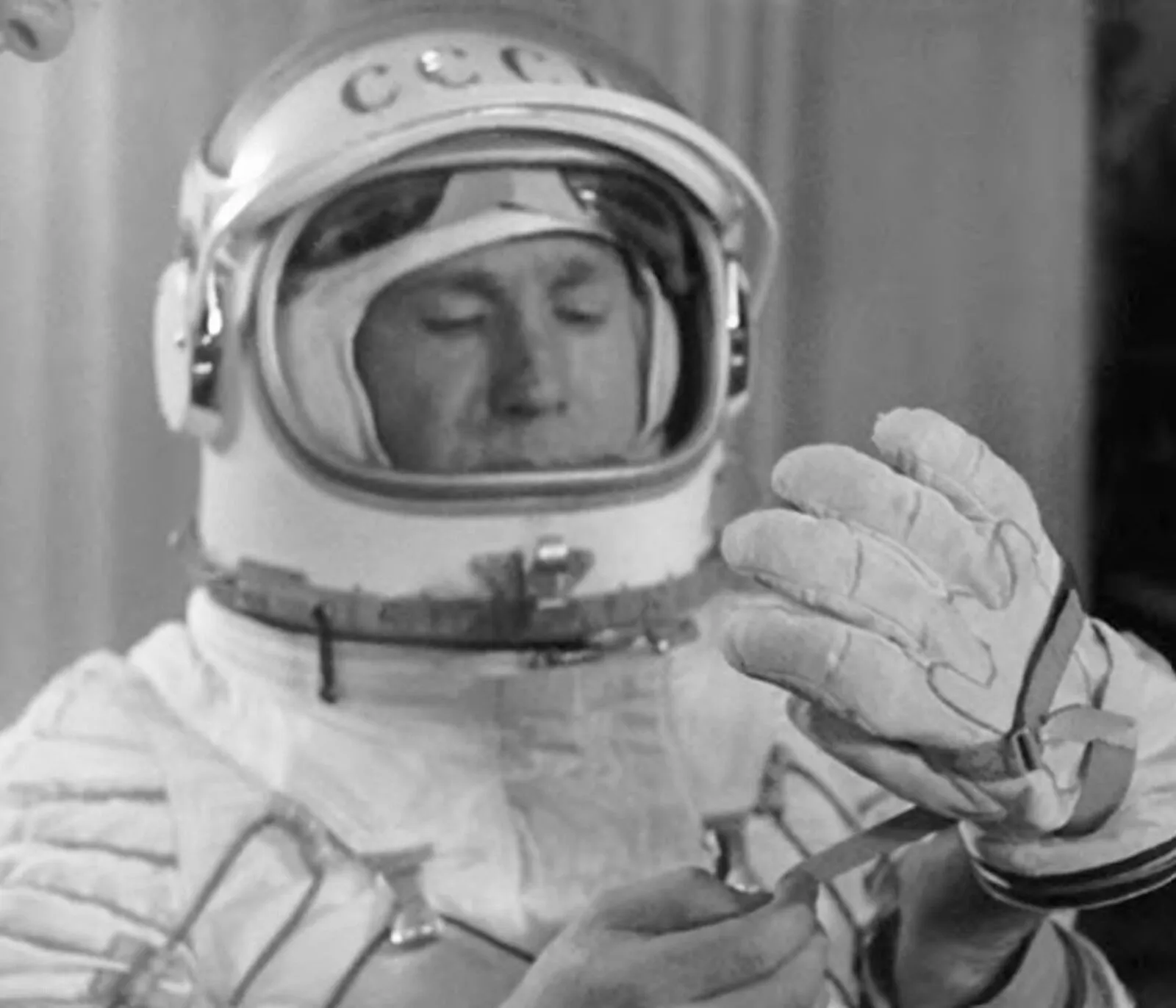
The single-seat Vostok was modified into the multiseat Voskhod.13 In October 1964 Vladimir Komarov commanded the first spacecraft to carry three people.4 On March 18, 1965, Voskhod 2 carried Pavel Belyayev and Alexei Leonov, and Leonov left the spacecraft through Volga, an inflatable airlock that engineers had designed, built and tested in about nine months from mid-1964. Fully deployed, its fabric tube was 2.5 meters long.10,32
The first spacewalk nearly ended badly. Leonov’s Berkut suit ballooned in vacuum, so that he could hardly bend and could not reach the switch for his chest camera. He tried to reenter the airlock head first, became stuck sideways, and lowered his suit pressure to free himself, at the risk of decompression sickness. He spent 12 minutes 9 seconds in free flight, and the spacecraft landed on March 19.10,17,32
Voskhod could not change its orbit, so it could not rendezvous or dock, and preparing more Voskhods would have delayed the more capable Soyuz. The American Gemini program went on to fly what later Voskhods had been meant to do: a two-week flight on Gemini VII, and artificial-gravity experiments and a high-apogee flight on Gemini XI.12
Two bureaus, two Moon programs and an argument about propellants
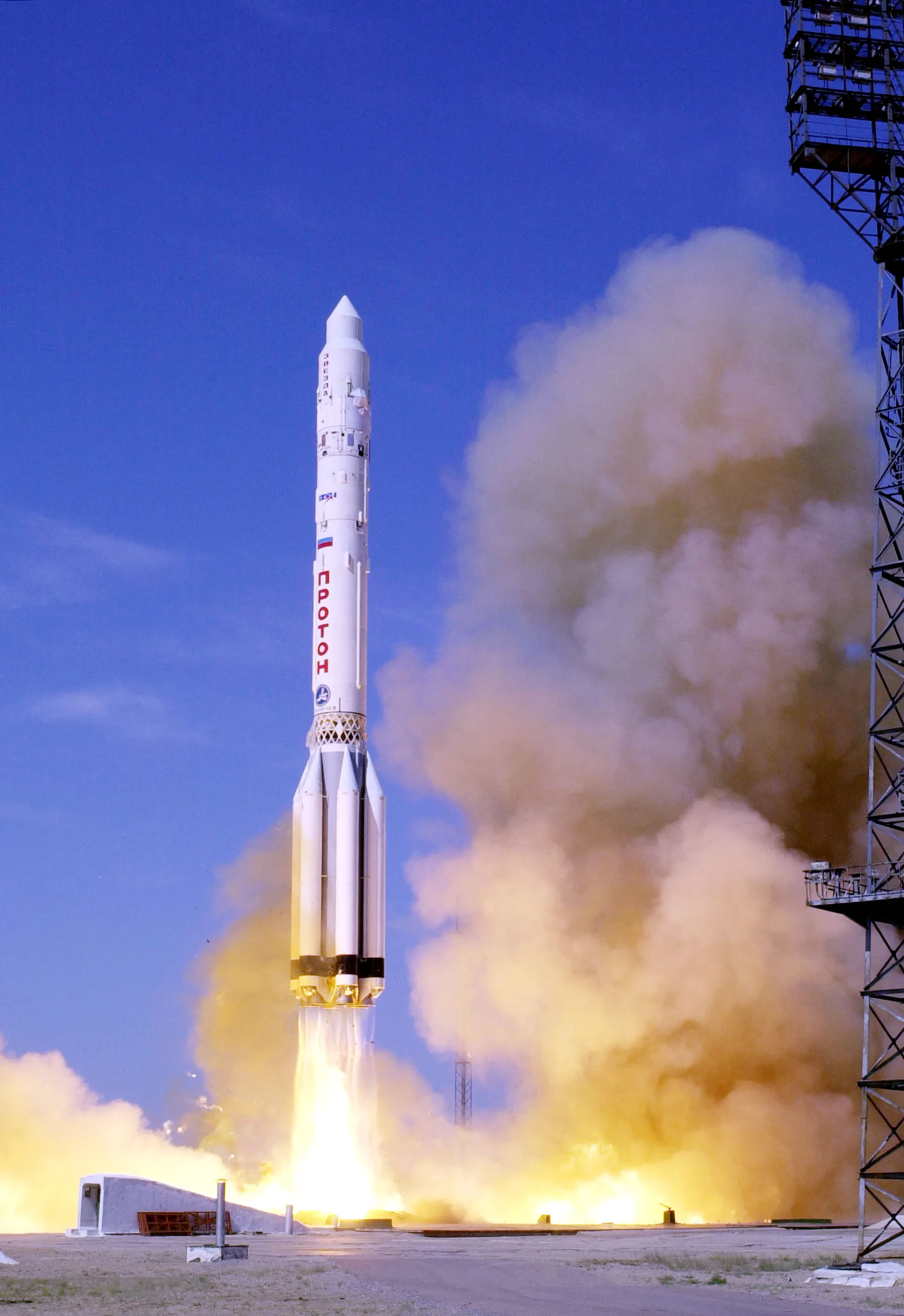
A Central Committee command of August 3, 1964, formally established both a piloted flight around the Moon and a lunar landing.13 The flight around the Moon went not to Korolev but to chief designer Vladimir Chelomei’s OKB-52, with its LK-1 spacecraft on Chelomei’s own UR-500K rocket, the Proton.12,14
The arrangement did not last. A commission that visited Chelomei’s bureau in September 1965 found the LK-1 effectively dead, and a decree of October 25, 1965, kept Chelomei’s UR-500K for the circumlunar flight but brought in Korolev’s OKB-1 for the spacecraft. In August 1965 Korolev had argued, in a letter to Brezhnev, for concentrating resources on his own giant rocket, the N1, with a piloted circumlunar flight in 1967 and a landing in 1968; that plan was rejected.11,12 The result was two parallel programs: L1, a circumlunar spacecraft launched on a Proton, and N1–L3, the landing, in which a lunar orbiter and a one-person lander would ride the N1.13
Engines divided the bureaus too. Glushko favored storable, toxic, hypergolic propellants; Korolev wanted cryogenic ones, especially liquid hydrogen and liquid oxygen. The military sided with Glushko, and when the two could not agree, the N1’s engines went to Nikolay Kuznetsov’s bureau in Kuybyshev. Siddiqi, editing Boris Chertok’s memoirs for NASA, lists what held the Moon program back: technical compromises, rivalry between chief designers, lack of money and weak commitment from the military.14
Soyuz: designed for the Moon and first flown in 1967, after Korolev’s death
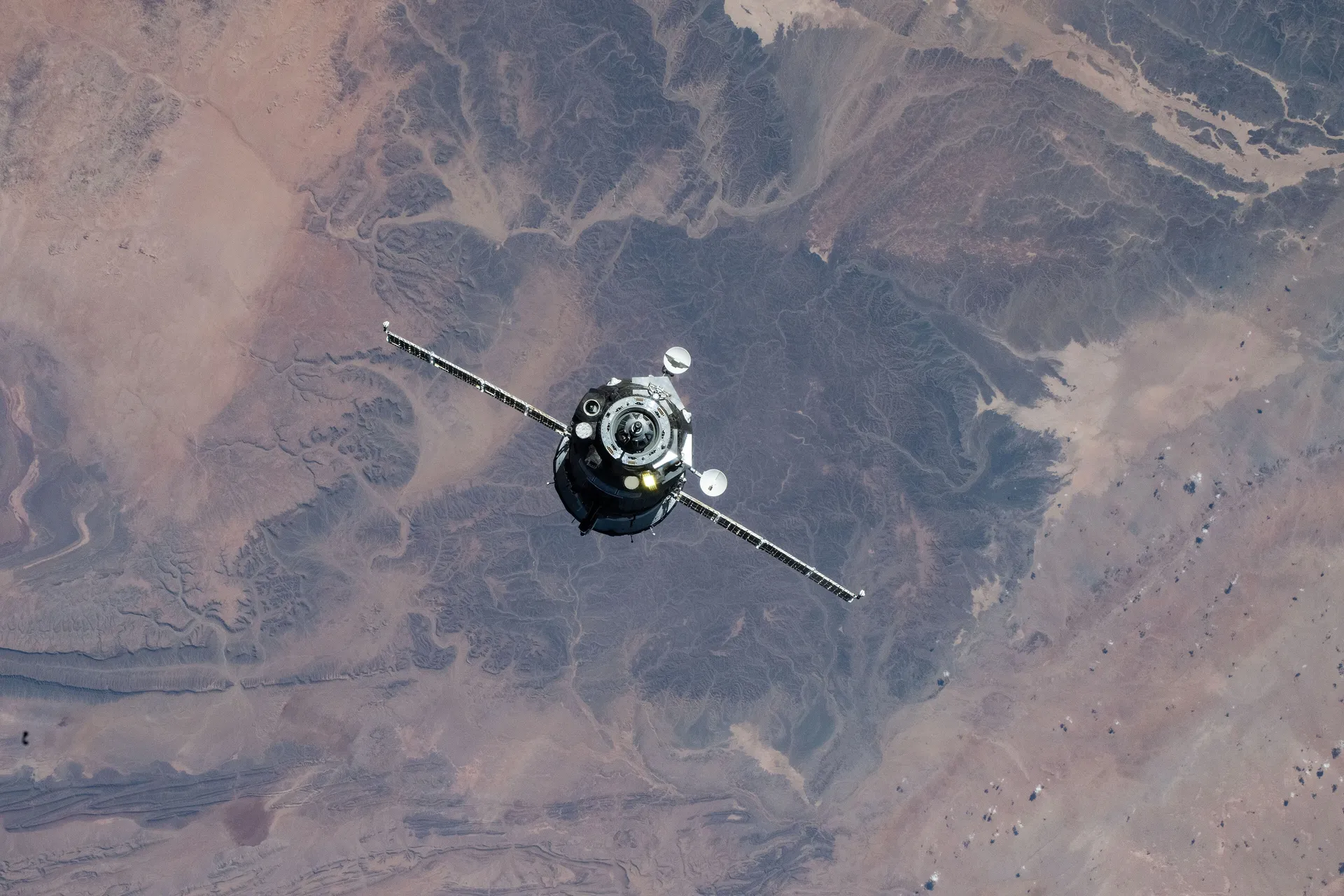
Soyuz began as Korolev’s plan for reaching the Moon by assembly in Earth orbit. A prospectus he approved on March 10, 1962, described a three-person spacecraft to be joined in orbit to propulsion modules for a flight around the Moon; a second, in May 1963, defined Soyuz-A, the crewed craft, with an unmanned propulsion module and a fuel tanker, a complex that needed five or six launches. The assembly plan was dropped in late 1965 in favor of a single Proton launch, but Soyuz-A survived as the pattern for the first Soyuz: a three-seat spacecraft about 9 meters long weighing about 6,600 kilograms, with an orbital module for living space and as an airlock, a descent module for the crew, and a service module with engines and solar arrays.13
Korolev did not see it fly. On January 14, 1966, he died at 59 after surgery at the Kremlin hospital to remove an abdominal tumor.12,16 When Luna 9 made the first survivable landing on the Moon three weeks later, his colleagues reportedly wanted to dedicate it to him and could not.20 His senior staff proposed his first deputy, Vasily Mishin, as successor; Party officials at first preferred an administrator who would curb the chief designer’s powers. OKB-1 was renamed TsKBEM in March, and Mishin was told of his promotion by Brezhnev on May 5, 1966.12
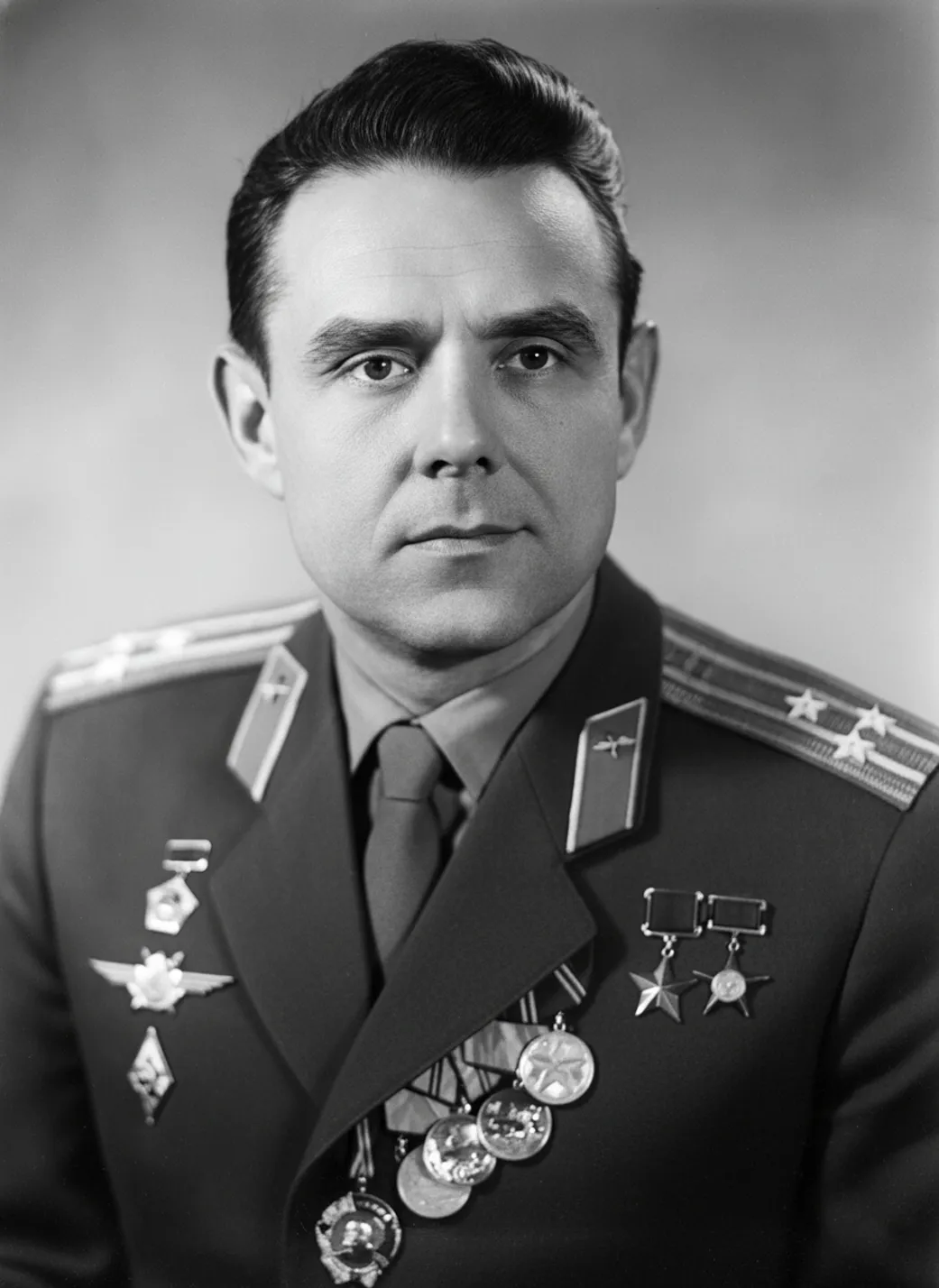
The first crewed Soyuz flew on April 23, 1967. Komarov was to dock with Soyuz 2, which would follow him with three cosmonauts, two of whom would cross to his ship by spacewalk. Once in orbit, one of Soyuz 1’s two solar arrays failed to deploy, and exhaust from the attitude jets fouled the sensors used for orientation. The second launch was canceled. An automatic reentry on the 17th orbit failed; Komarov brought the ship down manually on the 18th, but the parachute did not deploy properly, the descent module struck the ground and he was killed.13,17 Gagarin had been his backup. After the accident officials limited Gagarin to flying aircraft with an instructor, and he died in a MiG-15UTI crash on March 27, 1968.5
Soyuz did not carry crews to a docking until January 1969, when Soyuz 4 and Soyuz 5 joined in orbit and two cosmonauts crossed between them by spacewalk, a rehearsal of procedures for the lunar program.13
The N1 failed on all four launches
- 4–4.5 billion rubles
- estimated total Moon-program spending, roughly $12–13.5 billion in early-1970s terms14
- 20%
- share of annual Soviet space spending taken by N1–L3 in the late 1960s14
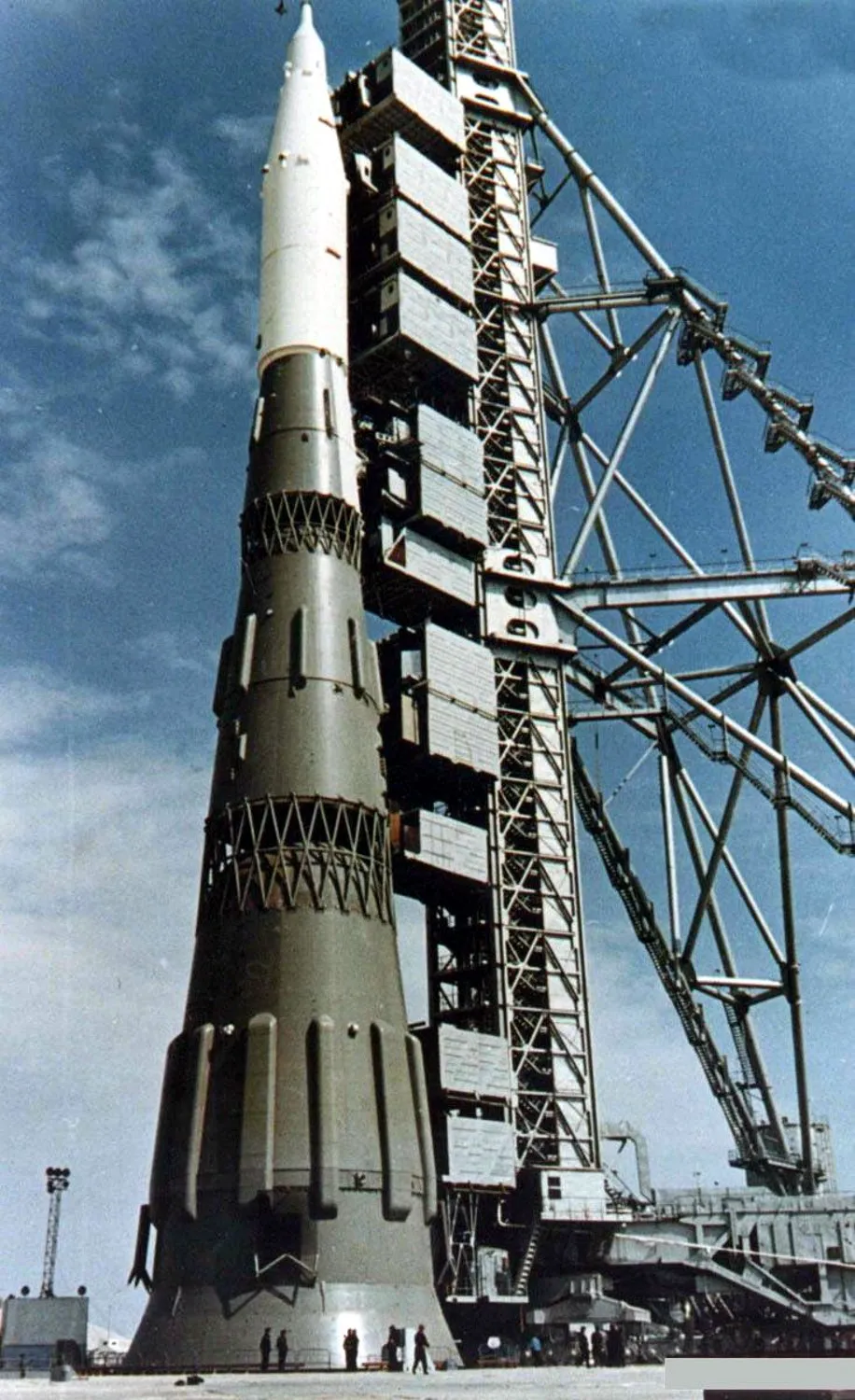
Studies leading to the N1 had begun in 1956, and work began in earnest in 1960. On December 25, 1964, Korolev approved the preliminary plan for N1–L3, which aimed to land one cosmonaut in 1967 or 1968.13 The rocket was comparable in size to the Saturn V. On November 25, 1967, a full-scale N1 mockup was rolled out horizontally to the new pad 110R at Baikonur and raised to vertical; it was rolled back on December 11. The Soviets hoped to fly the N1 in the first half of 1968; technical problems delayed the first attempt by more than a year.15
Two decisions made each launch a full test. A control system called KORD had to manage and synchronize the 42 engines of the rocket’s first three stages, 30 of them on the first stage, and the first stage was never test-fired as an integrated unit on the ground, a choice Siddiqi calls a critical lapse in judgment.11,14
Four N1 launches
February 21, 1969
First-stage fire19
A fire burned through control cables and the rocket fell about 50 kilometers downrange. Its simplified circumlunar spacecraft landed safely.
July 3, 1969
Explosion on the pad19
A foreign object in an oxidizer pump set off an explosion at liftoff; the rocket rose about 200 meters, fell back and destroyed the launch pad.
June 27, 1971
Uncontrolled roll13
The rocket rolled and broke apart about 50 seconds into flight, with test versions of the lunar orbiter and lander aboard.
November 23, 1972
Explosion before staging19
An explosion tore apart the base of the first stage at 107 seconds, just before staging. The cause was never settled.
The lander itself worked. Under the cover names Cosmos 379, 398 and 434, the L3 lander flew three uncrewed tests in Earth orbit between November 1970 and August 1971.13 The circumlunar L1, flown as Zond, did less well: Zond 5 circled the Moon in September 1968 and splashed down in the Indian Ocean, but Zond 6 lost cabin pressure during reentry that November and crashed, and the L1 never carried a crew.13
A fifth flight was planned for August 1974 and postponed in May. That month Mishin was removed, his bureau was merged with Glushko’s into NPO Energia under Glushko, and the N1 was suspended; it was canceled in February 1976.13,14
The robots reached the Moon first
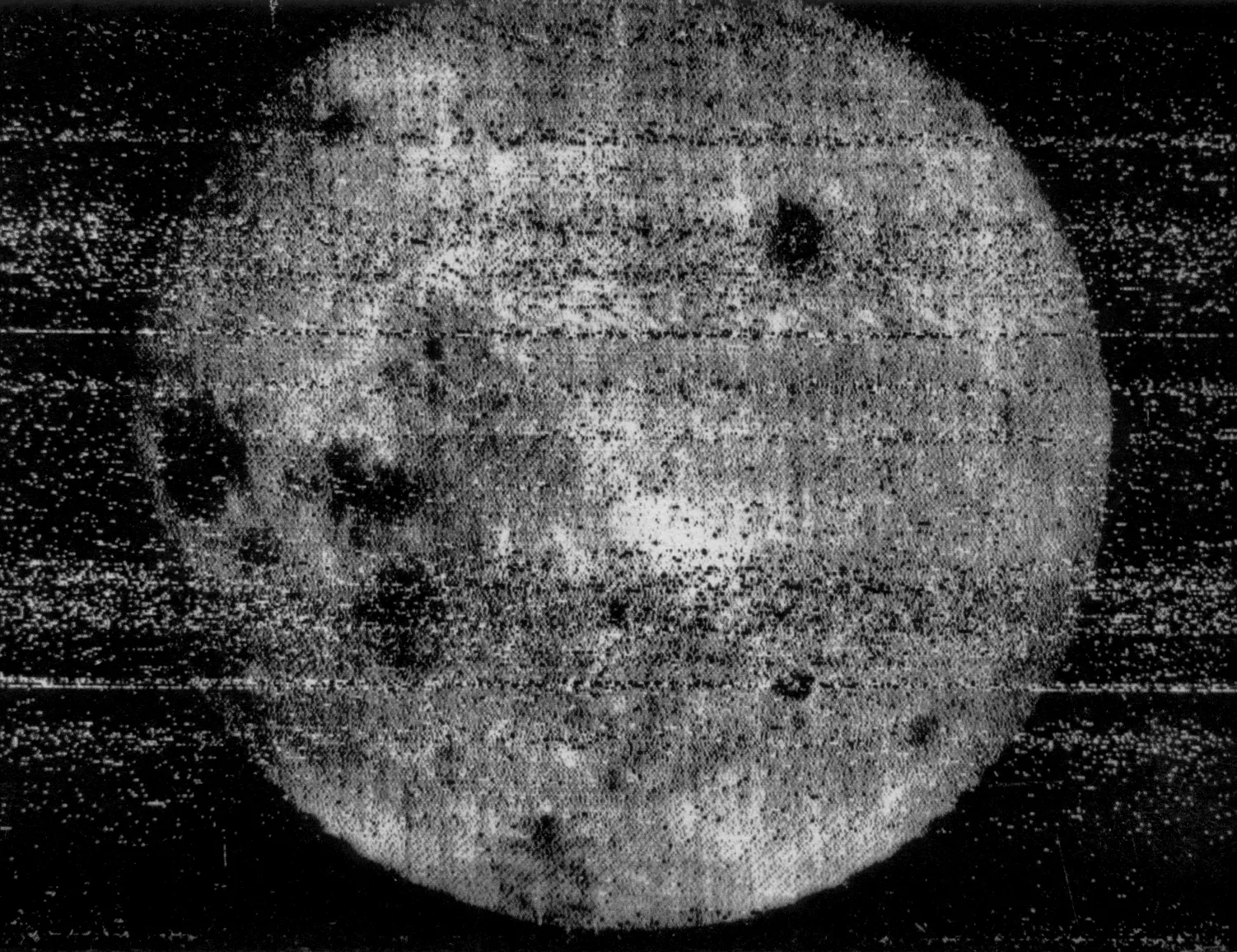
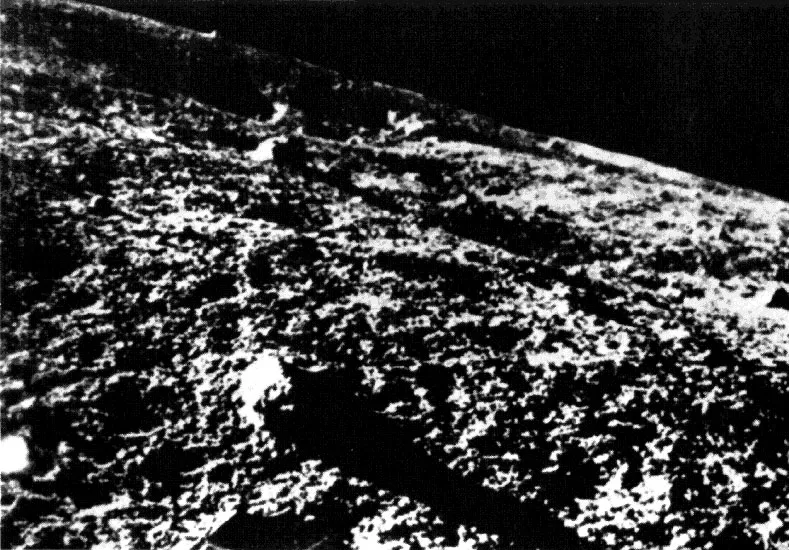
The Soviet answer on the Moon came from automatic spacecraft. Luna 2 struck the Moon in September 1959, and Luna 3 photographed the far side three weeks later.19,21 Landing was harder: in 1965 Luna 5, 7 and 8 struck the Moon and Luna 6 missed it.22 Luna 9, launched January 31, 1966, landed in Oceanus Procellarum on February 3. A pole sensed contact with the surface and triggered the ejection of a capsule of about 100 kilograms, which rolled upright, opened four spring-loaded petals to steady itself and sent back the first views from the lunar surface.19,20 Two months later Luna 10 became the first spacecraft to orbit another body.19
After the landing race was lost, the robots took on what Apollo did with crews. Luna 16 was launched on September 12, 1970, landed on the basaltic plains of Mare Fecunditatis on September 20, lifted off the next day and returned about 101 grams of lunar material to Earth on September 24; the sampling was done entirely in the dark, because the Sun had set before the landing.23 Luna 17 landed Lunokhod 1 on Mare Imbrium on November 17, 1970. The eight-wheeled rover weighed 756 kilograms and was designed to work for three months; driven by a five-person team near Moscow, it explored for 11 months.24,31 Lunokhod 2, landed in January 1973, drove 39 kilometers, and Luna 20 and Luna 24 returned more samples in 1972 and 1976.21,22
Venus received the most persistent effort
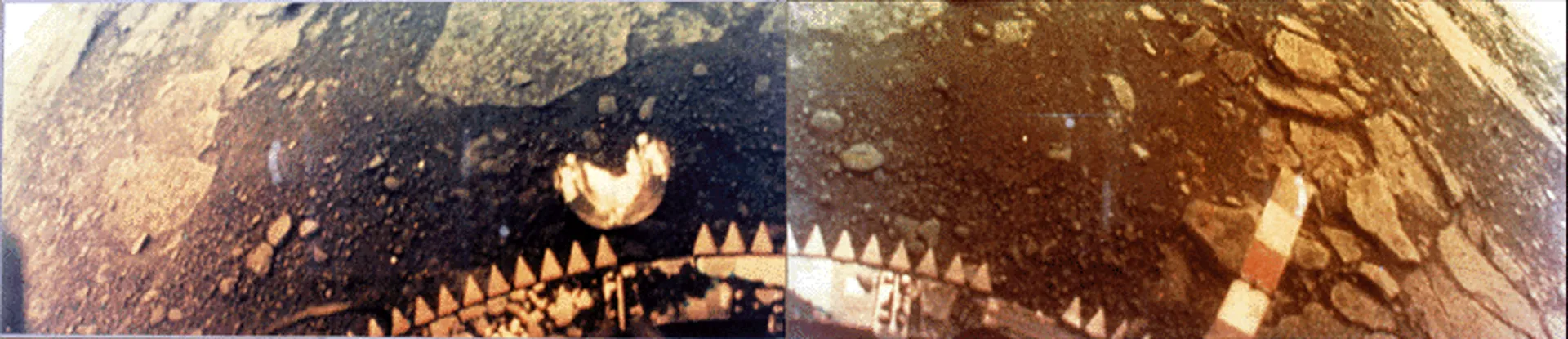
Venera 3 struck the planet on March 1, 1966, Venera 4 sent back data from inside its atmosphere on October 18, 1967, and on December 15, 1970, Venera 7 made the first transmission from the surface of another planet.19 Venera 9 touched down on October 22, 1975, and operated for 53 minutes, long enough to return a single picture of angular rocks 30 to 40 centimeters across.25 Venera 13 landed on March 1, 1982, and returned the first color panorama of the surface.26 It measured a temperature of 462°C and a pressure of 88.7 atmospheres, and it survived long enough to analyze the soil.19,26
Mars went worse: the first Soviet attempt was launched on October 10, 1960, and Mars 2, the first object to reach the Martian surface, crashed there on November 27, 1971.19
From the N1’s wreckage to Energia–Buran
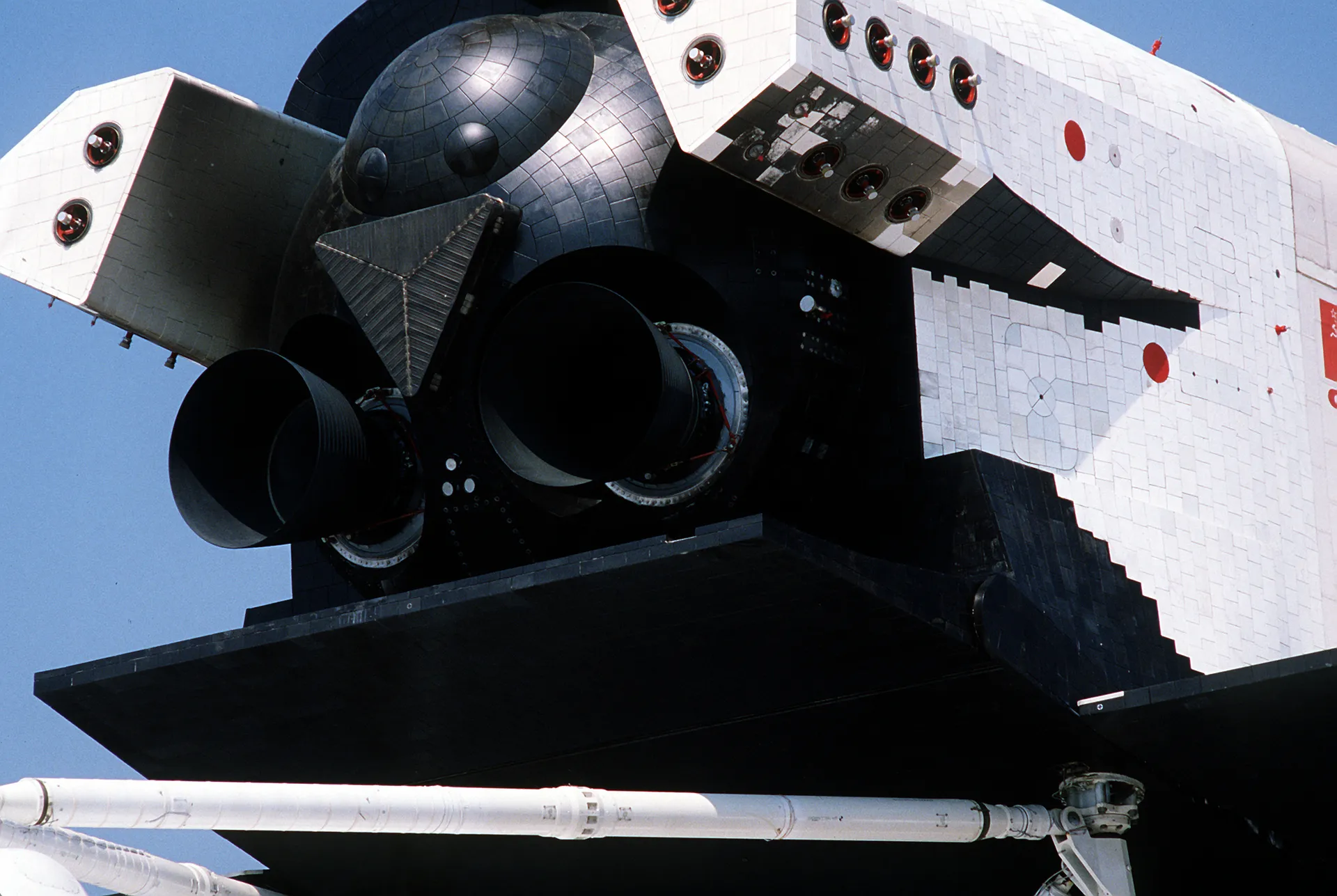
The N1’s work evolved into a new project under Glushko’s NPO Energia.14 A decree of February 17, 1976, approved the Energia rocket and the Buran orbiter.14 Soviet officials and designers believed that a reusable craft would give more reliable and efficient access to space than single-use rockets. According to the Smithsonian’s Cathleen Lewis, the Soviets obtained American Space Shuttle design specifications through espionage, and Buran closely resembled the Shuttle. Critics, among them Konstantin Feoktistov, argued that the expense would drain the budgets of existing programs.29
Energia was designed to lift up to 100 tonnes. Its first launch, on May 15, 1987, carried the Polyus military platform, which failed to reach orbit. On November 15, 1988, it launched Buran without a crew; the orbiter made two orbits and landed automatically.14 It never flew again. Buran was soon scrapped, partly for economic reasons, and the Soviets were left with no reusable spacecraft to ferry crews and supplies to the Mir station.28
The organization outlived the shuttle. NPO Energia, the bureau that traced its descent to Korolev’s department of 1946, became RSC Energia, Russia’s prime contractor for crewed stations and spacecraft and the operator of Mir.28,30 Much of what it had done in secret became known only after 1991, when documents declassified after the Soviet Union dissolved allowed historians to separate the institutional story of Sputnik from rumor.2
Sources
The text above is drawn from these 33 sources. Government works are adapted closely; company and press material is summarized. Numbers in the text point here. Last checked November 9, 2026.
Show all 33 sourcesShow fewer
- 1Back to the text
- 2Back to the text
- 3Back to the text
- 4Back to the text
- 5Back to the text
- 6Back to the text
- 7Back to the text
- 8Back to the text
- 9Back to the text
- 10Back to the text
- 11Back to the text
- 12Back to the text
- 13Back to the text
- 14Back to the text
- 15Back to the text
- 16Back to the text
- 17Back to the text
- 18Back to the text
- 19Back to the text
- 20Back to the text
- 21Back to the text
- 22Back to the text
- 23Back to the text
- 24Back to the text
- 25Back to the text
- 26Back to the text
- 27Back to the text
- 28Back to the text
- 29Back to the text
- 30Back to the text
- 31Back to the text
- 32Back to the text
- 33Back to the text
Continue