How Sputnik turned an aeronautics committee into NASA
In the year after Sputnik, Congress and President Eisenhower built a civilian space agency on the NACA’s laboratories, then gave it a Navy satellite, an Army rocket team and, by 1961, the Moon.
NASA
Drawn from 8 sources: NASA History Office (4), NASA (3) and NASA Science. About 12 minutes. Checked October 1, 2026.
Few Americans considered the reception on Friday, October 4, 1957, at the Soviet Union’s embassy in Washington, D.C., to be anything out of the ordinary. It closed a week of international meetings on rocket and satellite research for the International Geophysical Year. John P. Hagen, the Naval Research Laboratory scientist who headed the American satellite effort, Project Vanguard, arrived early. Vanguard was behind schedule and over budget, and Hagen wanted to learn from Soviet colleagues whether their satellite would really wait until 1958, as their public schedule said.2
A little before 6:00 p.m., Walter Sullivan of the New York Times took a call from his bureau chief: the Soviet news agency Tass had just announced the launch of Sputnik 1. Lloyd Berkner, the official American delegate, clapped his hands for silence. “I’ve just been informed by the New York Times that a Russian satellite is in orbit at an elevation of 900 kilometers,” he said. “I wish to congratulate our Soviet colleagues on their achievement.” Less than a year later the United States had a new civilian agency to answer that announcement, and it was built almost entirely from organizations that already existed.2
A 184-pound satellite became a political emergency
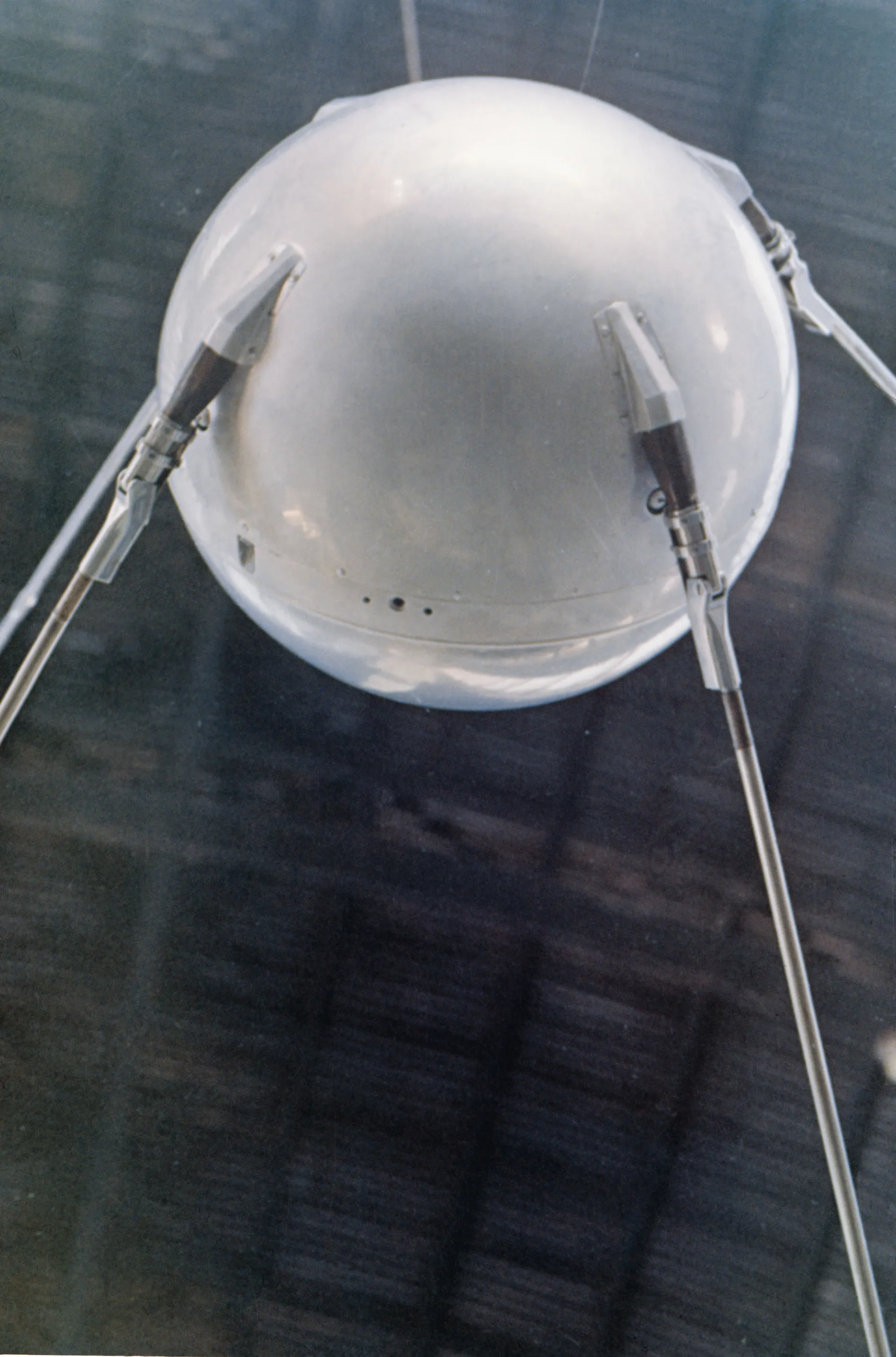
Sputnik 1 was a decidedly unspectacular satellite: an aluminum sphere about 23 inches across, with four spring-loaded whip antennas trailing behind it, that circled Earth every 96 minutes. It carried a small radio beacon that beeped at regular intervals, and it fell from orbit three months after launch, on January 4, 1958. Although it carried no scientific instruments, the 184-pound Sputnik had a large effect on the United States.1,2
The launch had a “Pearl Harbor” effect on American public opinion. It introduced the average citizen to the space age in a crisis setting, created an illusion of a technological gap, and provided the impetus for increased spending on aerospace, for technical and scientific education programs, and for new federal agencies to manage air and space research. Not only had the Soviets been first in orbit; Sputnik weighed nearly 200 pounds, against the 3.5 pounds intended for the first Vanguard satellite. On November 3, 1957, less than a month later, the Soviet Union launched Sputnik 2, a 1,120-pound spacecraft carrying a dog named Laika.1,2,3
On November 25, the Preparedness Investigating Subcommittee of the Senate Armed Services Committee, chaired by Majority Leader Lyndon B. Johnson of Texas, began six weeks of hearings on the perceived “missile gap.” By the time they ended in January 1958, 73 witnesses had provided more than 1,300 pages of testimony. The hearings found serious underfunding and an incomprehensible organization for space activities, and they changed Johnson’s own view of space from a battlefield to a place with scientific and commercial potential.1,2
We changed the perception of the problem from one that was originally only national defense to one that also had beneficial uses from space and meant that we could hope for peace.
The United States had picked a satellite that would not disturb the missile programs
In July 1955 both the United States and the Soviet Union had pledged to orbit a scientific satellite during the International Geophysical Year, a multinational effort to study Earth and its environment from July 1, 1957, to December 31, 1958. The two countries approached their pledges very differently. The Soviet Union worked in secret. Preferring a civilian-led effort, the Eisenhower administration gave priority to Vanguard, while the military services continued their own projects.1
Vanguard had been chosen on September 9, 1955, largely because it did not interfere with high-priority ballistic missile development. It used the non-military Viking research rocket as its basis, while an Army proposal to use the Redstone missile waited in the wings. Vanguard enjoyed exceptional publicity through 1956, but the technological demands on the program were too great and its funding too small to ensure success.3,4
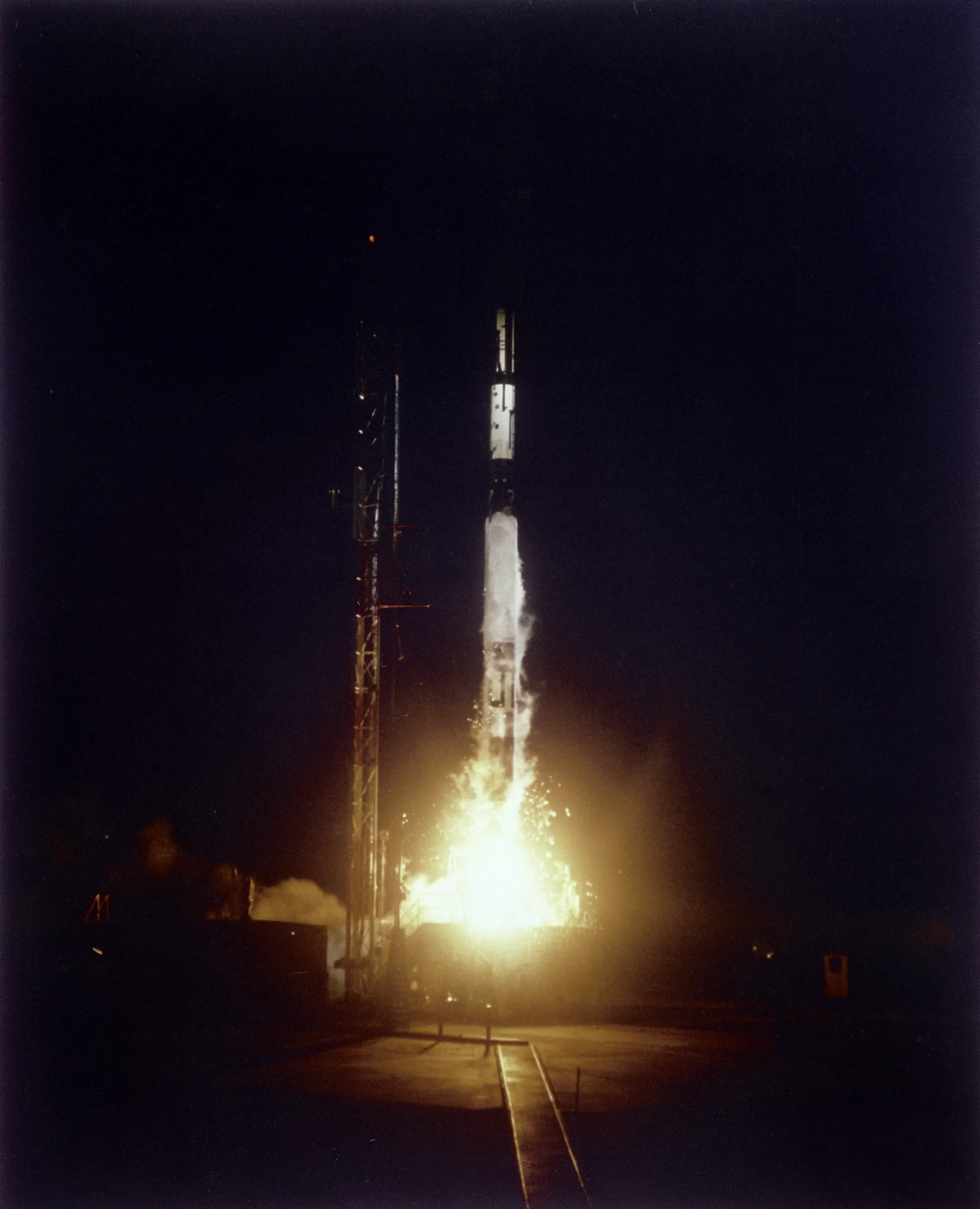
After Sputnik, the White House announced that a Vanguard test vehicle would be launched on December 6, 1957. Unlike the Soviet launches, the American attempt took place in front of the world’s press. Vanguard TV3 rose about four feet into the air, lost thrust and fell back onto the pad, exploding in a huge fireball. The tiny satellite was thrown clear and lay at the edge of the fire, still beeping. The very public failure fueled the urgency of the situation and lent support to the need for a single agency to manage the American civilian space effort.1,4
Explorer 1 joined an Army rocket, a JPL satellite and an Iowa instrument
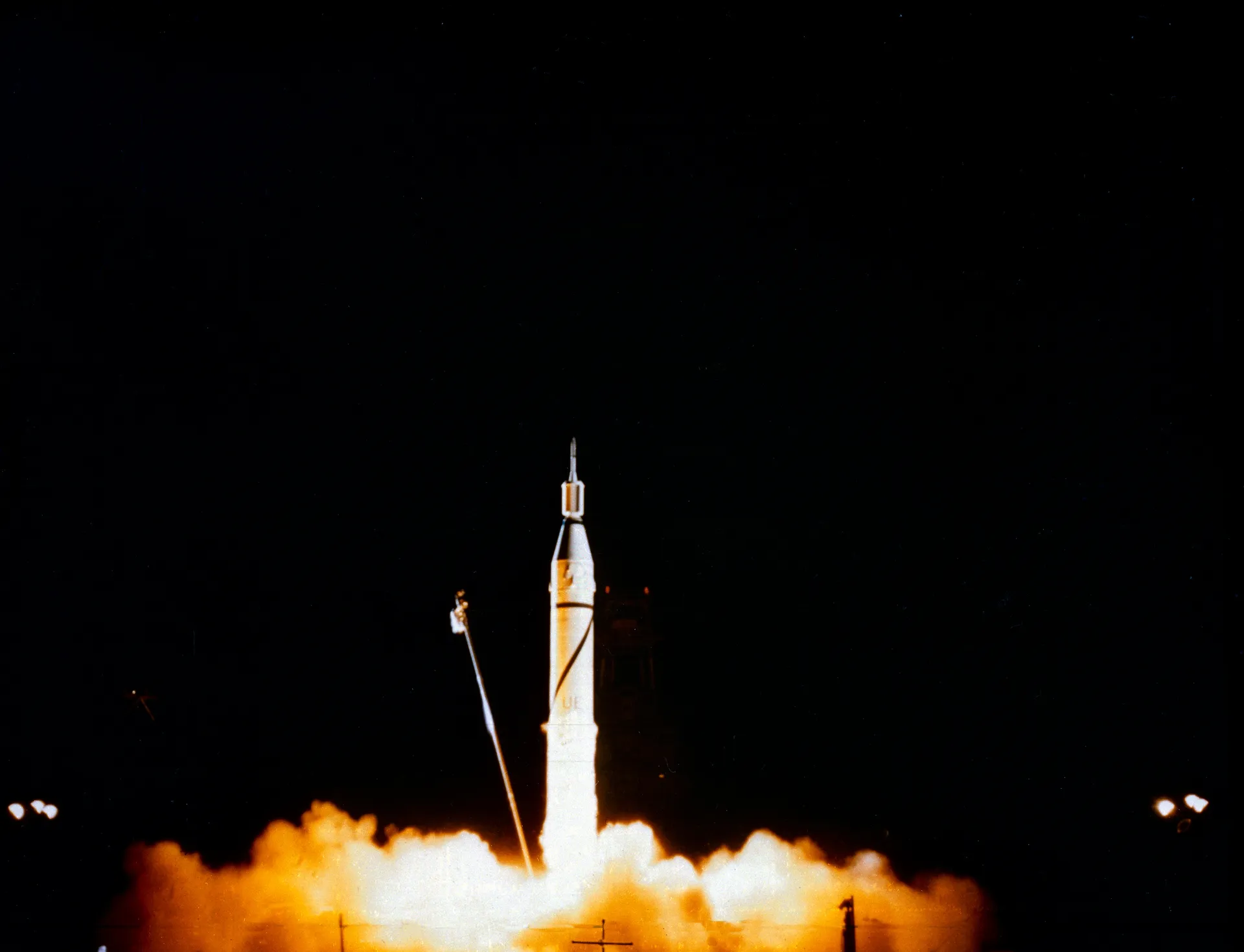
Following the Vanguard failure, the United States revived the Army Ballistic Missile Agency’s Jupiter-C program, developed by Wernher von Braun’s team in Huntsville, Alabama. The California Institute of Technology’s Jet Propulsion Laboratory designed and built the satellite. The Army agency and JPL modified the Jupiter-C into the Juno rocket and built Explorer 1 in 84 days. The rocket traced its ancestry to the German V-2, which von Braun had also designed; in the United States he had used it to develop the Redstone missile, then the Jupiter-C, and a fourth stage made it the Juno, capable of putting a satellite into orbit.1
Explorer 1 weighed 30 pounds, 18 of them scientific instruments, and lifted off from Cape Canaveral at 10:48 p.m. on January 31, 1958. A team of women mathematicians at JPL computed its trajectory. The team had agreed to say nothing until the satellite’s signal was picked up in California, and the signal was late. “There was a period of eight minutes there,” JPL director William Pickering recalled, “which is the longest eight minutes I’ve ever spent in my life.” The delay meant only that Explorer had reached a somewhat higher orbit than planned.1,6
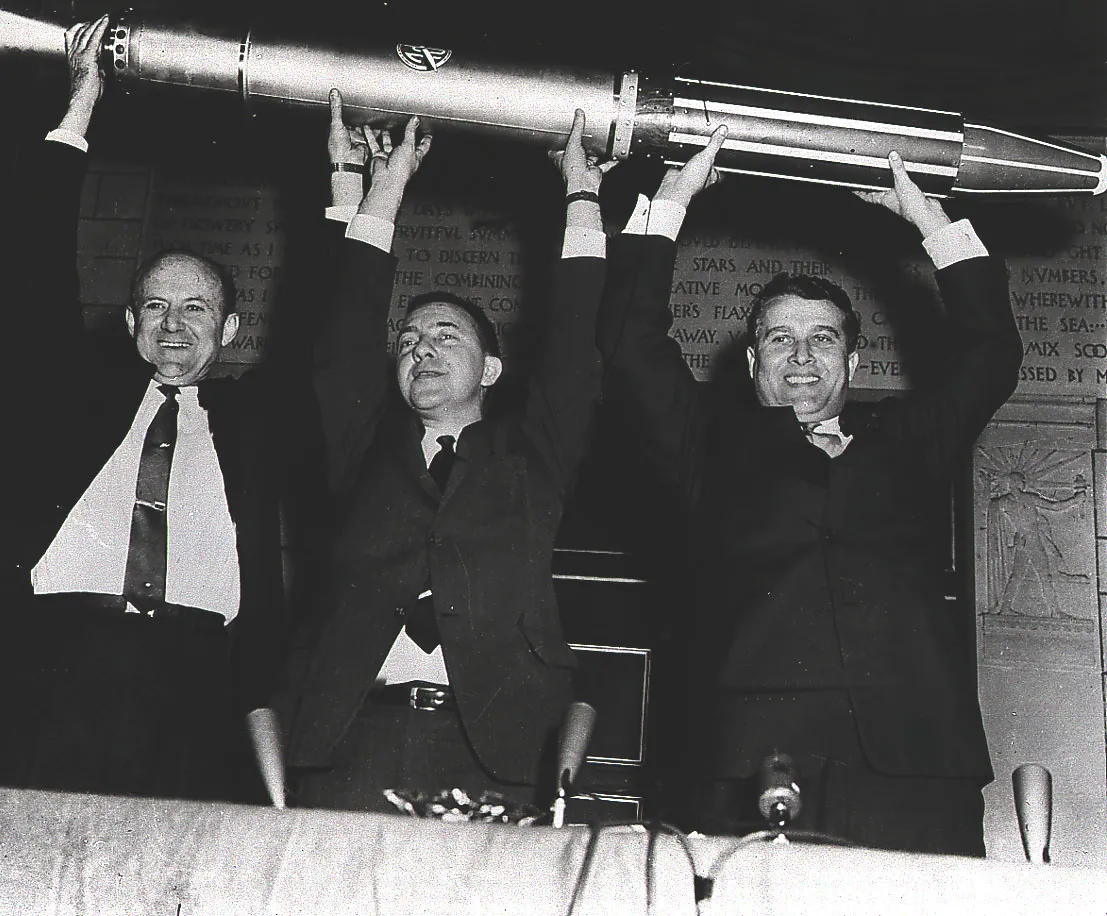
The satellite carried a cosmic-ray detector built by James A. Van Allen, a physicist at the University of Iowa, along with temperature sensors and micrometeorite detectors. Its counters reported a mysterious saturation at high altitude, which Van Allen took as evidence of a dense belt of radiation around Earth. The zones came to be called the Van Allen radiation belts. At a press conference at the National Academy of Sciences around 1 a.m., reporters encouraged Pickering, Van Allen and von Braun to hold a full-size model above their heads.2,3,4,6
Vanguard itself received more money to accelerate the work, and Vanguard 1 reached orbit on March 17, 1958. But the first American satellite had already shown how the program would be built. An Army team supplied the rocket, a university laboratory managed for the Army supplied the spacecraft, and a university scientist supplied the instrument that found the radiation belts.2,6
Why the new agency was built around the NACA
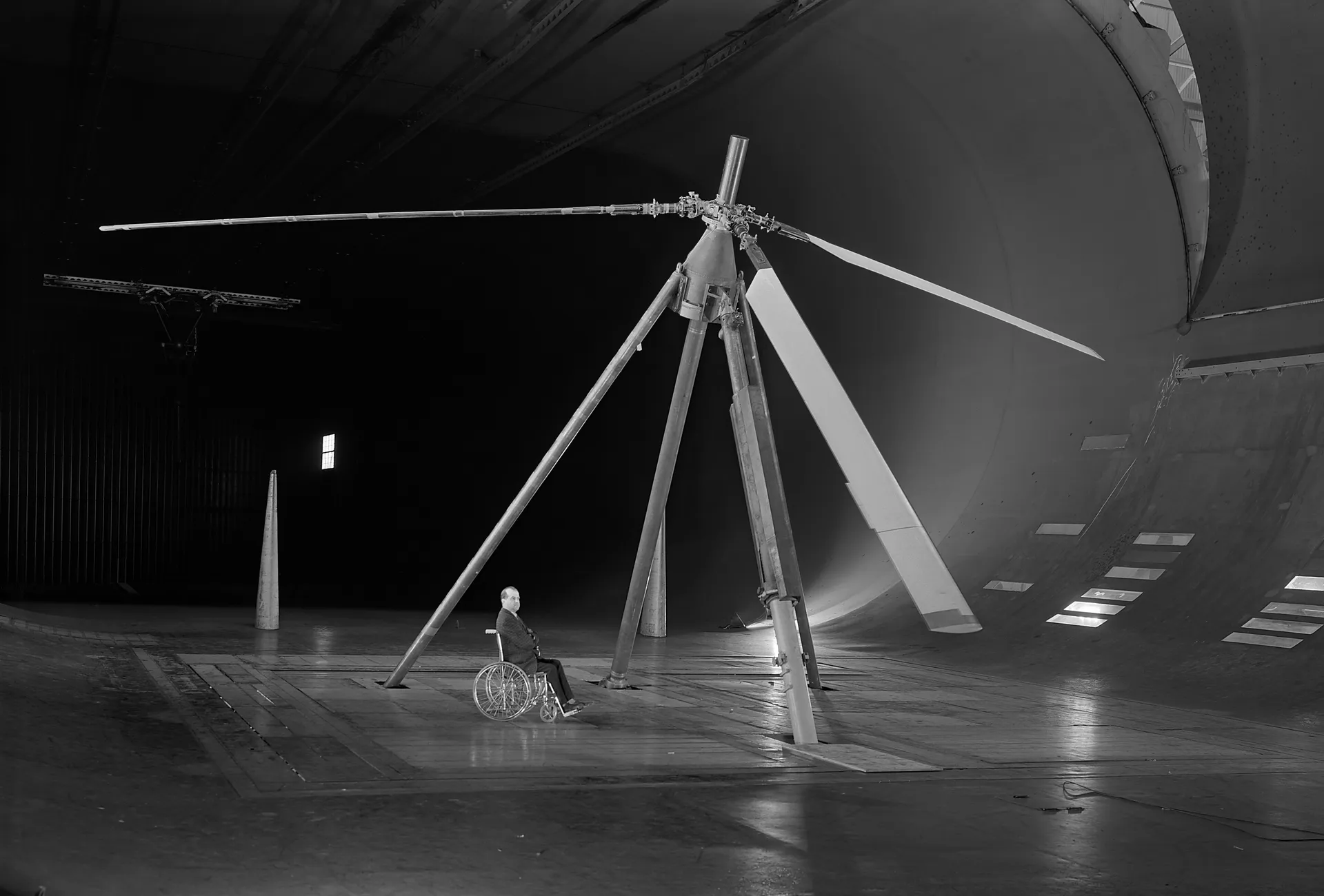
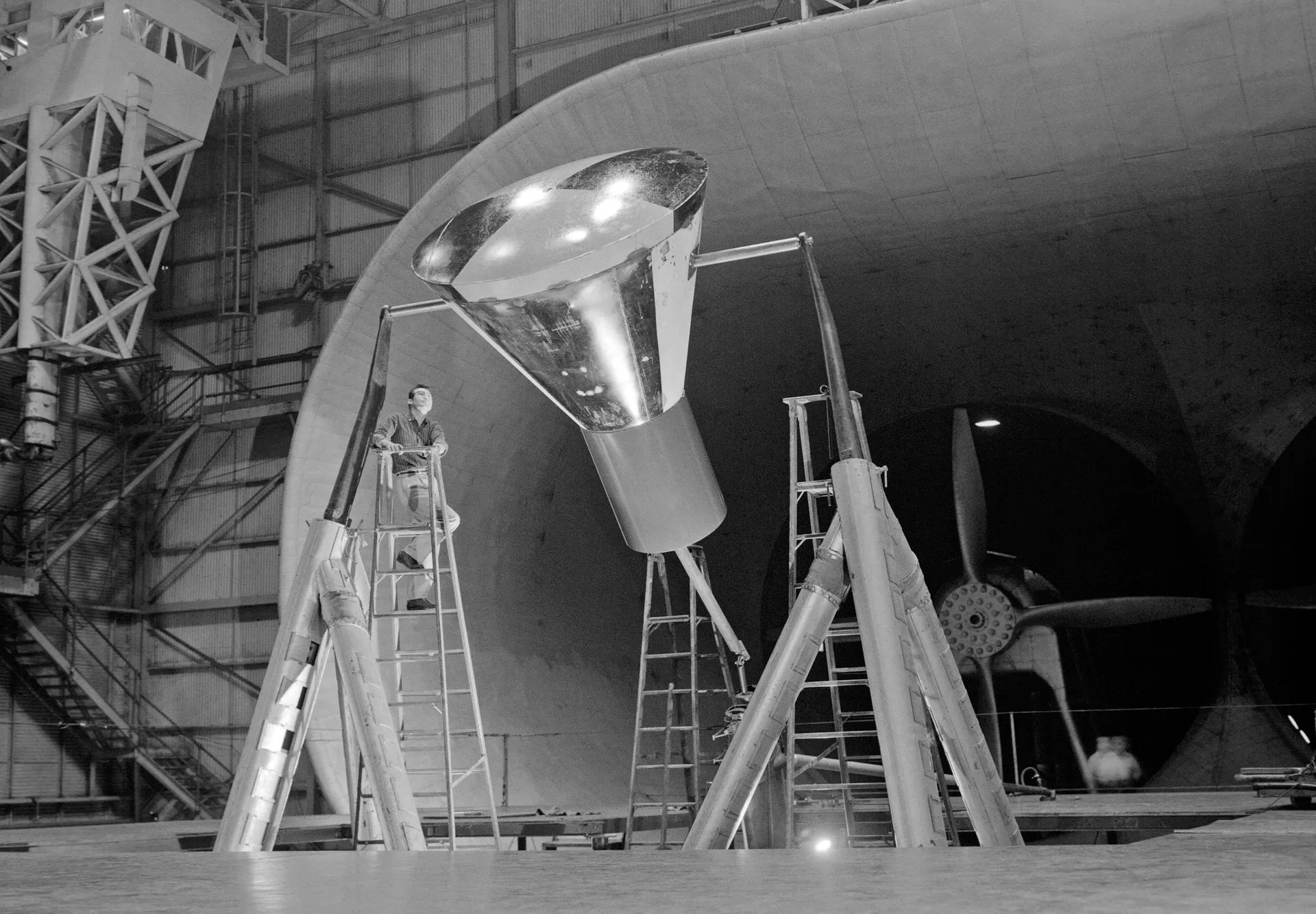
The NACA’s 40-by-80-foot wind tunnel at Ames, January 1957.
The political pressure eased after Explorer 1, but not enough to prevent a change in the structure of government. Through the winter of 1957–1958, consensus formed that an expanded national space program was essential, and competition formed over who would run it. The Department of Defense and its services were obvious front runners; the Atomic Energy Commission, already working on nuclear propulsion, had support in Congress; and there was the National Advisory Committee for Aeronautics.2,4
The NACA had been created on March 3, 1915, through a rider attached to the naval appropriation bill. It began as an unpaid committee of 12 with an annual budget of $5,000, charged “to supervise and direct the scientific study of the problems of flight.” By the 1950s it ran large research laboratories and had devoted more and more of its facilities, budget and expertise to missile research. It had a long-term plan for human spaceflight—a blunt-shaped ballistic capsule backed by a worldwide tracking network—and long experience working with the military services. Its greatest political asset was its peaceful, research-oriented image: Eisenhower, Johnson and others in Congress wanted above all to keep Cold War tensions out of the new arena of outer space.4
On February 4, 1958, Eisenhower asked his science adviser, James R. Killian, to convene the President’s Science Advisory Committee to plan a new organization. The committee proposed placing all non-military space efforts under a strengthened and renamed NACA. On April 2, in a letter to Congress, Eisenhower called for a civilian National Aeronautics and Space Agency built on the NACA. Although a former military commander, he believed a civilian agency would be more effective than assigning space to the military, where inter-service rivalry had already shown a lack of results in launching a satellite. As Congress drafted the bill, Legislative Reference Service analyst Eilene Galloway successfully lobbied to make the organization an administration rather than an agency, giving it broader authority to coordinate with other parts of the government.1,2
The Soviet launch in May of the nearly 3,000-pound Sputnik 3 gave the bills a strong push. The House passed its version on June 2 and the Senate on June 16. Johnson chaired a bipartisan panel to produce a joint version; Congress passed the National Aeronautics and Space Act on July 16, and Eisenhower signed it on July 29, 1958.1 The Act directed the new administration to “plan, direct, and conduct aeronautical and space activities,” to involve the scientific community, and to provide “the widest practicable and appropriate dissemination of information” about its work. Weapons, military operations and defense remained with the Department of Defense.5
The Congress hereby declares that it is the policy of the United States that activities in space should be devoted to peaceful purposes for the benefit of all mankind.
What NASA inherited on October 1, 1958
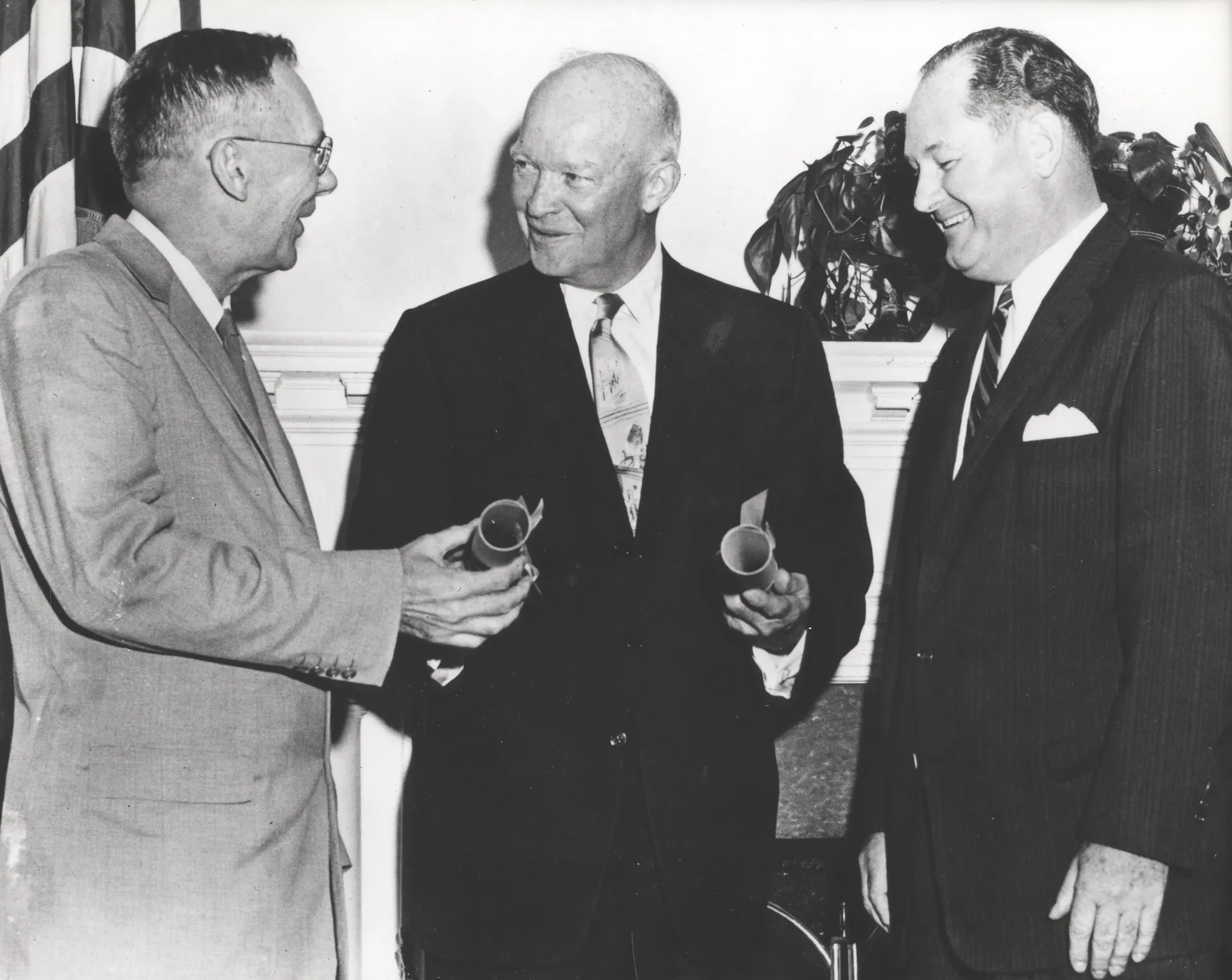
On August 8, Eisenhower nominated T. Keith Glennan, president of the Case Institute of Technology in Cleveland, as administrator and Hugh L. Dryden, the NACA’s director, as deputy administrator. They were sworn in at the White House on August 19.1 On October 1, the 170 people at headquarters gathered in the courtyard of their temporary building, the Dolley Madison House in Washington, to hear Glennan proclaim the end of the 43-year-old NACA and the beginning of NASA.4
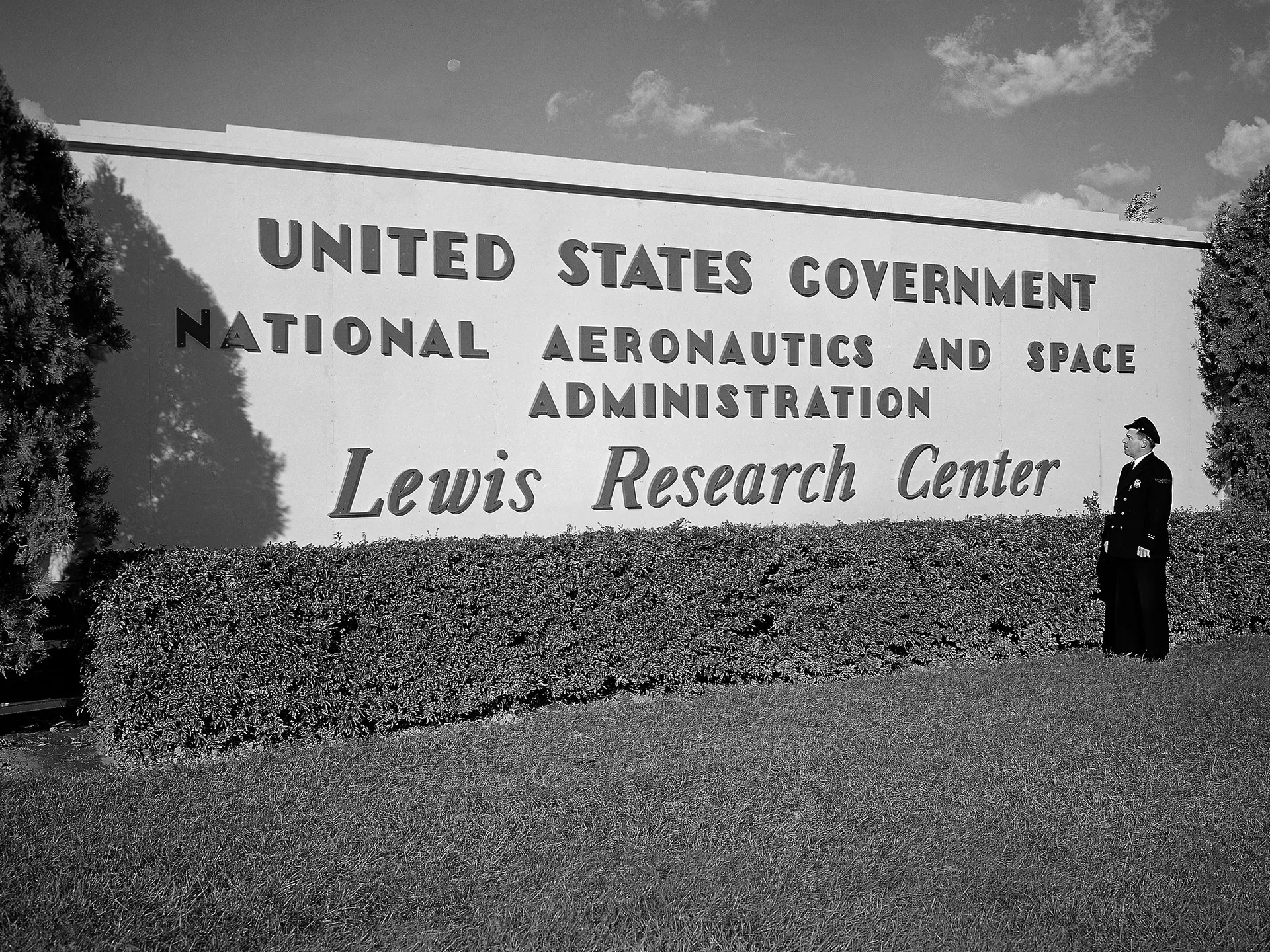
The NACA’s 8,000 people, its three laboratories—Langley, Ames and Lewis—and two smaller stations, with facilities valued at $300 million and an annual budget of $100 million, were transferred to NASA intact. On the same day, by executive order, the President transferred Project Vanguard and its 150-person staff from the Naval Research Laboratory, lunar probes from the Army, lunar probes and rocket engine programs from the Air Force—among them the F-1, the engine that would later lift the Saturn V—and more than $100 million in unspent funds. NASA immediately delegated operational control of these projects back to the military while it put its own house in order.3,4
- 8,000
- people transferred from the NACA4
- $100M
- annual budget inherited with them3
- 3
- research laboratories, renamed research centers, plus two test stations4
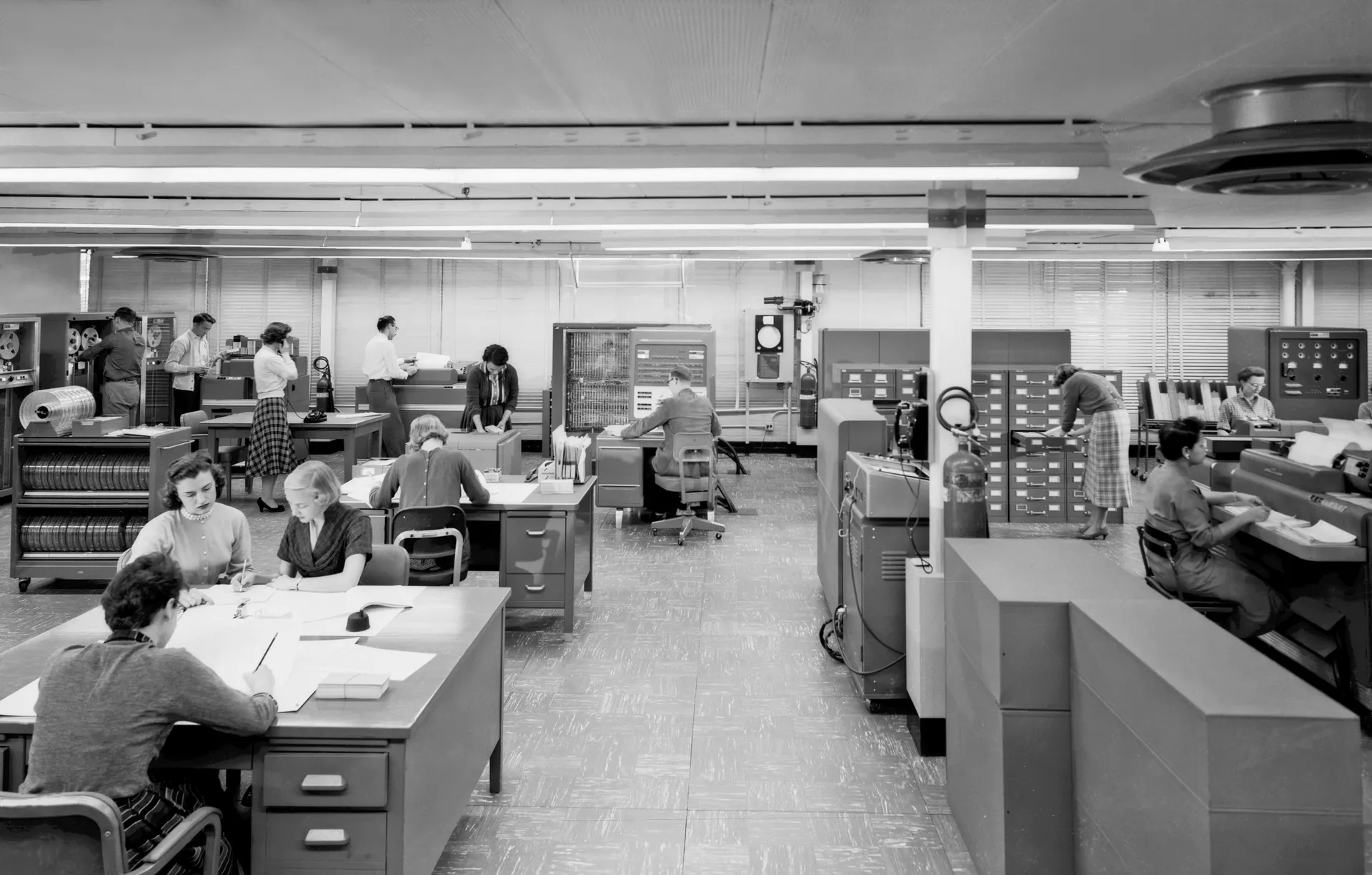
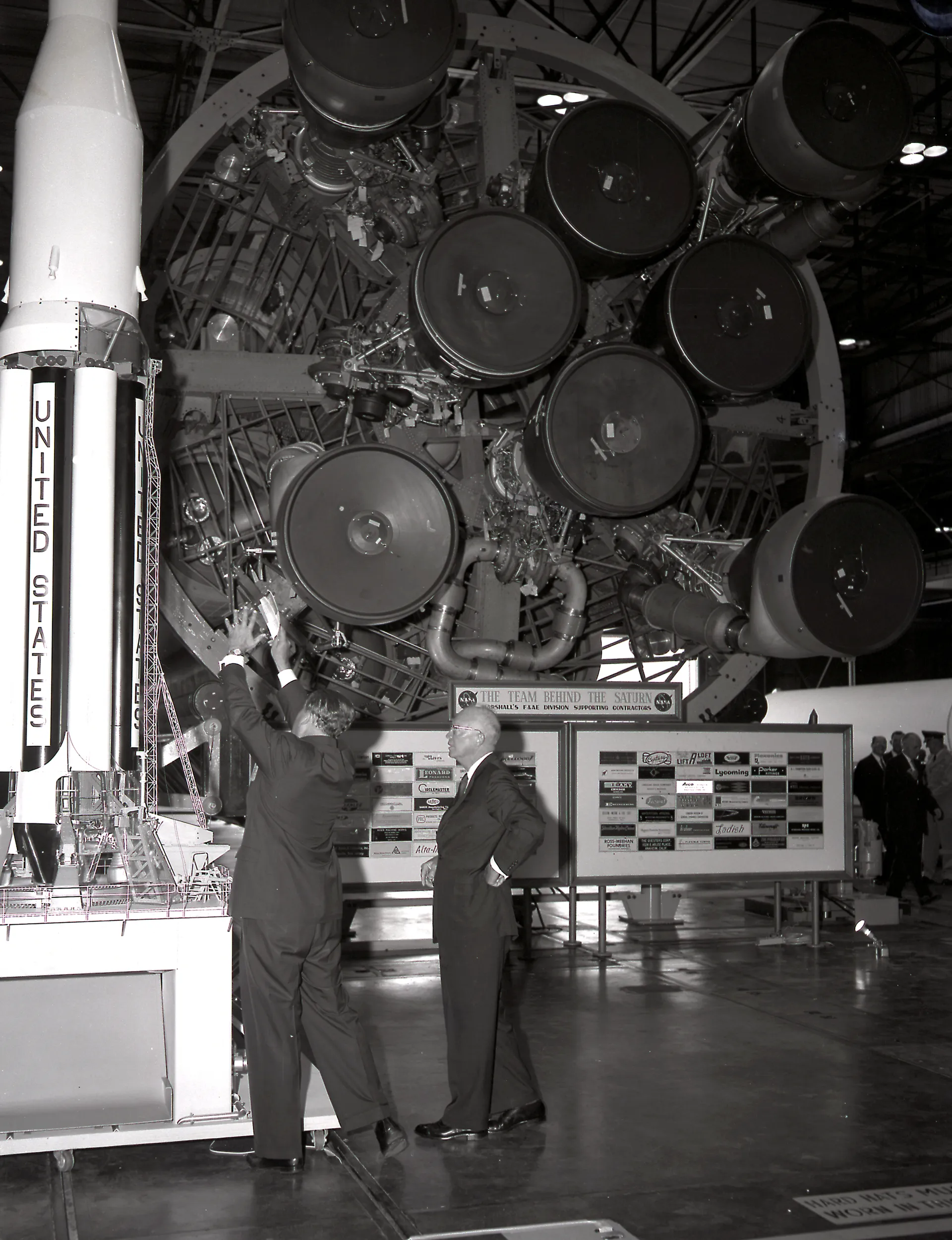
To run a space program, NASA needed capabilities it did not have. Glennan sought the Army team that had launched America’s first satellite and its contractor, JPL. The Army balked at losing the Huntsville group but gave up JPL: an executive order of December 3, 1958, transferred the government-owned laboratory and the Army contract with Caltech under which it was staffed and operated. Glennan renewed his bid in 1959, and on March 15, 1960, the Army Ballistic Missile Agency’s 4,000-person Development Operations Division, headed by von Braun, was transferred to NASA along with the big Saturn booster project; the team formally became NASA’s Marshall Space Flight Center on July 1.4,8
NASA also planned a new center for space science, satellite development, flight operations and tracking on nearly 500 acres of a Department of Agriculture research site in Beltsville, Maryland. The Robert H. Goddard Space Flight Center, named for the American rocket pioneer, was dedicated in March 1961.4
Thirteen months from Sputnik to a working agency
October 4, 1957
Sputnik 1 in orbit2
The Soviet satellite circles Earth every 96 minutes.
November 25, 1957
Senate hearings begin1
Lyndon Johnson’s subcommittee takes six weeks of testimony on the “missile gap.”
December 6, 1957
Vanguard TV3 explodes1
The first American attempt fails in front of the press.
January 31, 1958
Explorer 1 reaches orbit6
Army rocket, JPL satellite, Van Allen’s instrument.
April 2, 1958
Eisenhower asks Congress for a civilian agency1
Built on the existing NACA.
July 29, 1958
Space Act signed5
Public Law 85-568 creates the National Aeronautics and Space Administration.
October 1, 1958
NASA opens4
The NACA’s 8,000 people and three laboratories become its core.
October 7, 1958
Project Mercury approved4
One week after NASA was formed.
December 3, 1958
JPL transferred from the Army4
March 15, 1960
Von Braun’s rocket team joins NASA4
4,000 people and the Saturn project.
Two things the NACA had never done: fly spacecraft and contract out most of the work
There followed an intense two-year period of organization, build-up, planning and catch-up. Only one week after NASA was formed, Glennan gave the go-ahead to Project Mercury, America’s first human spaceflight program, and the Space Task Group, headed by Robert R. Gilruth, was set up at Langley to do the job. The first NASA ten-year plan, presented to Congress in February 1960, called for crewed flight first in orbit and then around the Moon; scientific satellites; lunar and planetary probes; weather satellites; aeronautical research; and larger launch vehicles. It was expected to cost between $1 billion and $1.5 billion a year.4
NASA was going to be markedly different from the NACA in two important ways. First, it was going to be operational as well as do research: it would design and build launch vehicles and satellites, then launch them, operate them, track them, and acquire and interpret their data. That required tracking sites in many countries and a network of antennas, telemetry equipment, computers and communications lines. Second, it would do the greater part of its work by contract rather than in-house, as the NACA had done. That required a far larger and more sophisticated contracting operation; in the first years NASA leaned heavily on the Defense Department’s procurement system.4
The most immediate problem was reliability. By December 1959 the United States had attempted 37 satellite launches, and fewer than a third had reached orbit. Valves, turbopumps, welds and structures all had to be redesigned or strengthened, and a new order of perfection had to be instilled in manufacturing and assembly. Results began to come. TIROS 1, the first prototype weather satellite, was launched on April 1, 1960, and returned 22,500 photographs of Earth’s weather. Echo 1, launched on August 12, 1960, inflated in orbit as a passive target for bouncing radio signals between distant points on Earth; millions of people saw it as a moving point of light in the night sky.4
Gagarin, Shepard and a goal for the end of the decade
The election of John F. Kennedy in November 1960 deepened the uncertainty around the young agency. A committee chaired by Jerome B. Wiesner, the President-elect’s science adviser, produced a report both critical of the space program’s progress and skeptical of its future.4 Then, on April 12, 1961, the cosmonaut Yuri Gagarin became the first human in space. Alan Shepard became the first American in space on May 5, but on a short suborbital flight rather than an orbit of the Earth: Gagarin had flown some 24,800 miles around the planet, Shepard about 300 downrange. The Bay of Pigs fiasco in mid-April added to the pressure on Kennedy.4,7
Kennedy asked Vice President Johnson to study what would be required to surpass the Soviets convincingly. James E. Webb, NASA’s new administrator, with Dryden and associate administrator Robert C. Seamans Jr., moved to accelerate the ten-year plan. The question was whether the United States could beat the Soviets to a crewed flight around the Moon, and the technical estimate was “not for sure.” But a landing and return would require both nations to build a whole new family of boosters and spacecraft, and the experts were confident that the American government–industry–university team would prove superior.4 Kennedy concluded that a Moon landing would be a very challenging feat, but one in which the United States had a potential lead.7
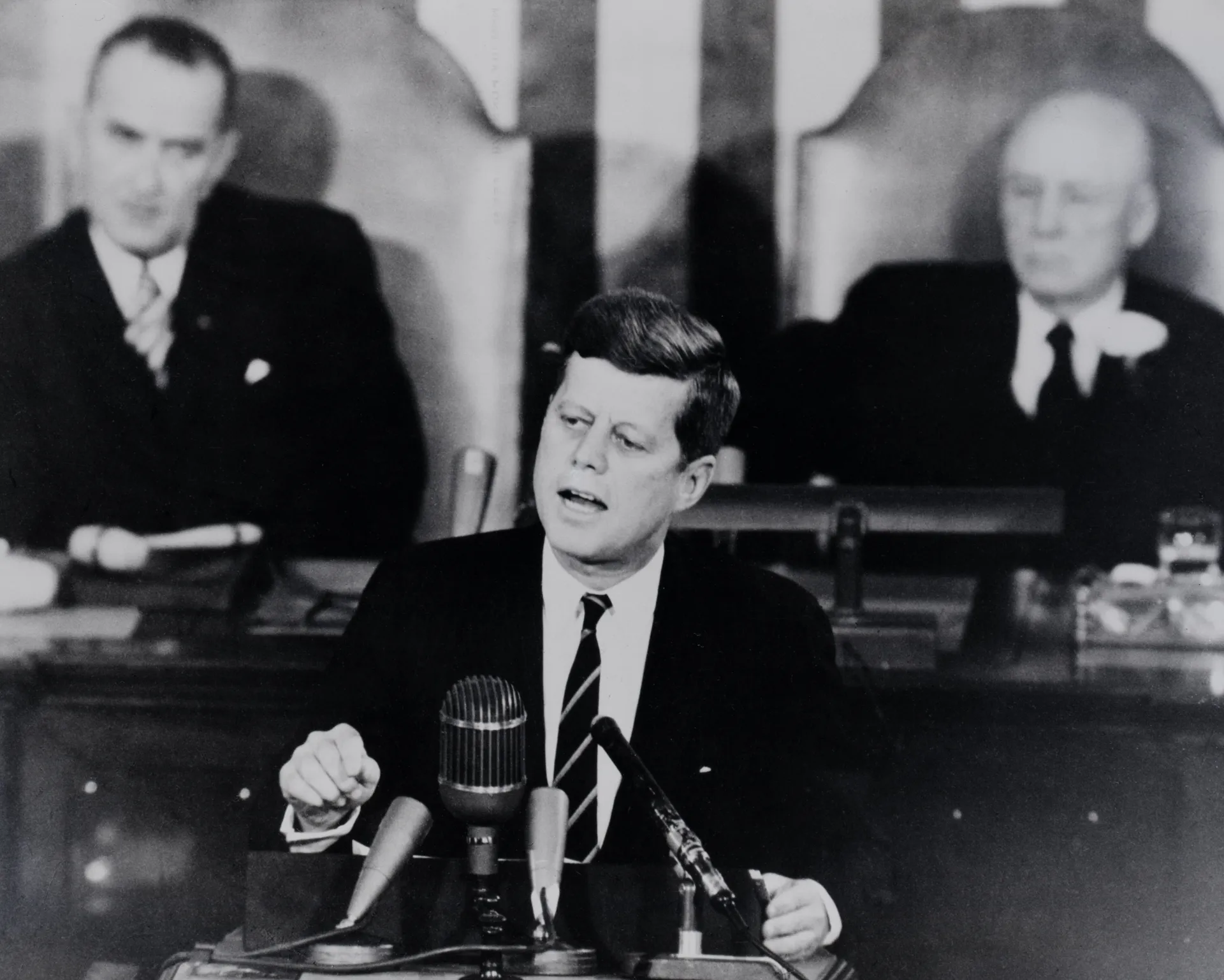
On May 25, 1961, Kennedy stood before a joint session of Congress. He asked for $531 million in fiscal 1962 and an estimated $7 billion to $9 billion more over the next five years, and he warned that the commitment would last many years and carry very heavy costs. Editorial support was widespread and congressional debate was brief; the decision was endorsed virtually without dissent.4,7
I believe that this nation should commit itself to achieving the goal, before this decade is out, of landing a man on the moon and returning him safely to the earth.
The money followed. NASA’s budget of $966.7 million in fiscal 1961 became $1.825 billion in 1962, $3.674 billion in 1963 and $5.1 billion in 1964, and it stayed near that level for three more years. NASA’s own staff grew from 17,471 to 35,860, but that was small beside the contractor and university workforce, where 90 percent of NASA’s money was spent. When the Apollo production line peaked in 1967, more than 400,000 people were working on some part of the program.4 The administration that had opened in a borrowed house with 170 people at headquarters was, six years later, spending $5 billion a year, nine-tenths of it outside its own walls.
Sources
The text above is drawn from these 8 sources. Government works are adapted closely; company and press material is summarized. Numbers in the text point here. Last checked October 1, 2026.
Show all 8 sourcesShow fewer
Continue
Related stories
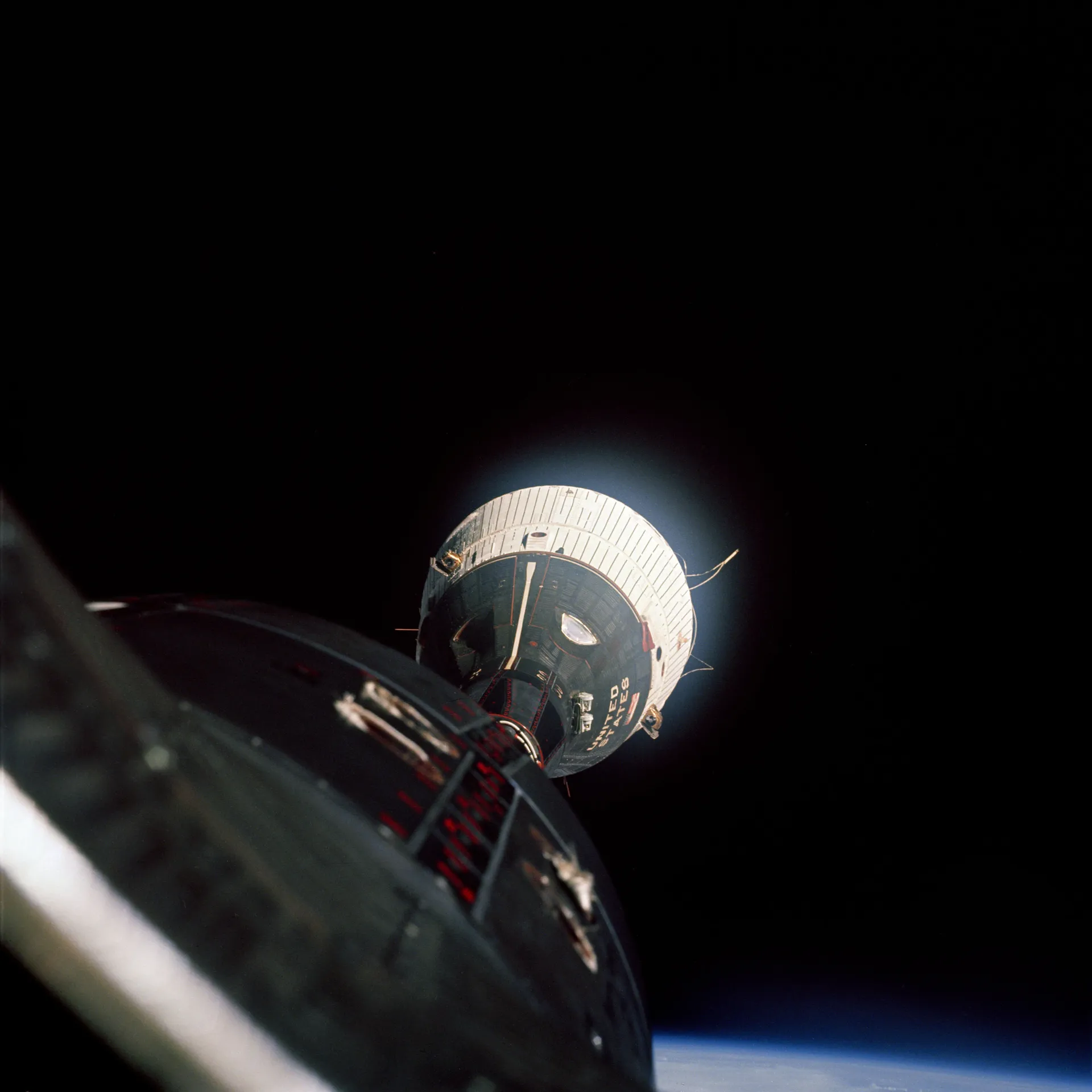
- ApolloKennedy’s 1961 goal became a program of 400,000 people and more than 500 contractors. It chose a risky route to the Moon, survived a fire on the pad, and landed six crews before Congress ended it.
- NASA’s budgetIn 1966 NASA spent 4.4 cents of every federal dollar; today about a third of a cent. Where its roughly $25 billion a year goes, how it is decided, and why Congress keeps rejecting an $18.8 billion request.
- The buildersNASA has always spent most of its money outside its own walls. From Apollo’s 500 contractors to SpaceX and Blue Origin, the question that shapes every program is who carries the risk when costs grow.