Salyut, Mir and the Russian half of the space station
The Soviet Union flew the first space station in 1971 and kept people in orbit for a decade on Mir. After 1991 its station designs, crews and Soyuz ships became half of the International Space Station.
Drawn from 35 sources: NASA History (12), NASA (7), SpacePolicyOnline (4), NASA Office of Inspector General (2) and 10 others. About 13 minutes. Checked November 9, 2026.
The Soviet Union placed Salyut, the world’s first space station, in orbit on April 19, 1971. It was designed to last six months, and its first crew died coming home. Soviet and later Russian engineers kept improving the design anyway, through later Salyuts and the core of Mir, and Zvezda, the module that holds the Russian segment of the International Space Station together today, traces its heritage directly to that first station. China’s Tiangong stations trace theirs to the same line.1
The United States flew one station in the 1970s, Skylab, whose three crews spent 171 days and 13 hours aboard.2 The Soviet Union kept flying them. When the Soviet state collapsed in 1991, Russia inherited that experience of operating stations for months at a time, while the American station ordered in 1984 was still being redesigned to cut its cost.1,3 This is how one program’s experience became half of the other’s station.
A civilian station built in under 18 months from a military shell
In 1966 the Soviets began work on a secret military space station called Almaz, a 20-ton module to be visited by crews of two or three cosmonauts in Soyuz spacecraft, with a first launch planned for the early 1970s. After Apollo 11 landed on the Moon in July 1969, the government approved a civilian station as well, and in February 1970 it approved a crash program to build one from an Almaz shell and Soyuz components and launch it in less than 18 months. The work went to the design bureau now called RKK Energia, in Kaliningrad, today’s Korolev.1
The station was 66 feet long and weighed 40,620 pounds, with about as much living space as a large in-ground swimming pool. Ten days before launch, managers renamed it Salyut (“salute”), although its original name, Zarya, was already painted on its side.1
A Proton rocket lifted Salyut from Baikonur on April 19, 1971, but a cover over its main scientific instrument failed to jettison. Soyuz 10, launched on April 23, reached the station the next day but could not achieve a hard dock, and its crew returned without ever going aboard.1
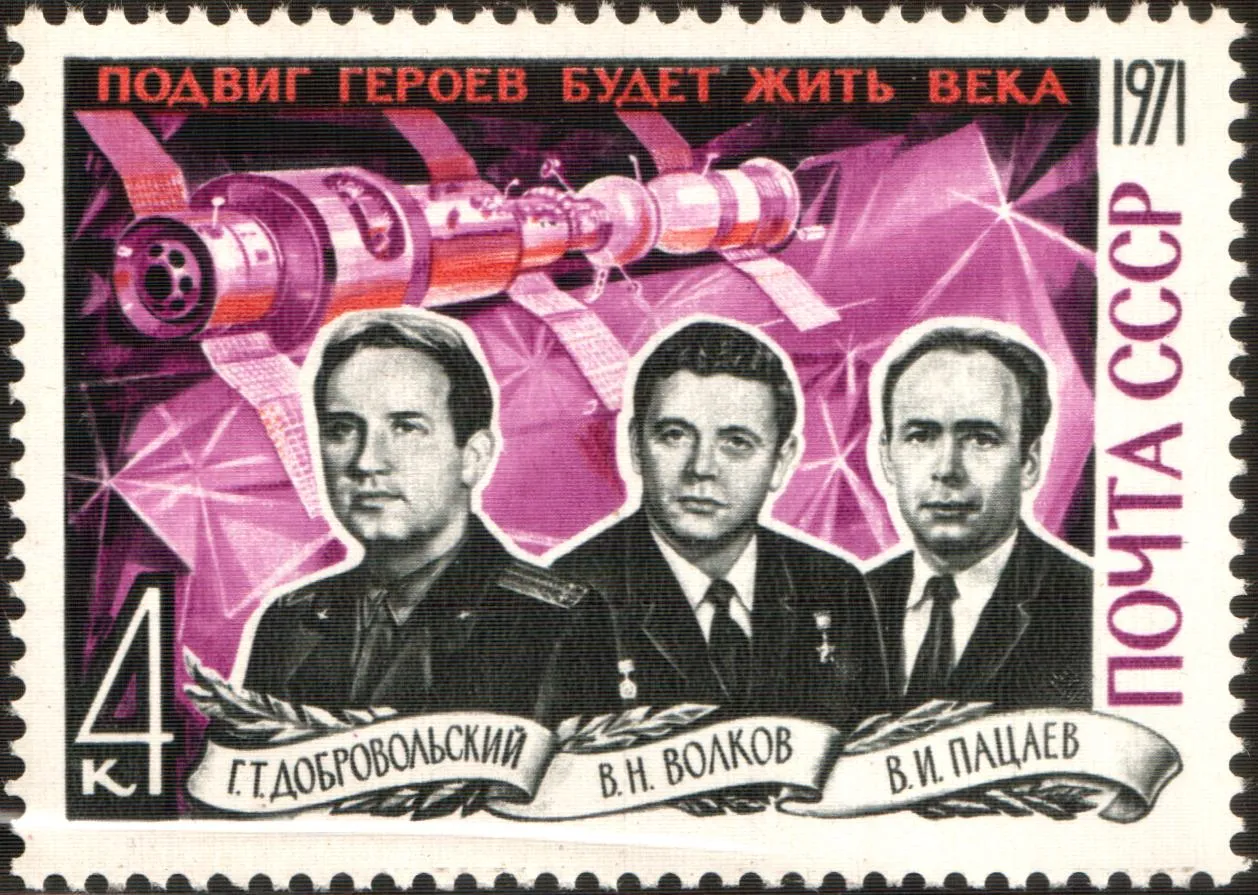
After a redesign of the docking probe, Soyuz 11 launched on June 6 with Georgi Dobrovolski, Vladislav Volkov and Viktor Patsayev. Their flight lasted a record 24 days; Patsayev turned 38 in orbit, the first birthday celebrated in space. During their return to Earth, the cosmonauts died as a result of the sudden depressurization of their spacecraft.1 The recovery team found them in their couches.4 Further flights to Salyut were canceled, and controllers sent the station into a destructive reentry over the Pacific on October 11, 1971, after 175 days in space. Engineers redesigned Soyuz and required cosmonauts to wear Sokol pressure suits for launch and landing, a requirement still in place today.1
Three of the next stations were military
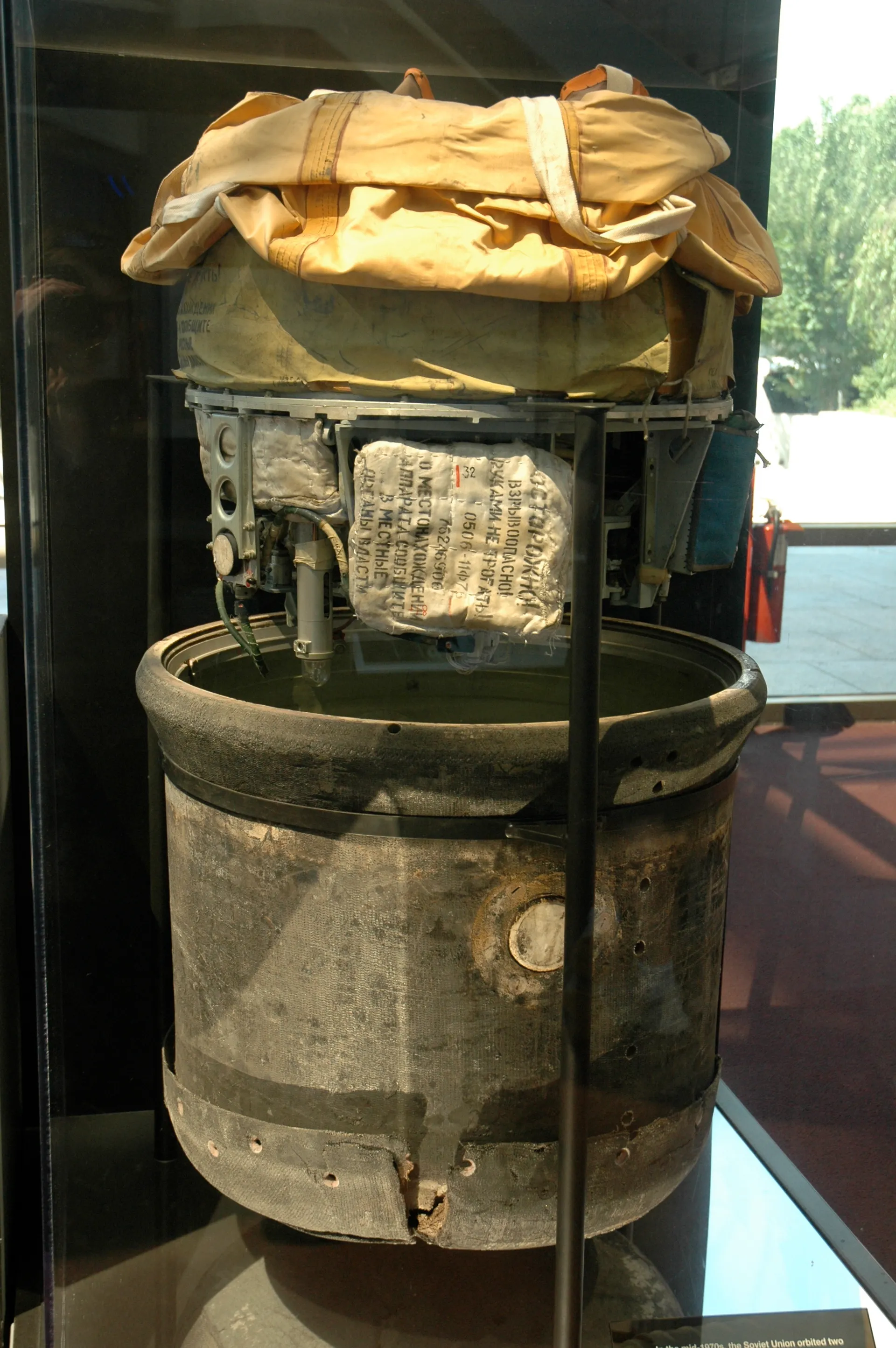
The Almaz stations, built by Vladimir Chelomei’s design bureau, flew under the same public name. Salyut 2 failed shortly after launch in 1973. Salyut 3 (1974) and Salyut 5 (1976) were Almaz stations, and between them they hosted three crews who flew there in Soyuz spacecraft. Almaz was designed for reconnaissance, with large long-focal-length optics meant to resolve about a meter on the ground, capsules to return exposed film, and lower-resolution real-time transmission.5,6 Salyut 5 was the last of them.6
The civilian line had failures of its own. Its second station never reached orbit in 1972, when a second-stage engine of its Proton rocket failed. The next, launched on May 11, 1973, three days before Skylab, lost all its fuel in its first orbit to errors in its attitude-control thrusters; the Soviets named it Kosmos 557 and let it reenter 11 days later. Salyut 4 followed in December 1974, and its crews spent 30 and 63 days aboard in 1975, both Soviet endurance records.1,6
A second docking port and an uncrewed freighter made long stays possible
First-generation stations had one module and one docking port and could not be resupplied: when the crew’s food, water and propellant ran out, the station’s life was over.6 After the Kosmos 557 failure, the design bureau began work in mid-1973 on a cargo ship built from Soyuz, with tanks of propellant and air in place of the crew’s descent module.7
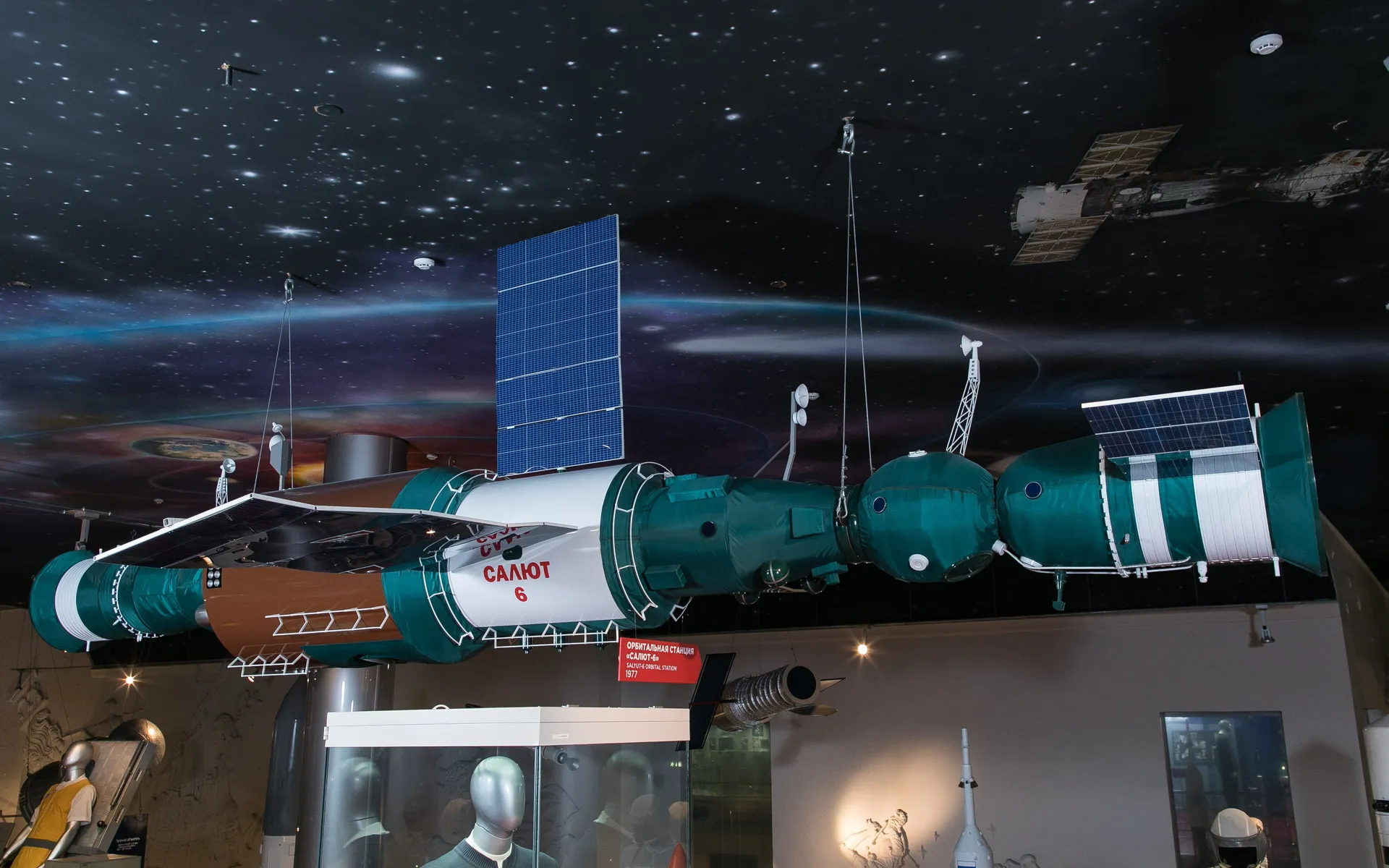
Salyut 6, launched on September 29, 1977, and Salyut 7, launched on April 19, 1982, had a docking port at each end.4 Progress 1 reached Salyut 6 in January 1978 and docked automatically after a two-day rendezvous. It carried about 5,100 pounds of cargo, 2,200 pounds of it propellant and oxygen. Once Yuri Romanenko and Georgi Grechko had unloaded it, the ship pumped propellant into the station’s tanks, raised its orbit, and undocked with the trash to burn up over the Pacific. Those supplies allowed Romanenko and Grechko to set a record of 96 days.7
The second port also let visiting crews arrive in a fresh Soyuz and leave the long-duration crew the newer ship, a procedure carried over to Mir and the ISS.6 Twelve Progress ships served Salyut 6 and thirteen more served Salyut 7.7 Salyut 6 hosted 16 crews, one of them for 185 days, with guests from eight Soviet-allied countries; Salyut 7 hosted 10, the longest for 237 days, including French and Indian cosmonauts.6 Larger Almaz-built ships, the TKS, docked with both and showed that whole modules could be delivered and joined in orbit.6,7
Mir: a core module with a docking hub for research modules
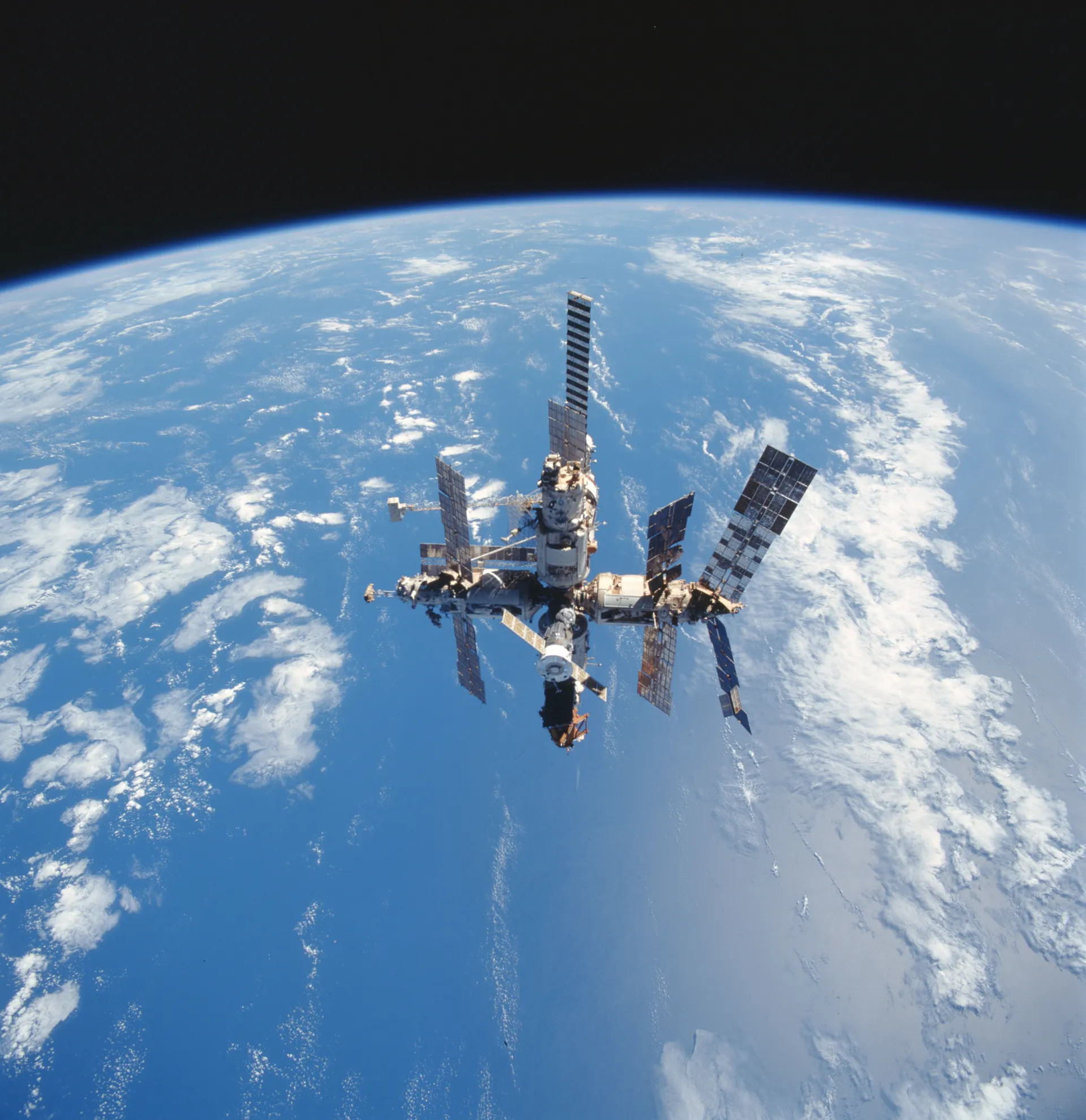
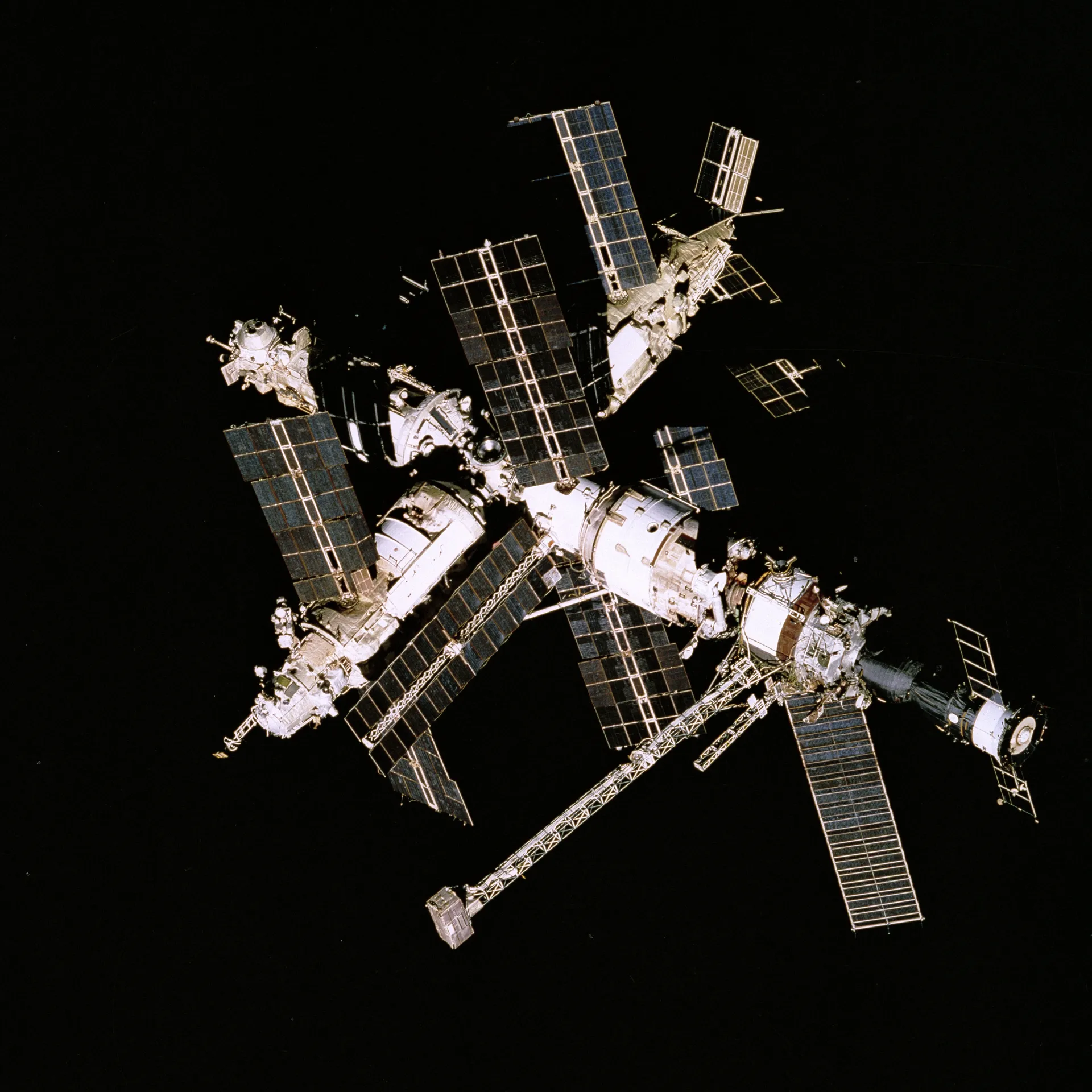
Mir as the crew of Atlantis saw it during their approach on June 29, 1995.
The Soviet Union approved Mir in 1976, drawing on Salyut and Almaz hardware. Its main upgrade was a docking hub at the forward end of the core module, with four radial ports for large research modules, so that a permanently staffed station could grow around it.8 After delays, the 45,000-pound base block launched on a Proton from Baikonur on February 19, 1986 (February 20 in Moscow).4,8,10
Its first crew, Leonid Kizim and Vladimir Solovyov, activated Mir, then flew their Soyuz to Salyut 7, about 3,800 miles away, worked there for 50 days and returned to Mir in June with 880 pounds of equipment, a guitar among it, the only flight ever made from one station to another.8
1987: the core and Kvant
The base block carried the docking hub at its forward end, with four radial ports for research modules, and a docking port at its aft end. Kvant 1, an astrophysics module, arrived at the aft port in 1987.8
1989 to 1996: the hub fills
The research modules came late. Kvant 2 was launched in November 1989 and Kristall in May 1990, and both docked at the forward hub. NASA research hardware went into the last two, Spektr and Priroda, and a Docking Module was added in 1995. With every module installed, Mir weighed 285,900 pounds and had 12,400 cubic feet of habitable volume, at the time the largest spacecraft ever assembled.8,10,14
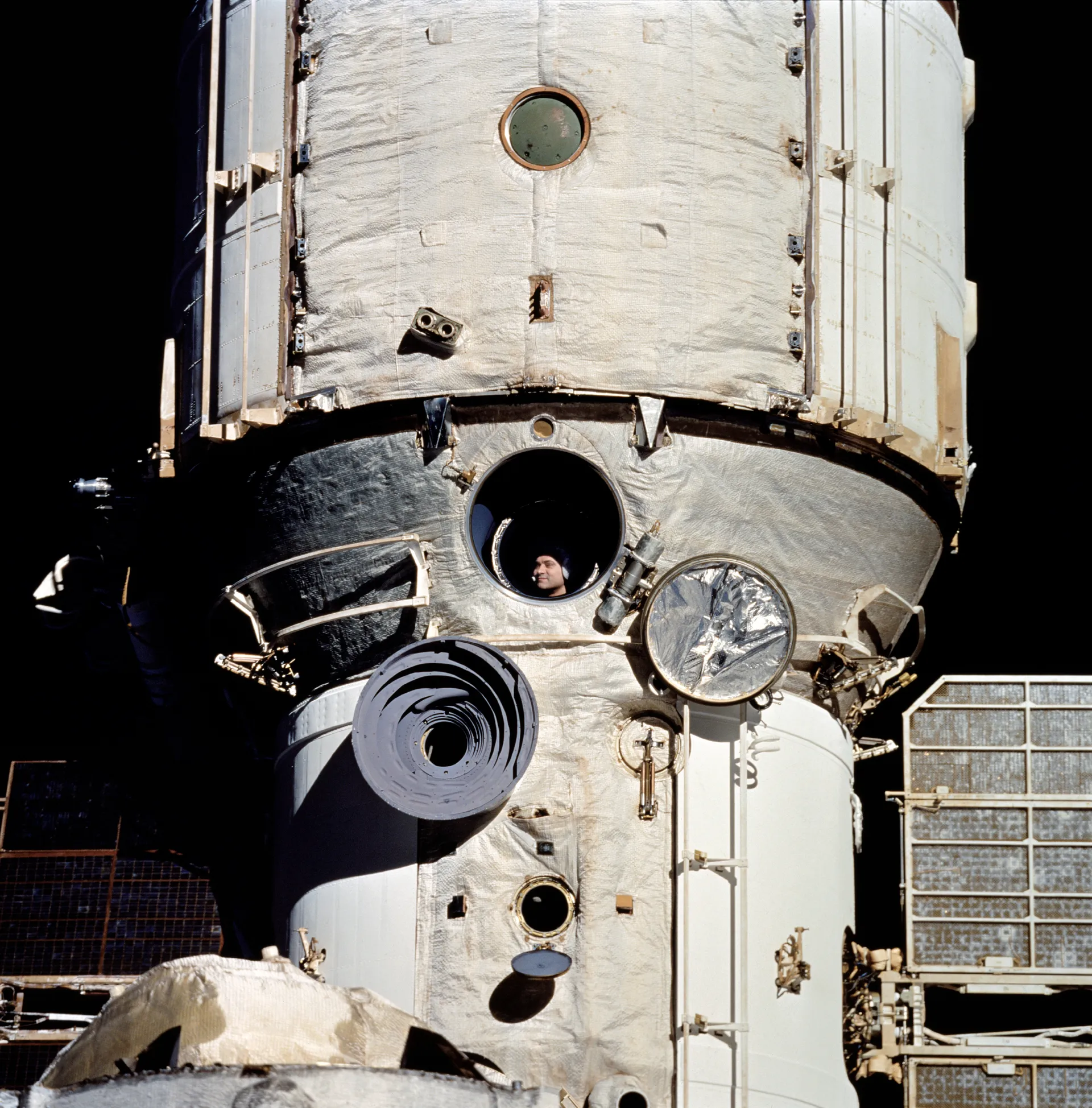
Yuri Romanenko stayed 326 days in 1987; Vladimir Titov and Musa Manarov then stayed a full year. Delays to the research modules left Mir empty from April 1989, but the crew that arrived that September began ten years of uninterrupted habitation, a record the ISS did not pass until October 2010.8
The physician-cosmonaut Valeri Polyakov began the longest single spaceflight in January 1994: 438 days, ending in March 1995. Cosmonauts and astronauts from four countries made 77 spacewalks from Mir.8
Sergei Krikalev was aboard Mir on December 25, 1991, when Mikhail Gorbachev resigned as Soviet president.4 Mir now belonged to Russia, and its planned successor, Mir-2, had an uncertain future.3
How Russia came into the American station, 1992–1993
In June 1992 the United States and the new Russian Federation renewed their space cooperation agreement, while Freedom, the American station, was still being redesigned to cut its cost.3,4 An implementing agreement of October 1992 provided for a Russian cosmonaut to fly on the Shuttle, an American astronaut to make a long stay on Mir, and a Shuttle to dock with the station.4
In 1993, during yet another redesign, President Bill Clinton invited Russia to join as a full partner, adding the modules planned for Mir-2; the result was named the International Space Station.3 On November 1, an addendum to the station plan merged the American design, then called Alpha, with Mir-2 and set out three phases.4 On December 16, in Moscow, NASA Administrator Daniel Goldin and Russian Space Agency Director General Yuri Koptev signed a contract under which the United States would pay $100 million a year for four years.4,12
Phase 1 meant up to 10 Shuttle flights to Mir and up to 24 months of astronaut crew time aboard. In Phase 2, Russia would supply the FGB, a spacecraft for propulsion, guidance and control; Soyuz capsules as crew-return vehicles; and Shuttle docking systems. Phase 3 would complete the station with elements from all the partners.4,11
The General Accounting Office noted one cost of the partnership for the Shuttle: the station’s more steeply inclined orbit, 51.6 degrees instead of 28.8, narrowed its daily launch window from 50 minutes to 5.11
Shuttle–Mir: nine dockings and 975 days
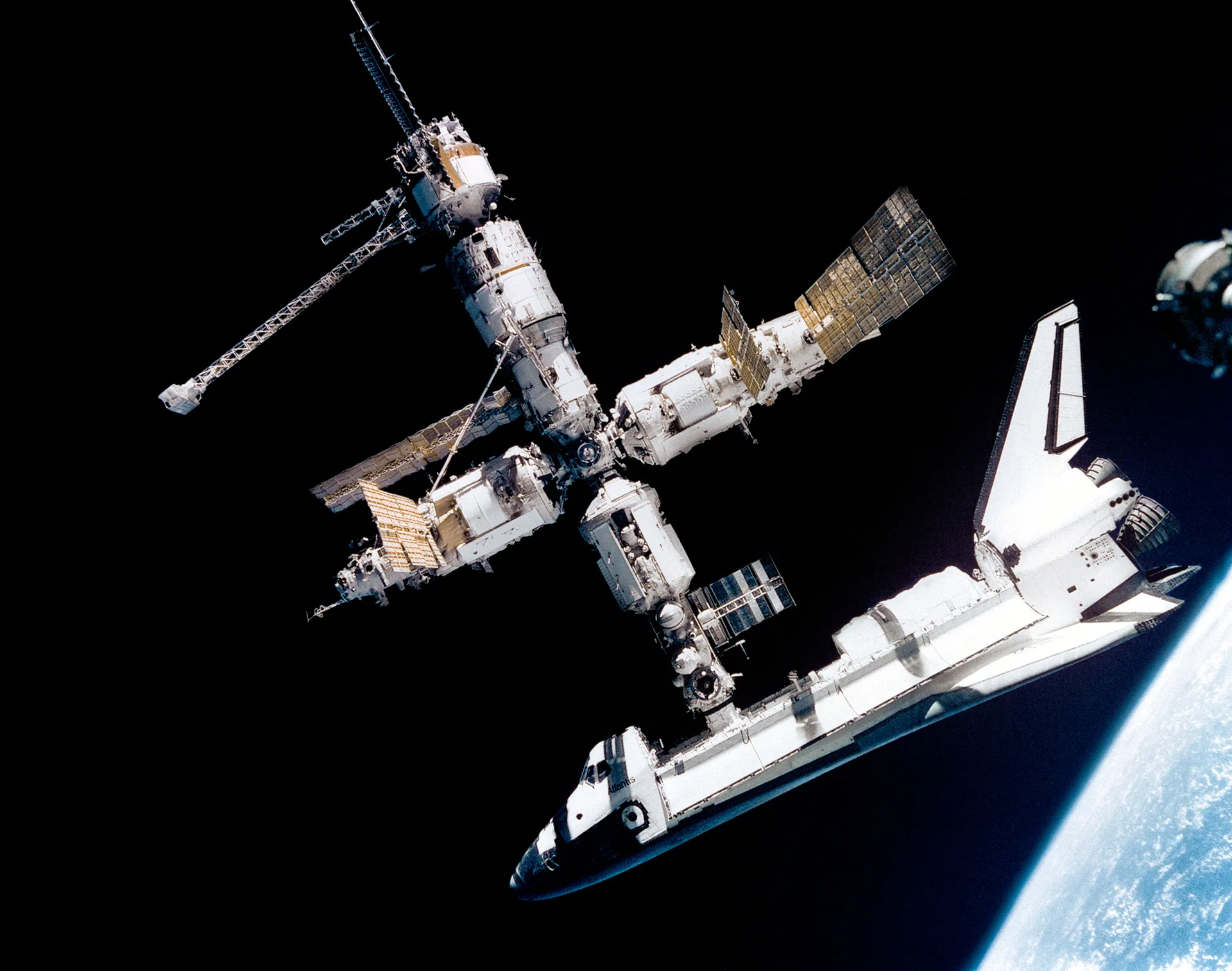
Sergei Krikalev became the first cosmonaut to fly on a Space Shuttle, on STS-60 in February 1994. On March 14, 1995, Norman Thagard launched from Baikonur on Soyuz TM-21, the first American to make a long-duration flight on a Russian station; his first six days aboard Mir were the last of Valeri Polyakov’s 438-day flight.4
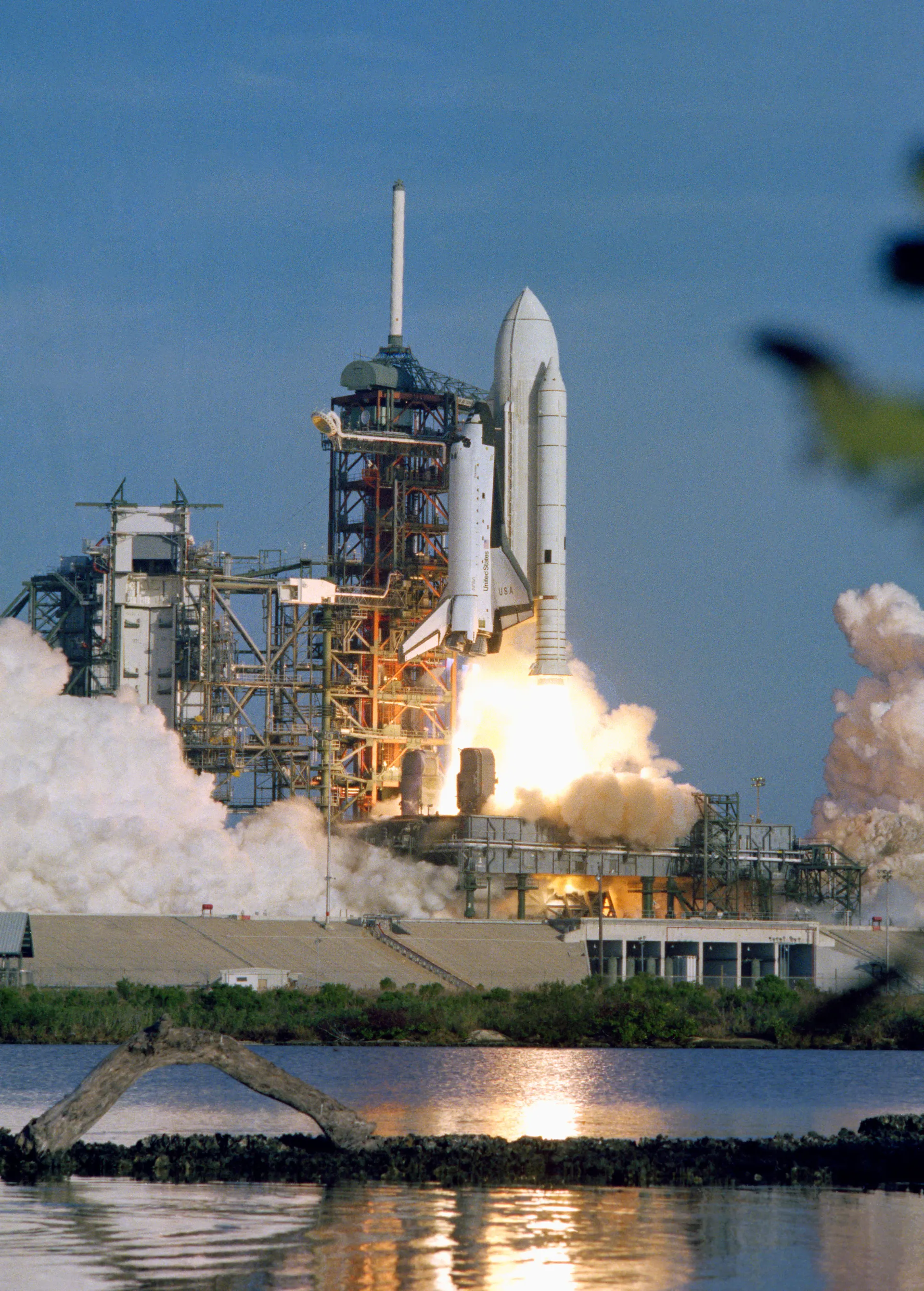
Atlantis launched on STS-71 on June 27, 1995, the 100th American human space launch from the Cape, and docked with Mir on June 29. Joined, the two had a mass of about 225 tons, the largest spacecraft yet in orbit. Atlantis left a new crew aboard Mir and brought Thagard and his crewmates, Vladimir Dezhurov and Gennadi Strekalov, home after more than 100 days in space.13
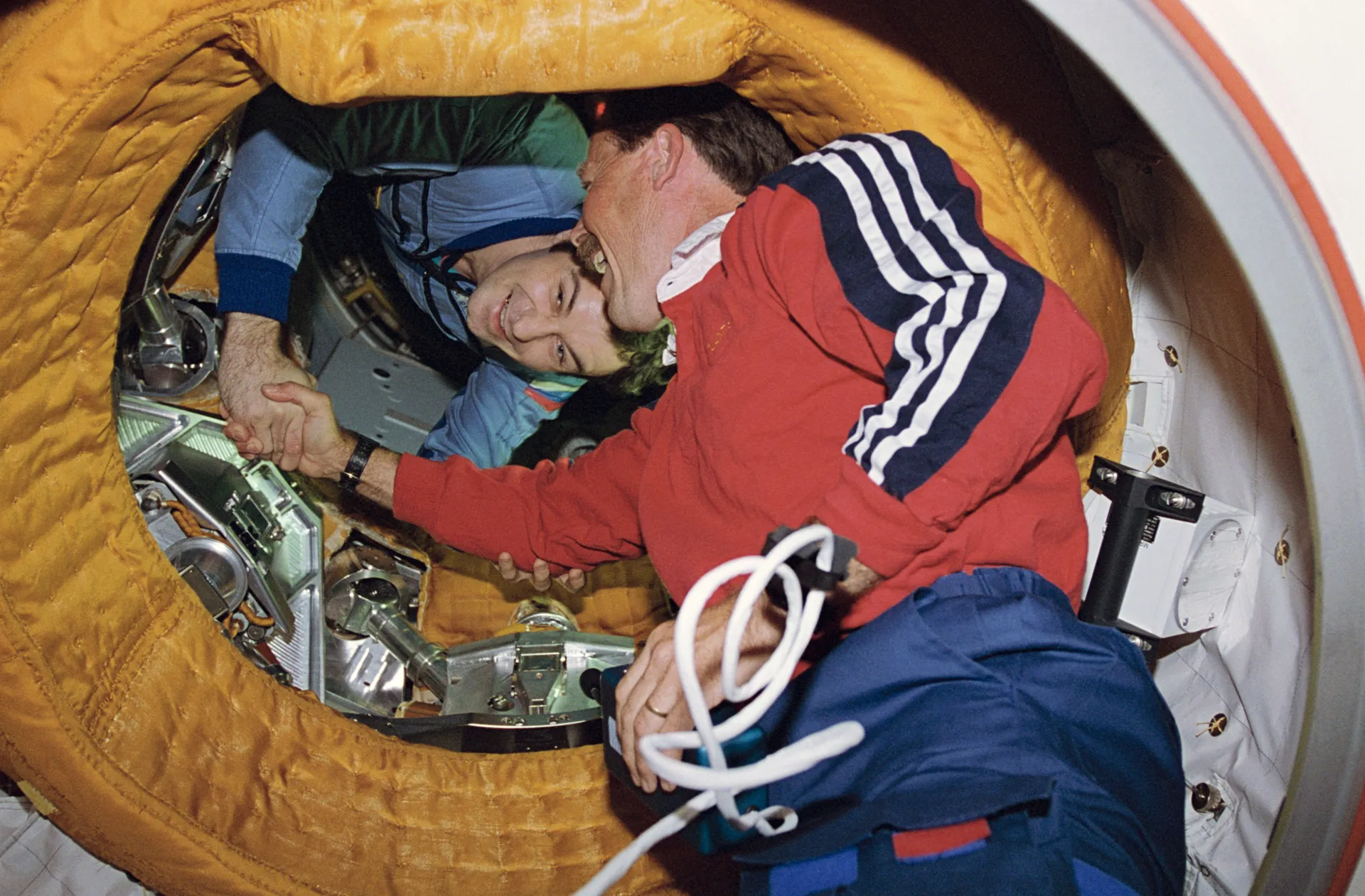
Seven American astronauts lived aboard between 1995 and 1998: Thagard, Shannon Lucid, John Blaha, Jerry Linenger, Michael Foale, David Wolf and Andrew Thomas. Lucid’s stay of 188 days, ending in September 1996, set a record for a woman.4,8
Before Shuttle–Mir, NASA’s longest experience in orbit was Skylab’s 84 days; the program gave its astronauts 975 days aboard a station, more than 27 consecutive months.6 Ten Shuttle flights went to Mir, beginning with Discovery’s close approach on STS-63 in February 1995, and the last nine docked with it.9,14,15
A fire and a collision in four months of 1997
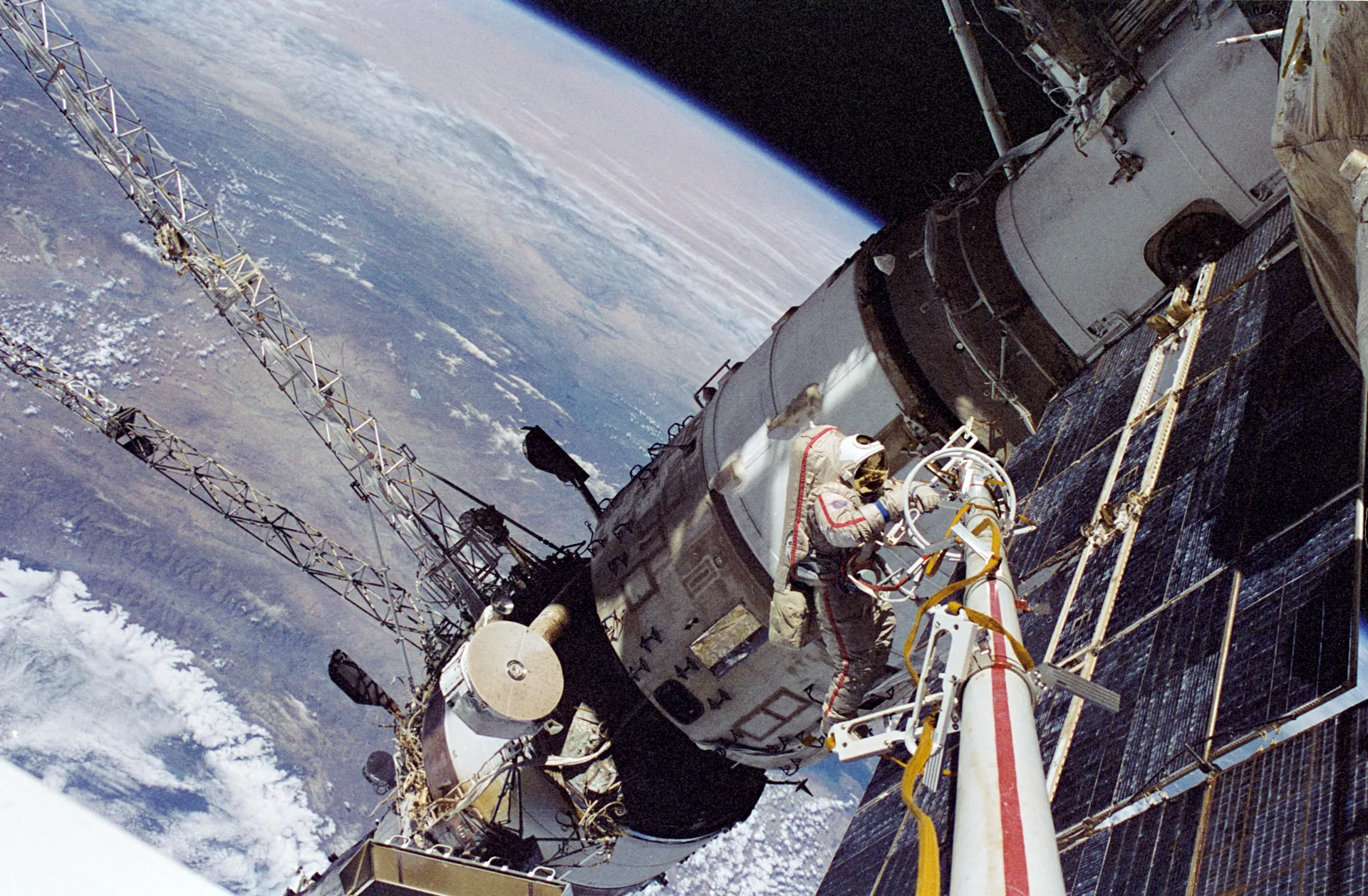
During a crew handover in February 1997 Mir held six people instead of three, among them Linenger, who had arrived on Atlantis in January. Shortly after dinner on February 24, cosmonaut Aleksandr Lazutkin activated a solid-fuel oxygen generator in Kvant 1. The canister ignited, producing a three-foot flame, sparks, molten metal and dense smoke. The flame blocked the way to the Soyuz docked at the far end of Kvant 1, one of the two escape ships.16
The crew put on oxygen masks. Valeri Korzun fought the flame with foam from an extinguisher while Linenger held him in place and others handed him two more. The flame eventually burned itself out; the life support system cleared the smoke over several hours, and no lasting harm came to the crew. Such generators had operated more than 2,500 times on Mir without incident. After two years of study, investigators concluded that hydrocarbons in the canister, most likely from latex glove material, had raised the risk.16
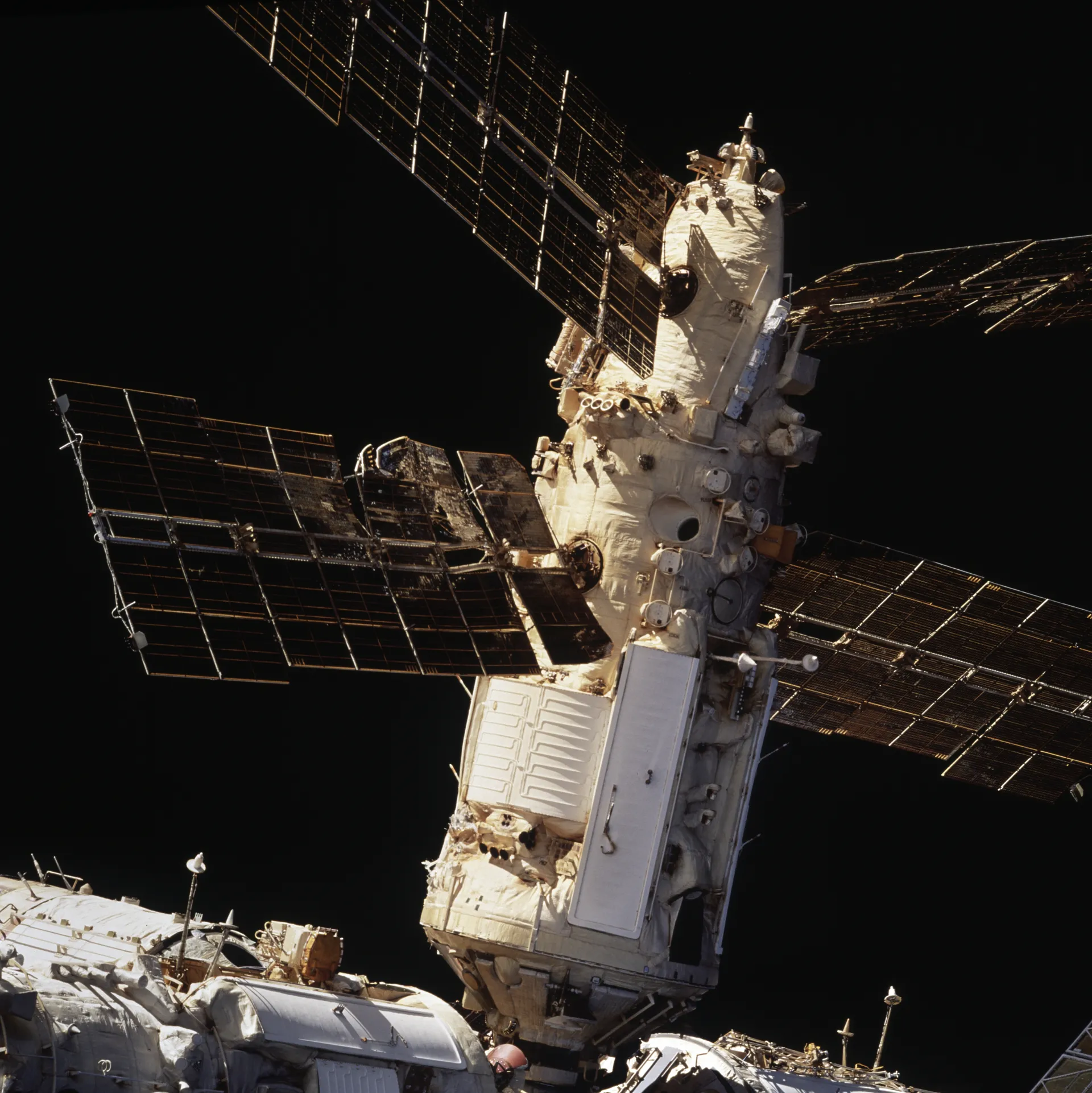
On June 25, 1997, Mir-23 commander Vasily Tsibliyev was guiding an uncrewed Progress to a docking by hand when it struck the Spektr module, damaging a radiator and one of Spektr’s four solar arrays and puncturing the hull. The crew sealed the hatch to the leaking module, which left Foale’s personal effects and several NASA experiments inside, and repressurized the rest of the station. Restoring power from Spektr’s three undamaged solar arrays meant reconnecting cables inside the airless module.17
Recovery took months. After Tsibliyev developed an irregular heartbeat, the next crew, Anatoly Solovyev and Pavel Vinogradov, reconnected 11 power cables inside the airless Spektr on August 22, while Foale waited in the Soyuz.17 Critics in Congress and elsewhere called for the United States to abandon the program. NASA ordered reviews by a commission under Thomas Stafford, by its inspector general and by others, and decided that continuing was worth the risk; its history of the program says the partnership now ran on Reagan’s old rule for arms control, trust but verify.18
The lessons went into the ISS: a single command to shut down ventilation in a fire, quick-disconnect cables for a depressurization, and more lighting for rendezvous.6 Knowing the cause also changed how oxygen canisters are prepared on the ground.16
Learning to solve problems jointly is the skill we must not lose, or we will have to start over.
Zarya, Zvezda and the end of Mir
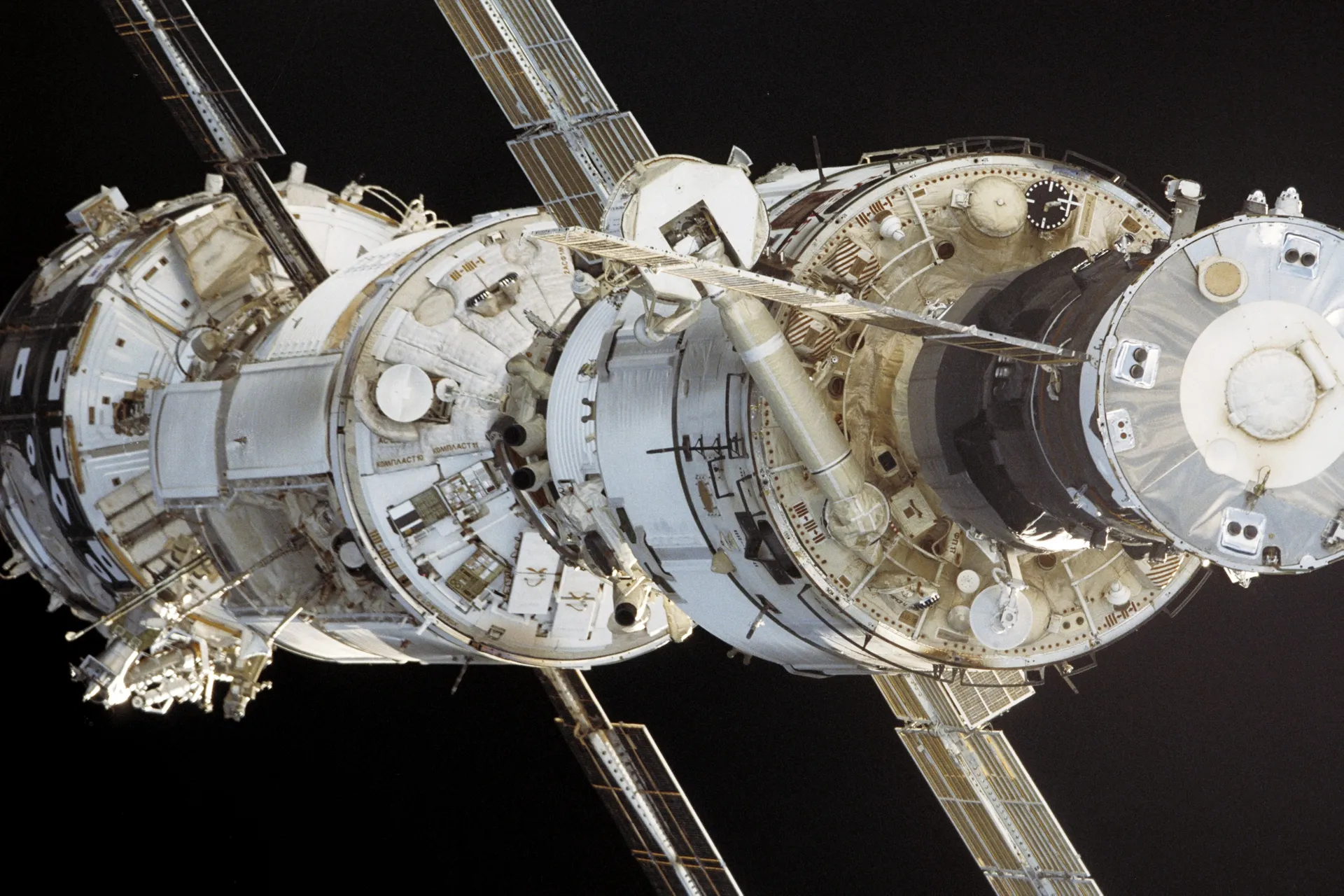
The young ISS from Atlantis in September 2000: a Progress ship in the foreground, docked to Zvezda, with Zarya and Unity beyond.
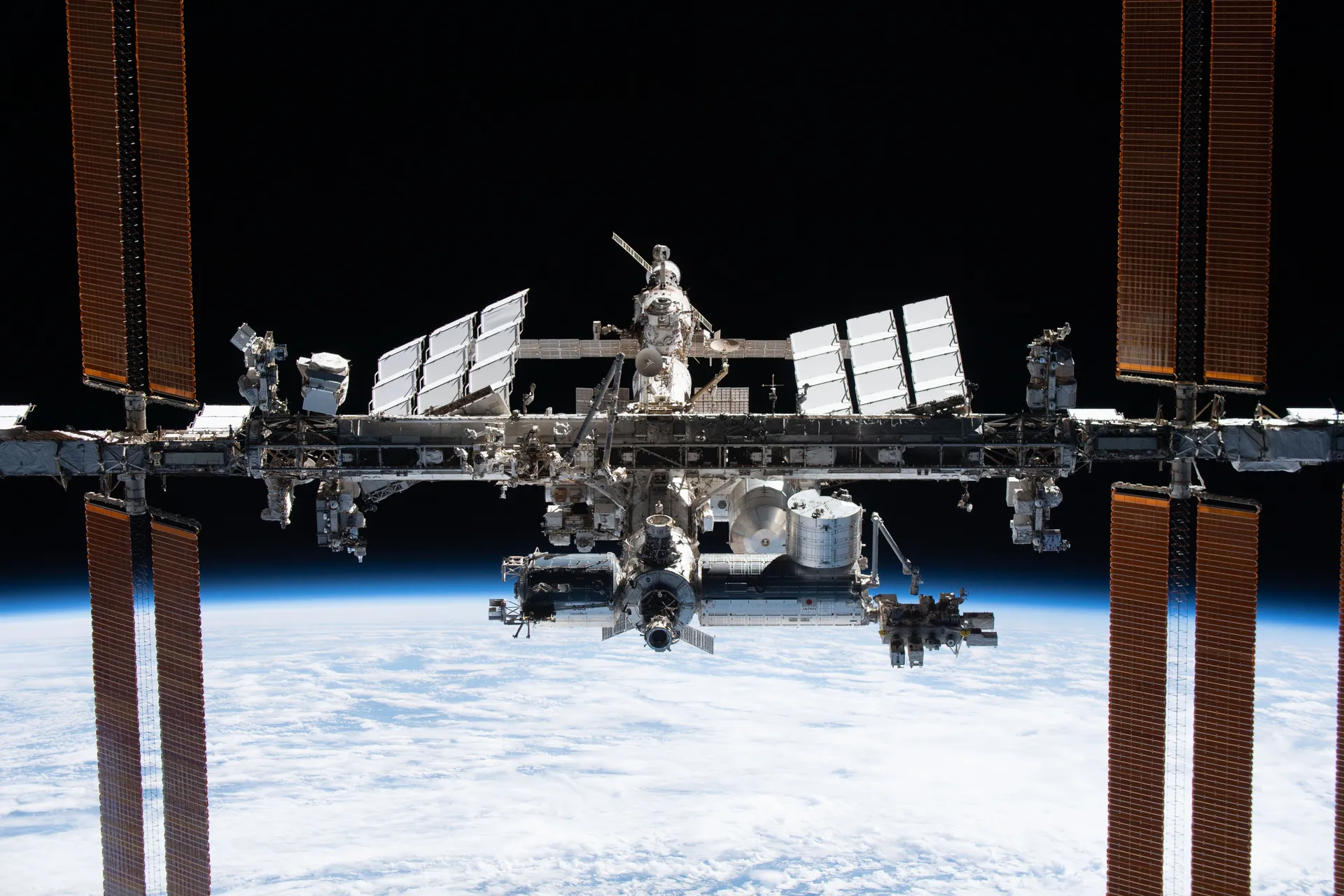
Russia launched Zarya from Baikonur on a Proton on November 20, 1998.20 Zarya, the FGB of the 1993 plan, shares its heritage with the Mir research modules, which derived from transport ships planned for the Almaz program.8 The Zvezda service module arrived in July 2000. NASA’s historians describe it as the flight backup for Mir’s base block, and it made permanent occupancy possible.8,20 Expedition 1 launched from Baikonur on October 31, 2000; people have lived on the station ever since.20
Mir’s 28th and last main expedition left it on June 16, 2000. Progress M1-5 docked in January 2001 with 5,900 pounds of propellant, and on March 23 three burns brought Mir down; its debris fell in the South Pacific east of New Zealand after 86,331 orbits. Forty-two people who had flown to Mir later flew to the ISS.9
From 2011 to 2020 the only ride to the station was Soyuz
Russia’s ships first carried the station alone after the loss of Columbia in February 2003 grounded the Shuttle, and the station’s crew was reduced to two. “Russian Soyuz and Progress vehicles have succeeded in providing reliable crew and cargo access,” NASA’s associate administrator for space flight, William Readdy, told Congress that October.22
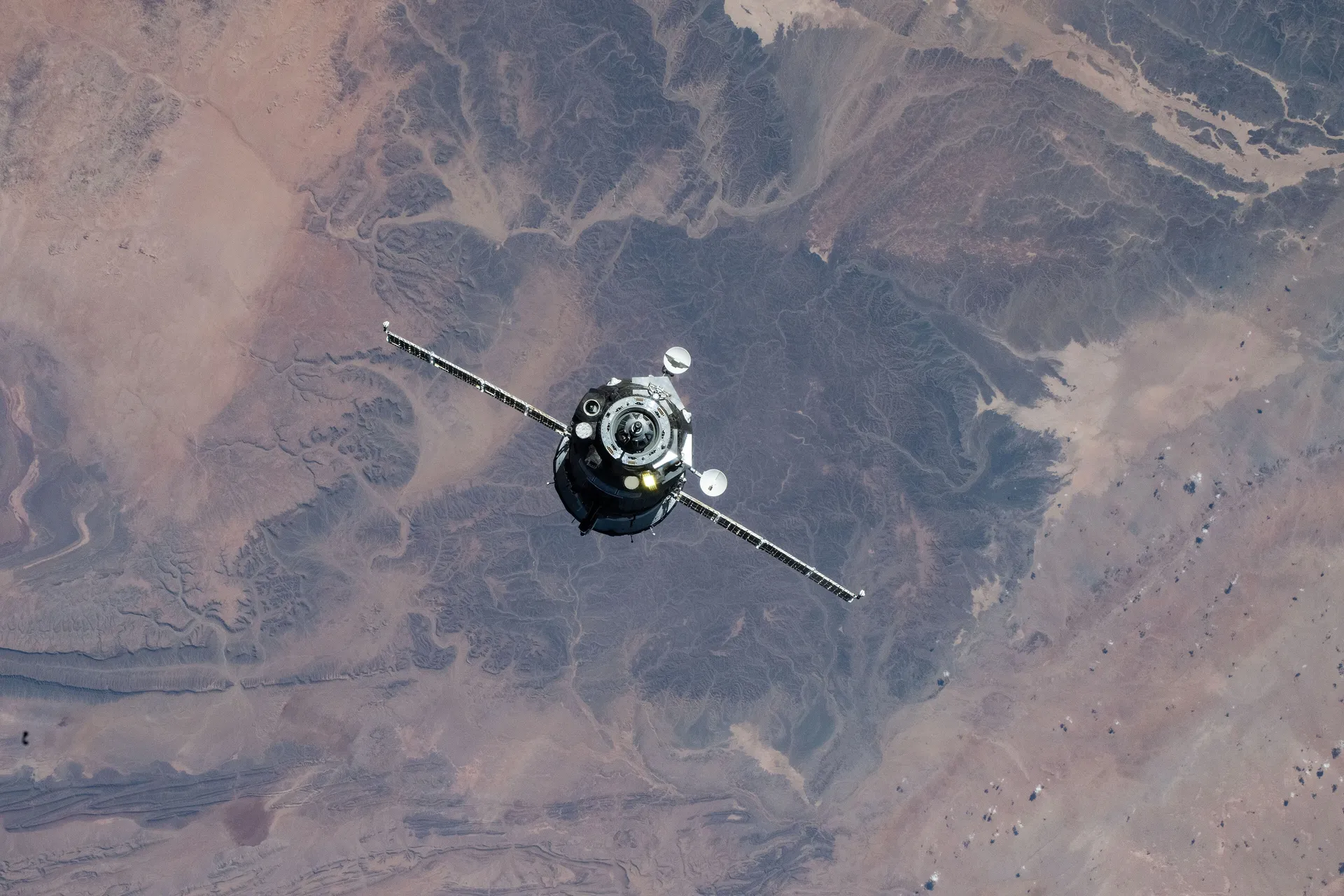
When the Space Shuttle Program ended in 2011, Soyuz became the only way to carry astronauts to and from the ISS, and NASA bought seats on it until American commercial crew ships were ready. By July 2019 NASA’s inspector general counted 70 Soyuz seats bought for about $3.9 billion, for flights from 2006 through 2020: an average of $55.4 million a seat.23
The dependence was tested on October 11, 2018, when Soyuz MS-10 launched from Baikonur with NASA astronaut Nick Hague and cosmonaut Alexey Ovchinin. Shortly after launch, NASA reported, an anomaly with the booster forced an abort and a ballistic landing; both men came out of the capsule in good condition.24 About two minutes into the flight, one of the four strap-on boosters had struck the core stage as it separated, and the escape system pulled the capsule away. Russian investigators traced the failure to a sensor in the booster separation system that had been deformed during final assembly at Baikonur. The next crew launched on December 3.25
One launch pad for every Russian crew
Since 2022 NASA and Roscosmos have swapped seats instead of selling them. Frank Rubio launched on Soyuz MS-22 in September 2022 and cosmonaut Anna Kikina on SpaceX’s Crew-5, with no money changing hands, so that each segment always has crew trained to maintain it and each country’s vehicle backs up the other’s.26
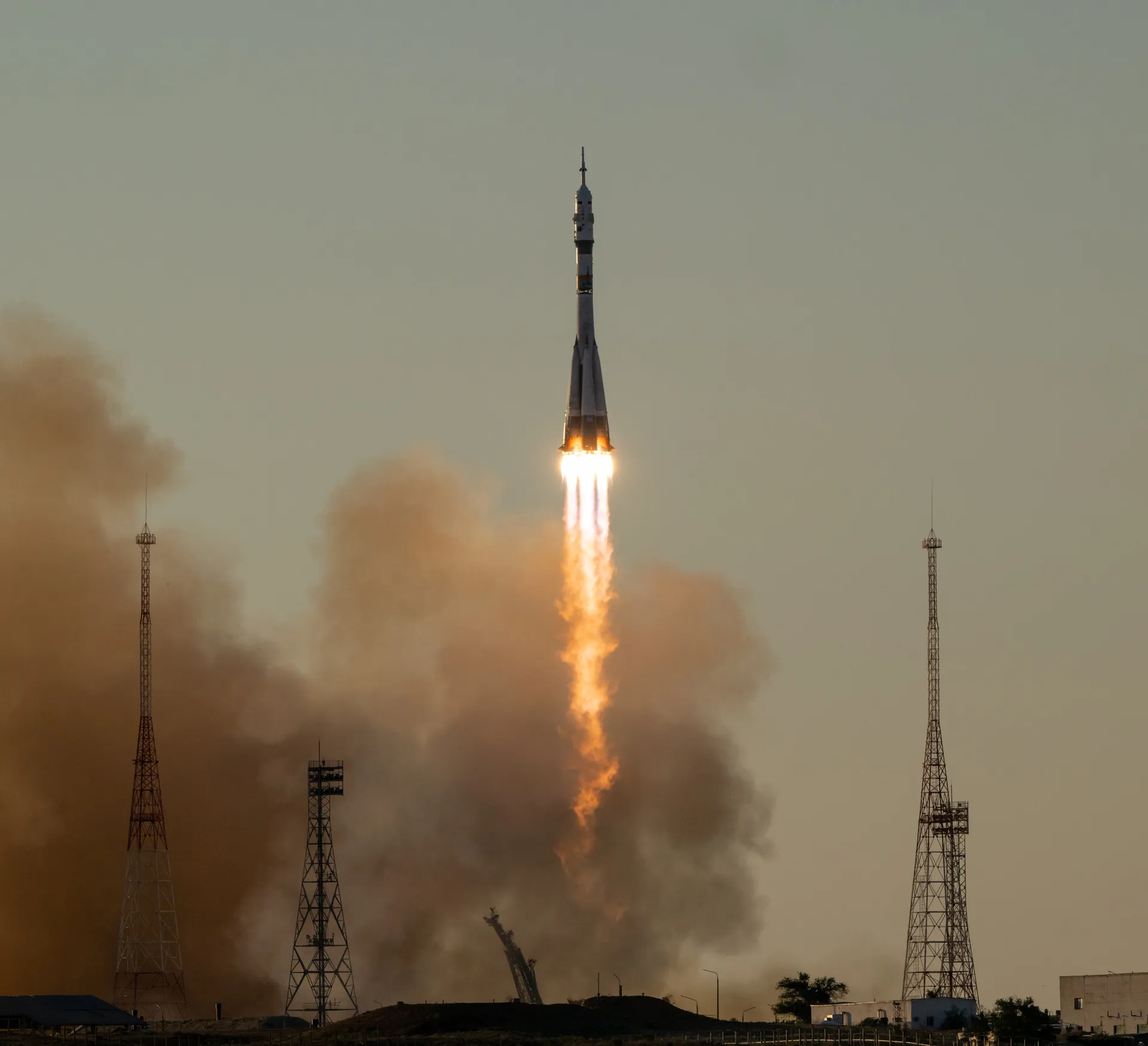
Every Russian crew still leaves from one pad. Site 31 at Baikonur is the only pad that can launch Soyuz crews to the ISS; Gagarin’s pad, Site 1, was retired in 2019.28 When Soyuz MS-28 lifted off from it on November 27, 2025, the pad’s service cabin collapsed into the flame trench; the cause was not announced, though experts suggested its locks may not have been closed. The crew, including NASA’s Chris Williams, reached the station, but the Progress launch planned for December waited about three months for repairs, which Roscosmos announced complete on March 3, 2026.10,27,28
Every Russian launch to the station since has used the repaired pad, among them Soyuz MS-29 on July 14, 2026, with NASA’s Anil Menon and the cosmonauts Pyotr Dubrov and Anna Kikina.10,29 At Baikonur for the July launch, Roscosmos agreed to support the station through 2030, the end date its partners had already adopted, instead of 2028, and to continue the seat swaps until then.30
A Russian station planned around the Russian segment
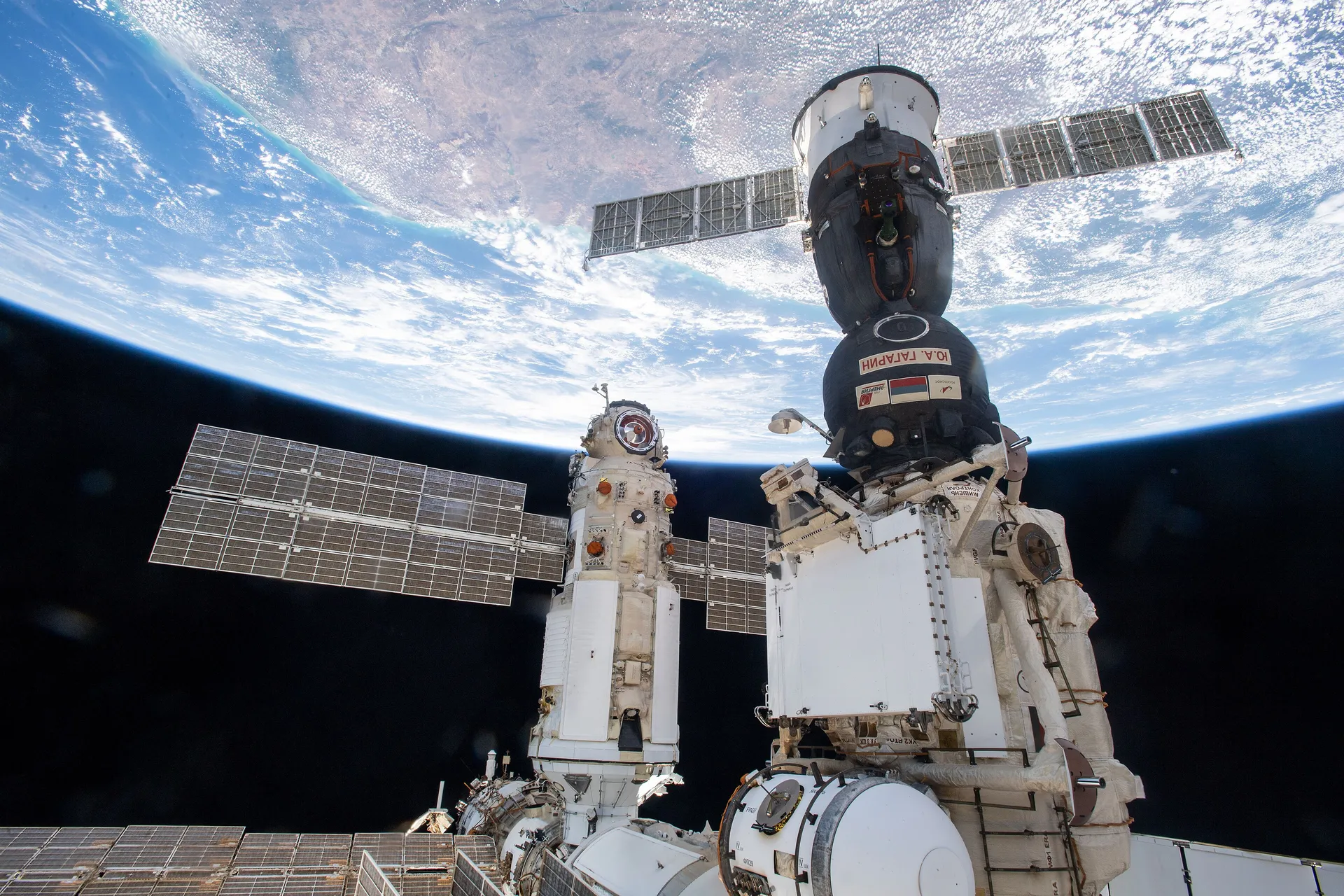
Russia’s plan for after 2030 has moved. In December 2025, First Deputy Prime Minister Denis Manturov announced that the Russian Orbital Station would fly at the ISS’s inclination of 51.6 degrees instead of the near-polar orbit planned before.31,32 Later that month Oleg Orlov, director of the Institute of Biomedical Problems, said Roscosmos’s scientific and technical council had approved, as the main possible scenario, building the station from the Russian segment of the ISS: separating Zarya, Zvezda, Nauka and the other Russian modules when the ISS ends and using them as its core.32
The first new module has slipped. In January 2025 RSC Energia’s general designer planned it for December 2027.33 In April 2026 Roscosmos head Dmitry Bakanov said that module, a science and power module already assembled, would launch in 2028, with the station to be completed by 2033 at an estimated cost of 608.9 billion rubles.34
When Russia’s first new station module was due34
20252026202720282029
Science and power module
- Said Jan 2025December 2027
- Said Apr 20262028
If that plan holds, the station Russia flies in the 2030s will be built around Zvezda, the flight backup for Mir’s base block, whose lineage runs back to the military Almaz shell that Soviet engineers turned into Salyut in 1970 and 1971.1,8
Sources
The text above is drawn from these 35 sources. Government works are adapted closely; company and press material is summarized. Numbers in the text point here. Last checked November 9, 2026.
Show all 35 sourcesShow fewer
- 1Back to the text
- 2Back to the text
- 3Back to the text
- 4Back to the text
- 5Back to the text
- 6Back to the text
- 7Back to the text
- 8Back to the text
- 9Back to the text
- 10Back to the text
- 11Back to the text
- 12Back to the text
- 13Back to the text
- 14Back to the text
- 15Back to the text
- 16Back to the text
- 17Back to the text
- 18Back to the text
- 19Back to the text
- 20Back to the text
- 21Back to the text
- 22Back to the text
- 23Back to the text
- 24Back to the text
- 25Back to the text
- 26Back to the text
- 27Back to the text
- 28Back to the text
- 29Back to the text
- 30Back to the text
- 31Back to the text
- 32Back to the text
- 33Back to the text
- 34Back to the text
- 35Back to the text
Continue
Related stories
- The Soviet programFrom Korolev’s missile bureau to Energia–Buran, the Soviet Union took most of the early firsts with a program run by competing design bureaus, hidden behind anonymous names, and built around a Moon rocket that never flew successfully.
- ISSHow five space agencies assembled the largest structure ever flown, what it has cost the United States, why its oldest Russian tunnel leaks, and how NASA plans to bring it down after 2030.
- Commercial crewHow NASA stopped owning its crew vehicles and started buying rides, why SpaceX’s Dragon has flown every rotation since 2020, and what still stands between Boeing’s Starliner and its first crew.