Why reaching orbit is a problem of speed, and rockets are mostly propellant
Orbit means moving sideways at about 17,500 mph. The rocket equation explains why that speed costs so much propellant, why rockets drop stages, and why a Moon lander must be refilled in orbit.
NASA
Drawn from 15 sources: NASA Glenn Research Center, Beginner’s Guide to Aeronautics (7), NASA (4), NASA Jet Propulsion Laboratory, NASA Office of Inspector General and 2 others. About 7 minutes. Checked October 1, 2026.
To stay in orbit 100 miles above Earth, a spacecraft has to travel at about 17,500 miles per hour. Getting high is the smaller part of the job. NASA’s Glenn Research Center puts the sequence simply: a launch vehicle “gets out of the atmosphere as quickly as possible, then gains the velocity needed to remain in orbit.” Orbital flight is a combination of altitude and horizontal velocity. In 2004 SpaceShipOne flew high enough to “go into space,” but it lacked the horizontal velocity needed to “go into orbit.”1
The speed depends on the height. A circular orbit’s velocity falls as the orbit gets higher, so a spacecraft in a low orbit must travel faster than one in a higher orbit.1 Earth’s rotation gives some of it for free: a launch pad near the equator is already moving at more than 1,000 miles per hour, against the roughly 17,500 miles per hour needed to orbit, which is why rockets aimed at low-inclination orbits launch eastward.9 Everything else the rocket has to supply itself, while carrying the propellant it will burn a few minutes later. That is the problem the rocket equation describes.
A rocket pushes against its own exhaust
Isaac Newton’s three laws of motion, NASA’s rocket educator guide says, are the foundation of all rocket science. A rocket sitting on its pad stays there until an unbalanced force moves it: the thrust of its engines has to exceed the force of gravity holding it down. The thrust itself comes from the third law, action and reaction. Burning propellants accelerate out of the nozzle, and the rocket is pushed the other way. The two forces are equal, but the exhaust leaving at any moment has far less mass than the rocket, so the gas rushes out while the rocket at first rises slowly.8
A rocket does not need air to push against. Its engines carry their own oxidizer, so they can produce thrust in a vacuum, where a jet engine or a propeller cannot work. In fact the surrounding air works against them. The thrust depends on the rate at which mass flows through the engine, the speed of the exhaust, and the difference between the pressure at the nozzle exit and the air outside it. The guide compares the outside air to a cork in the engine: as the rocket climbs and the atmosphere thins, thrust increases.2,8
Engineers compare engines by their specific impulse, a measure of how much thrust an engine produces for a given flow of propellant. The engine with the higher specific impulse is more efficient, because it produces more thrust for the same amount of propellant.3 Liquid hydrogen and liquid oxygen are very energetic when burned, but they come at a cost, the guide notes: both must be kept extremely cold, and their low mass means very large tanks are needed to hold enough propellant.8
Speed from a ratio of masses
As a rocket burns its propellant, its mass keeps falling, so the simplest form of Newton’s second law cannot describe its motion. Working through the momentum of the rocket and its exhaust gives what is called the ideal rocket equation. In words: the change in velocity a rocket can produce equals its effective exhaust velocity multiplied by the natural logarithm of its mass ratio, the mass of the rocket fully fueled divided by its mass when the propellant is gone.4
Change in velocity = exhaust velocity × ln(full mass ÷ empty mass)
Glenn’s guide works an example. Take a hydrogen-oxygen engine like the Space Shuttle main engine with a specific impulse of about 350 seconds, and a velocity change of about 25,000 feet per second, roughly what a 200-mile-high orbit requires. The equation gives a mass ratio of 10. In the guide’s words: “From the ideal rocket equation, 90% of the weight of a rocket going to orbit is propellant weight. The remaining 10% of the weight includes structure, engines, and payload. So given the current state-of-the-art, the payload accounts for only about 1% of the weight of an ideal rocket at launch. Rockets are terribly inefficient and expensive.”4
How much of a rocket must be propellant4
Show the numbers
| mph | Propellant share of liftoff mass |
|---|---|
| 0 | 0% |
| 2,500 | 27.8% |
| 5,000 | 47.9% |
| 7,500 | 62.3% |
| 10,000 | 72.8% |
| 12,500 | 80.4% |
| 15,000 | 85.8% |
| 17,500 | 89.8% |
| 20,000 | 92.6% |
| 22,500 | 94.7% |
| 25,000 | 96.1% |
The curve flattens because of the logarithm. Each additional thousand miles per hour costs more propellant than the last, since the extra propellant must itself be accelerated. Real flights do worse than the ideal: the rocket also spends part of its thrust holding itself up against gravity while it burns, so the guide’s fuller version of the equation subtracts gravity multiplied by the burn time.4
Rocket designers express the same problem with a few ratios. The structural coefficient compares the mass of a stage’s structure, its tanks, engines and frame, with that structure plus its propellant; a small value indicates a good design. A large mass ratio implies that the empty weight needed to hold the propellant is very small.5 NASA’s educator guide puts the result plainly: the most efficient rockets have mass fractions of about 0.91, meaning propellant accounts for 91 percent of the total mass and the structure and payload for the other 9 percent.8 Kevin Hand, a planetary scientist at the Jet Propulsion Laboratory, made the comparison with a car: “The most cleverly engineered, efficient rocket is still about 85% fuel by mass.” Held to the same proportion, he calculated, a car carrying 75 to 93 pounds of gasoline in a full tank could weigh, with everything in it, only 13 to 16 pounds more.9
Why rockets drop pieces of themselves
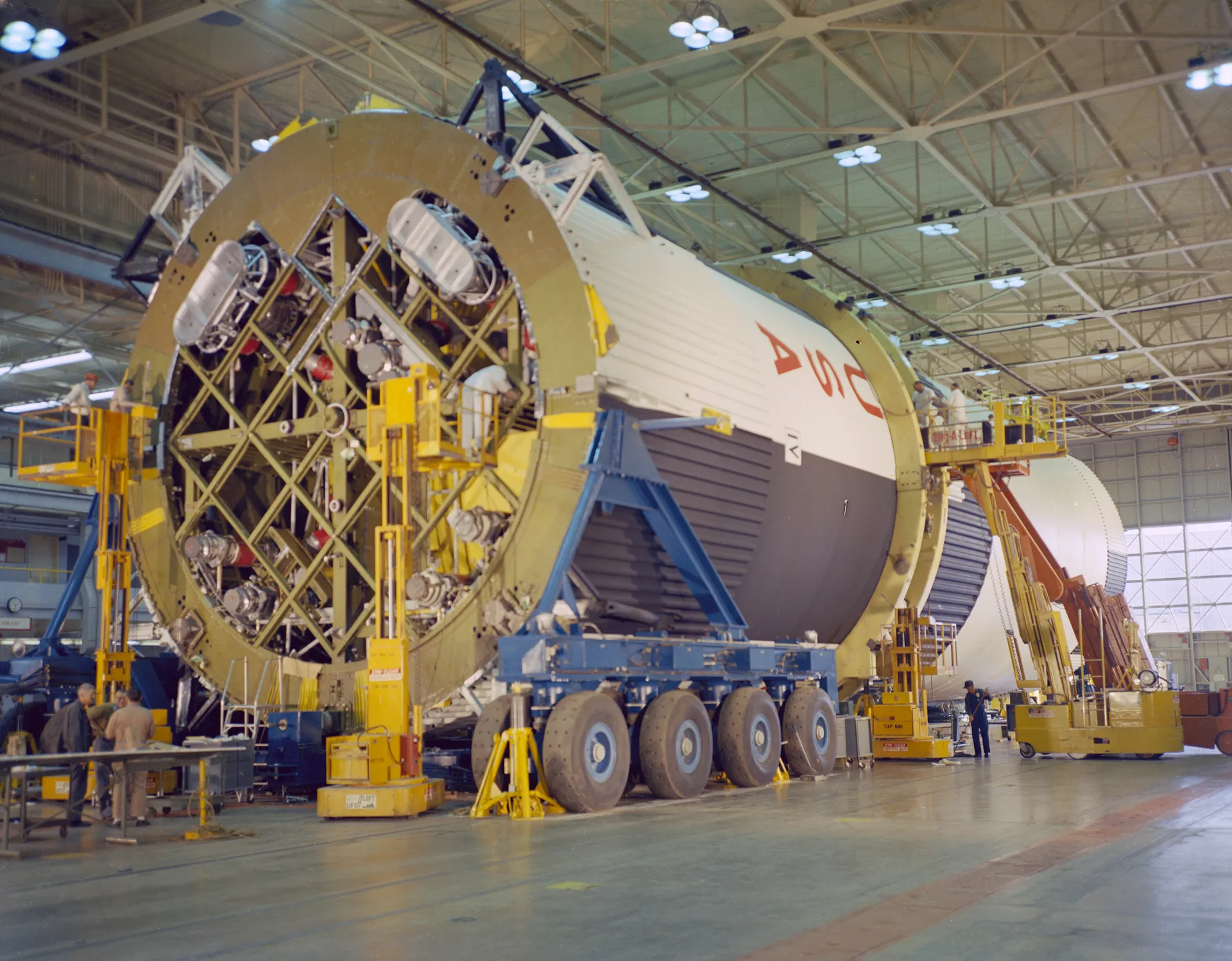
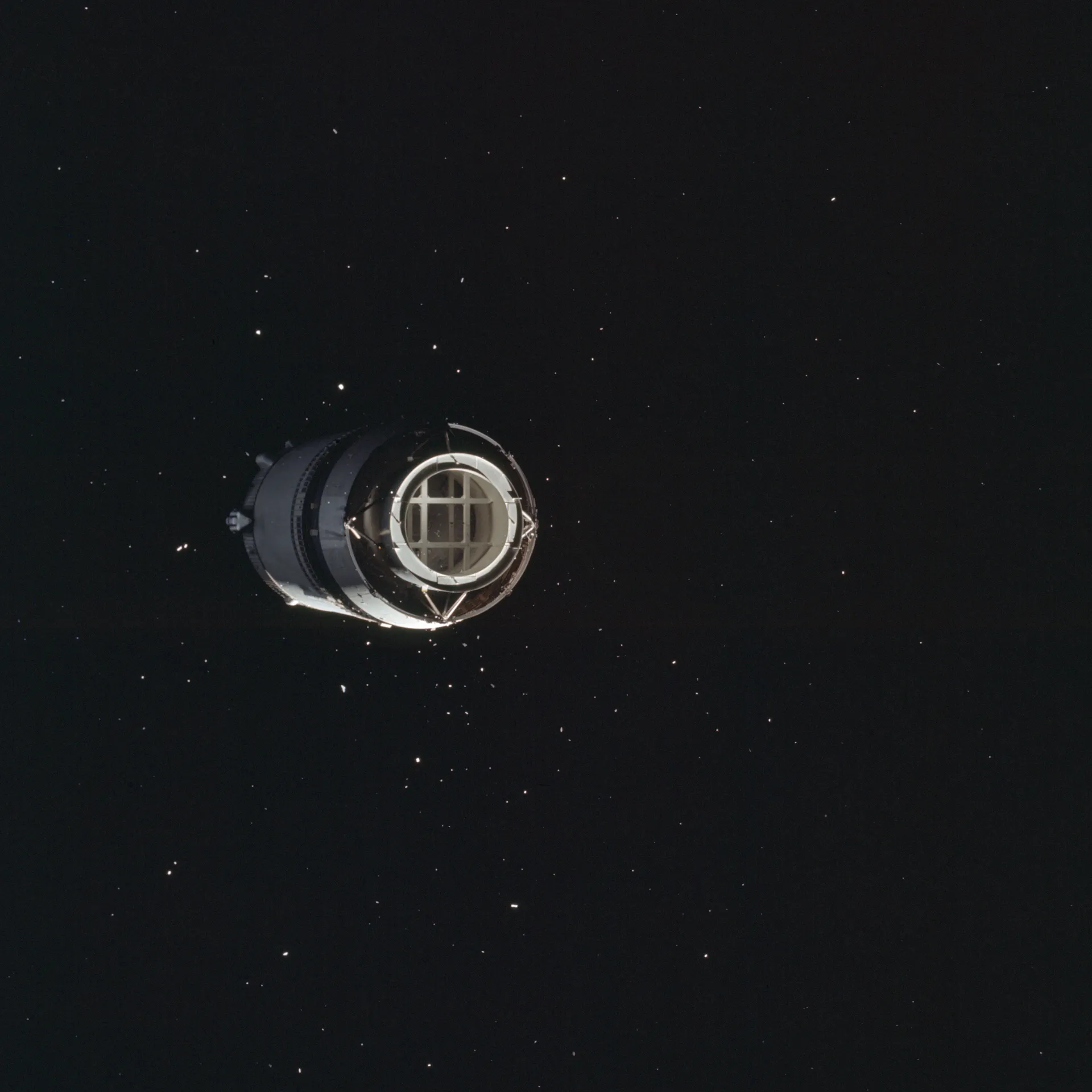
As a rocket burns its propellant, a growing share of what it is carrying is near-empty tanks and structure that were needed only when it was full. To lighten the vehicle enough to reach orbital velocity, most launchers discard part of themselves. This is staging.6
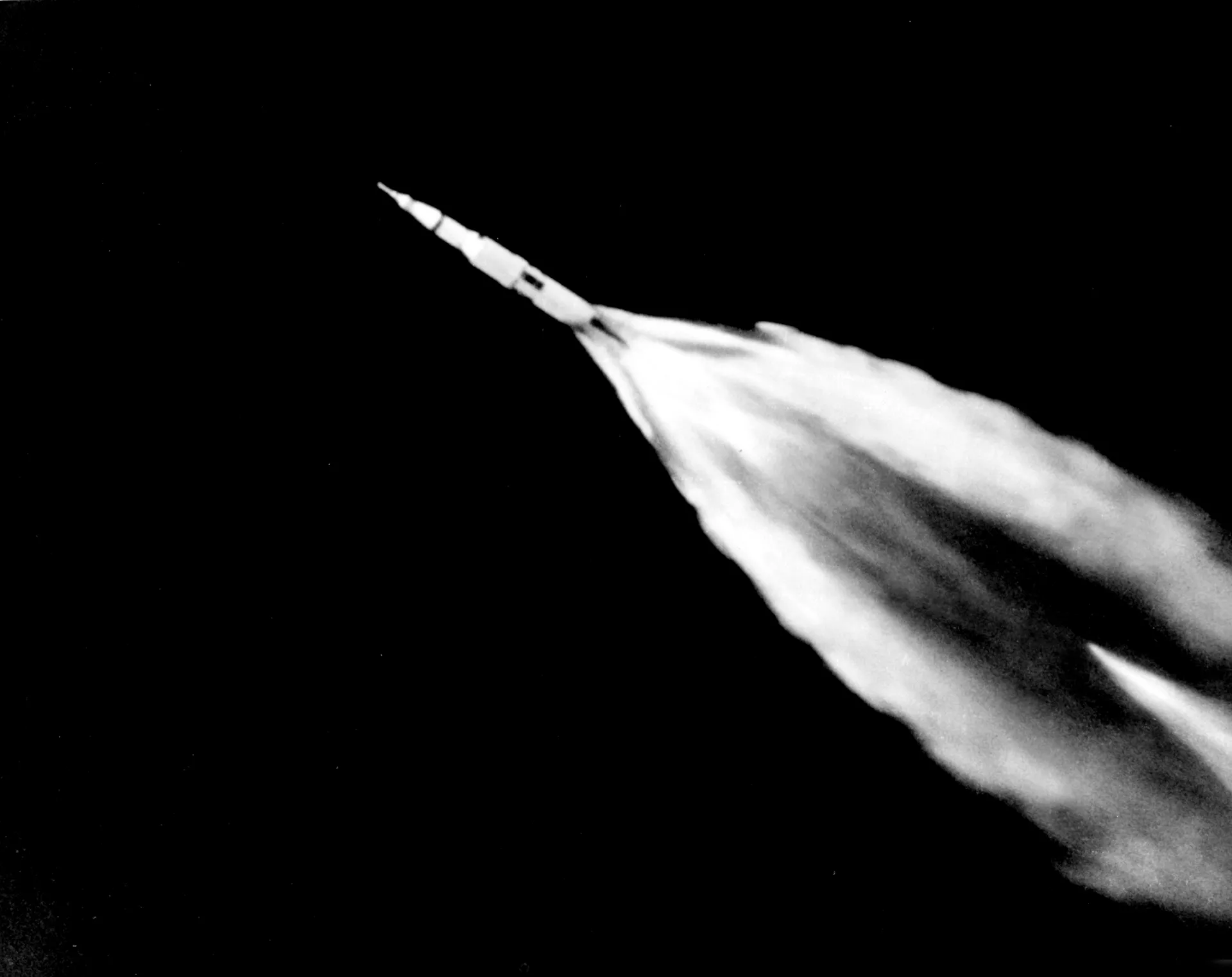
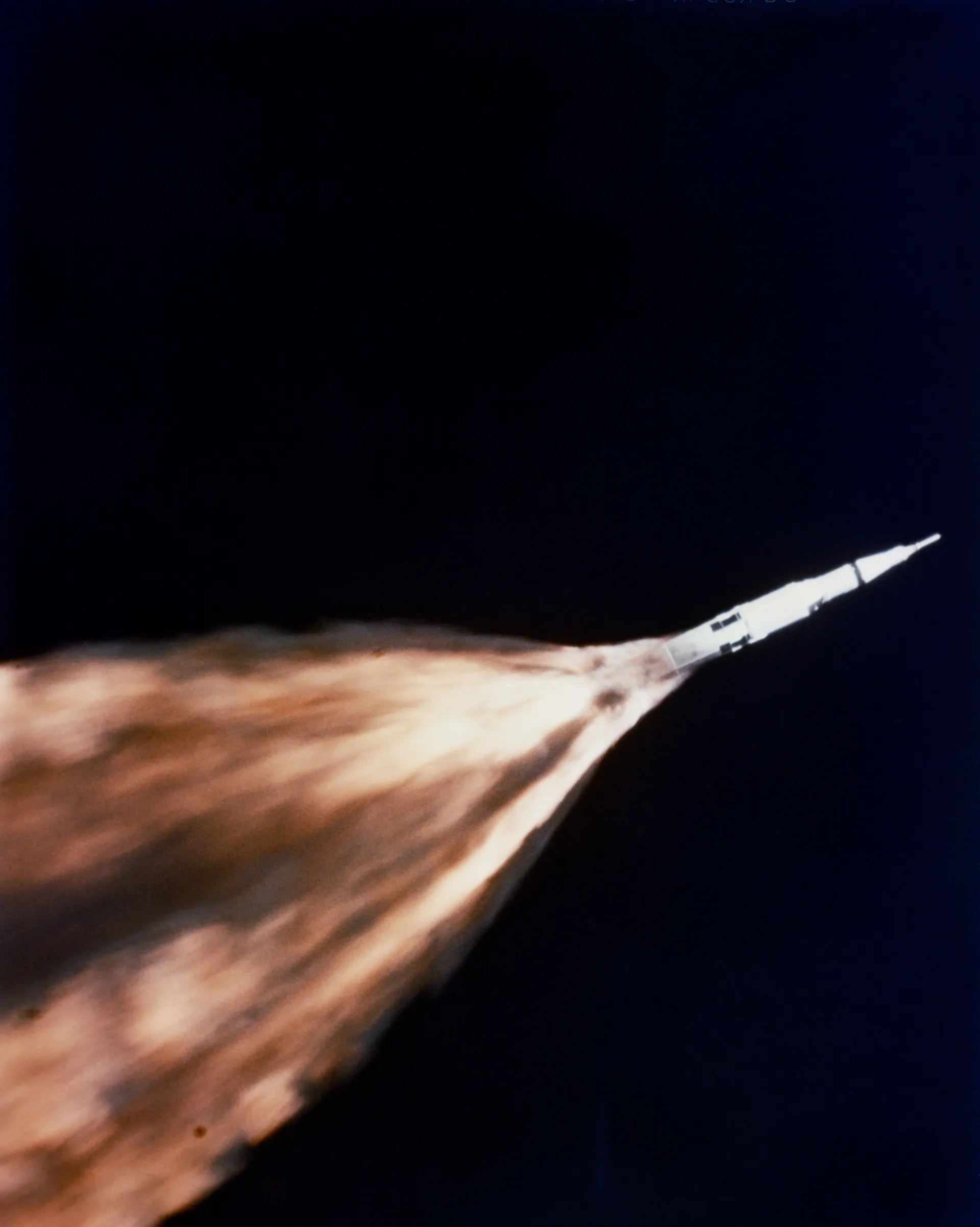
The Saturn V shows why. Its first stage was 138 feet tall and 33 feet in diameter and weighed 305,000 pounds empty; before launch it was filled with 4.5 million pounds of propellant.7 That stage alone had a mass ratio of nearly 16. But it also had to lift the second and third stages and the Apollo spacecraft, so the whole rocket’s ratio was far smaller, and once its tanks were empty the 305,000 pounds of structure was dead weight.
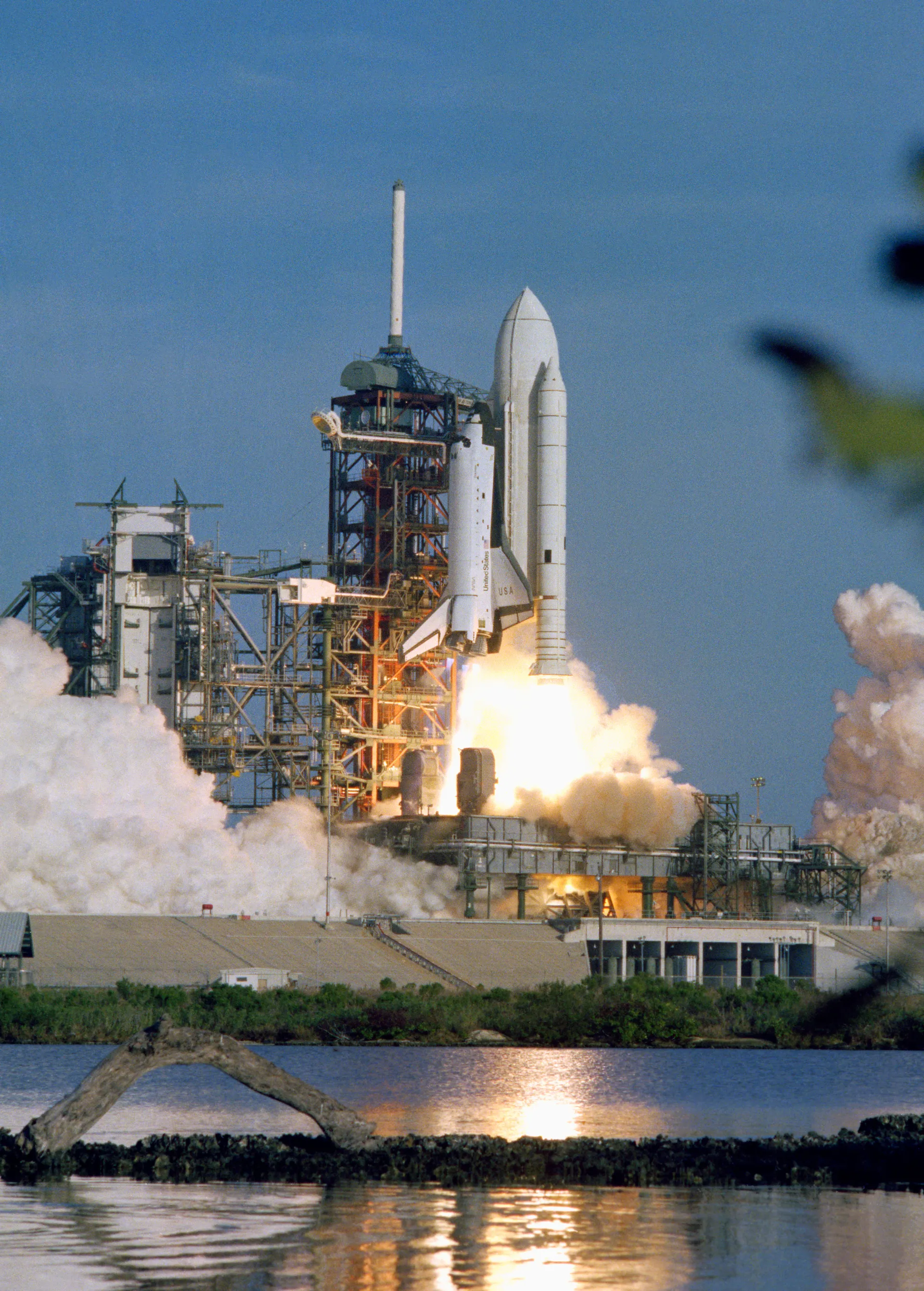
Glenn’s guide describes two ways to stage. In serial staging a smaller second stage sits on top of a larger first stage; when the first stage’s propellant is exhausted, it shuts down, separates, and the second stage ignites. The Saturn V was a three-stage rocket that staged twice on its way to orbit, and its stages were never retrieved. In parallel staging, several first stages are strapped to a central sustainer rocket and all ignite at launch; when the strap-ons burn out they are discarded and the sustainer keeps going. The Space Shuttle staged this way. Some rockets use both.6
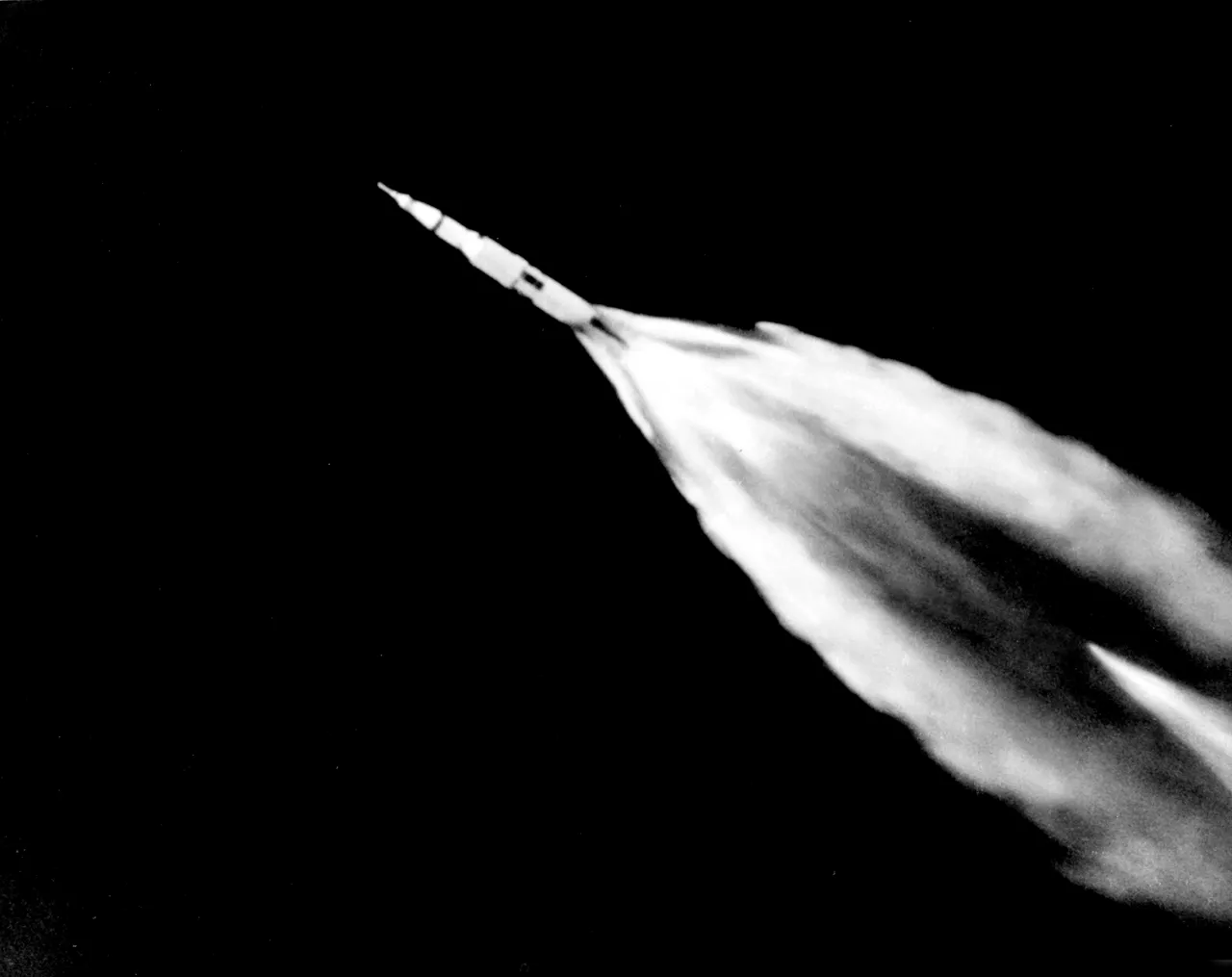
Staging is not free. Each stage needs its own engines and structure, and every separation is an event that has to work. The educator guide calls it one simple but old trick: the large rocket lifts its own mass and the mass of the stages above it, drops off when it is empty, and leaves the smaller stages to finish the job with less dead weight.8
One rocket, two rockets
A two-stage rocket like Falcon 9 is really two rockets stacked. The first stage, with most of the propellant and most of the engines, lifts the whole vehicle, including the second stage, which is itself a full rocket waiting to fire.6
Staging
A few minutes into the climb, the first stage shuts down and is discarded. The lighter upper stage ignites its own engine and keeps accelerating and pitching over toward horizontal flight. At a carefully chosen altitude and speed it cuts off, and the stage and its payload are in orbit.1
Six rockets, six answers to the same equation
Loading the machines
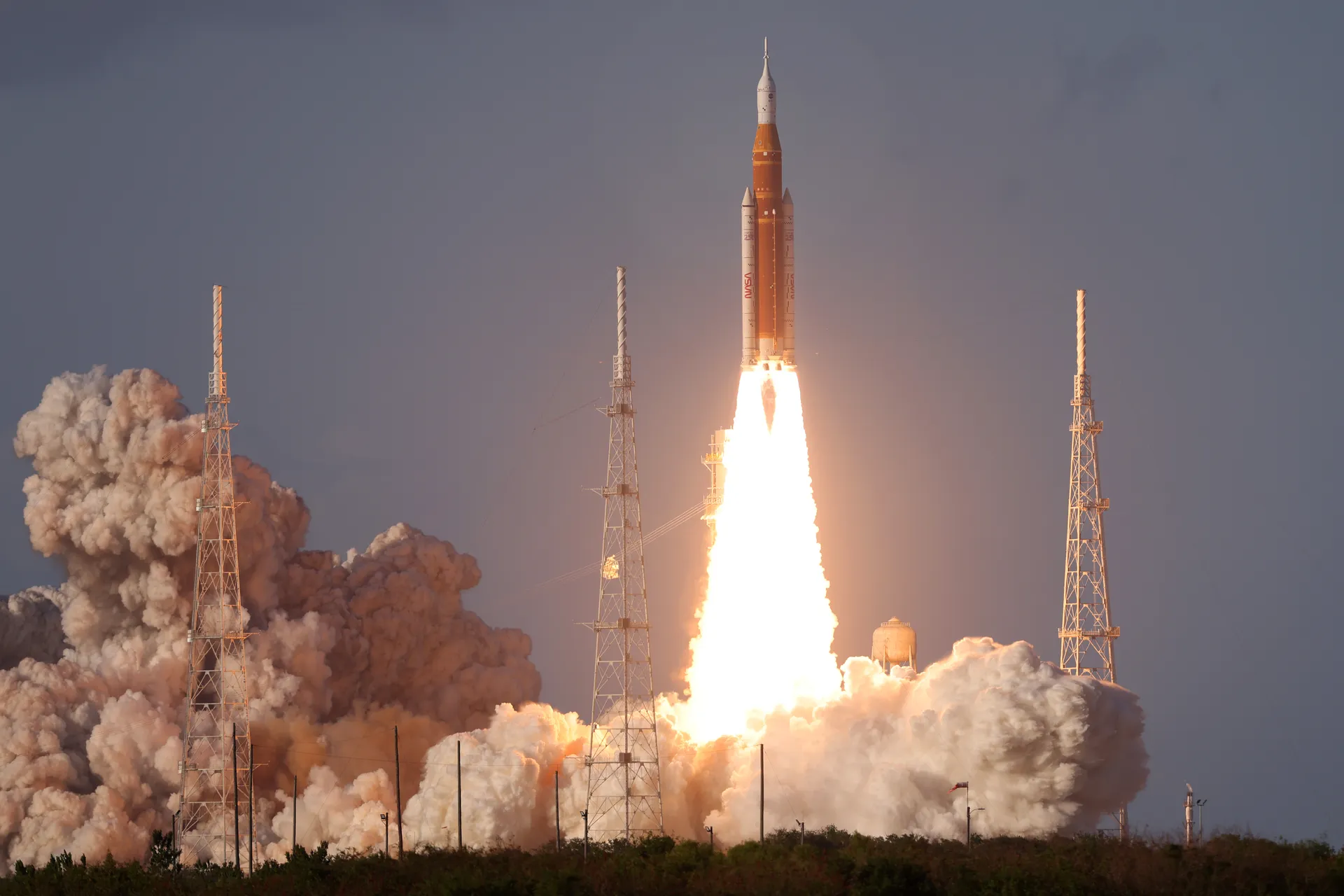
Every rocket in the American fleet is a different answer to the same arithmetic. The Saturn V used three stages in series. SLS combines both kinds of staging: two solid boosters strapped to a core stage, then an upper stage that sends Orion toward the Moon.6,11 Falcon 9 and New Glenn are two-stage rockets whose first stages land to be flown again.12,14 Vulcan straps zero to six solid boosters to a two-engine core, depending on the payload, and finishes with a hydrogen-fueled Centaur upper stage.15 Starship, the largest, is intended to become a fully reusable system, booster and ship alike.13
Hydrogen fuels the upper stages of SLS, Vulcan and New Glenn for the reason Glenn’s numbers suggest: an engine with a higher exhaust velocity, and so a higher specific impulse, gets more speed from every pound of propellant.3,4,11,14,15
Refilling in orbit: splitting one launch into many
NASA’s rocket educator guide notes that a rocket must carry all of its propellants because “there aren’t any filling stations in space—YET!”8 NASA’s plan for landing astronauts on the Moon now depends on building one.
A lander that is to leave Earth orbit, brake into lunar orbit, descend to the surface and climb back needs more velocity change than any single launch can give it with a useful payload. SpaceX’s Starship lander is therefore to be launched into low Earth orbit and filled there. According to NASA’s inspector general, SpaceX will first launch a storage depot and then more than ten Starship tankers, about one every six days, each of which docks with the depot and transfers its propellant; when the depot is full, the lander docks with it, refuels and heads for the Moon.10
The equation does not change; the tankers simply let the lander start its trip with full tanks from orbit instead of from the ground. Whether it works depends on what the equation leaves out: storing extremely cold propellants in space for months, and moving them between two spacecraft without losing too much along the way.10
Sources
The text above is drawn from these 15 sources. Government works are adapted closely; company and press material is summarized. Numbers in the text point here. Last checked October 1, 2026.
Show all 15 sourcesShow fewer
Continue
Related stories
- Space Launch SystemCongress wrote SLS into law in 2010, with Shuttle engines and boosters and a 2016 goal. It first flew in 2022, at an estimated $4.1 billion a launch with Orion, and in 2026 NASA stopped upgrading it.
- StarshipSpaceX built the largest rocket ever flown by launching prototypes and fixing what broke. NASA’s Moon landings depend on the step it has not yet taken: moving propellant between ships.
- New Glenn & VulcanBlue Origin’s BE-4 powers its own New Glenn and United Launch Alliance’s Vulcan. Both entered service in 2024–2025; by mid-2026 neither could fly, for different reasons.