Falcon 9
SpaceX’s workhorse: a two-stage rocket whose first stage lands and flies again.
- Type
- Rocket
- Status
- Flying
- First flight
- June 4, 2010
- Height
- 70 m (230 ft)
- Built by
- SpaceX
- 700+
- Falcon 9 and Falcon Heavy launches since 2010, as of October 1, 2026
- 660+
- Falcon booster landings, as of October 1, 2026
- 110
- Falcon launches in 2026 through September 28
- 37
- flights by one booster, B1067, as of August 25, 2026
From a $278 million NASA cargo agreement to America’s workhorse rocket
Drawn from 16 sources: NASA (8), NASA Office of Inspector General (2), SpaceX (2), U.S. Government Accountability Office and 3 others. About 11 minutes. Checked October 1, 2026.
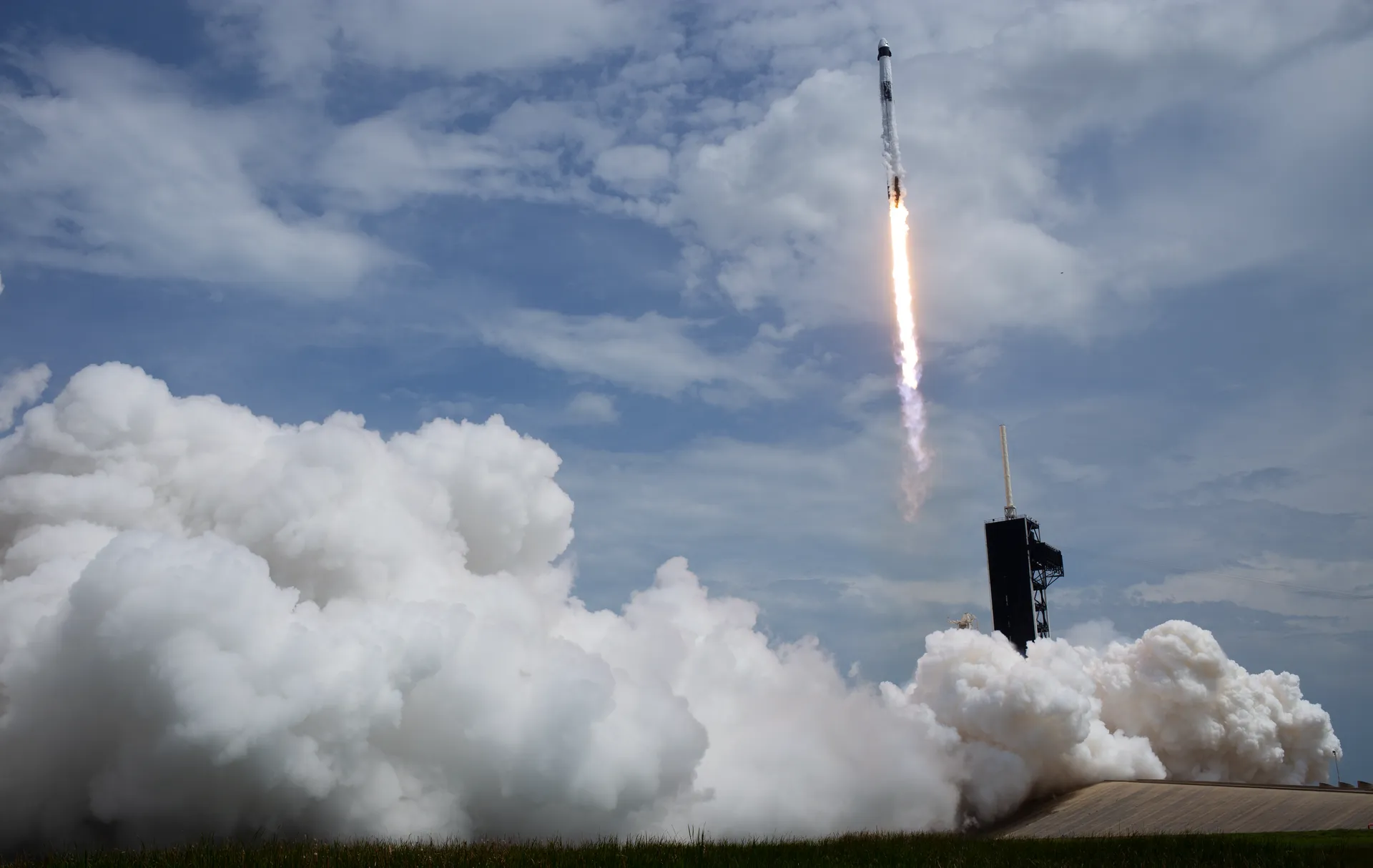
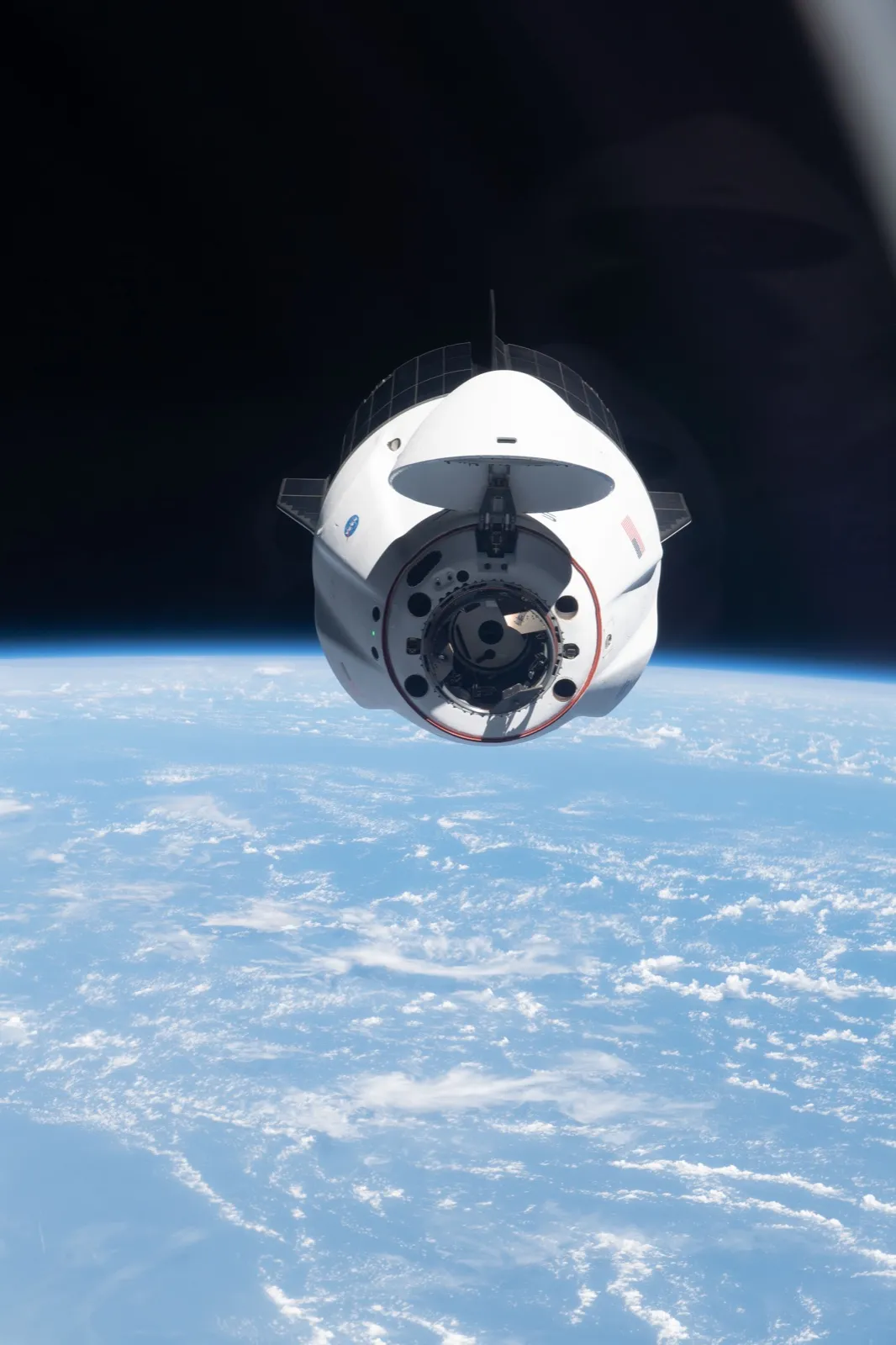
At 11:10 a.m. on October 1, 2026, a Falcon 9 lifted the four members of NASA’s Crew-13 mission from Space Launch Complex 40 at Cape Canaveral. Minutes later its first stage landed back at the Cape, and the Dragon spacecraft was scheduled to dock with the International Space Station that evening, about seven hours and 50 minutes after liftoff, which would be the fastest launch-to-docking by a U.S. spacecraft in the station’s history.8,15 It was SpaceX’s 13th crew rotation flight for NASA, and one of more than 110 Falcon launches that year.8,9
The rocket began as the answer to a narrower problem. In 2006 NASA needed a way to keep the station supplied after the Space Shuttle retired, and it chose to pay small companies for demonstrated milestones rather than design a cargo rocket of its own.1
$500 million for a “side bet” on commercial cargo
At the time of the first COTS award in 2006, officials at NASA Headquarters envisioned that commercial companies would take over low Earth orbit transportation as part of the Vision for Space Exploration, announced in January 2004. That plan put the nation on a path to the Moon and then Mars, with NASA building its own spacecraft in a program called Constellation. Administrator Michael Griffin allocated only $500 million, spread over five years, to the Commercial Orbital Transportation Services program. Members of the program office at Johnson Space Center saw that COTS was somewhat “off the radar” for many policy makers; they understood commercial cargo as a “side bet,” a high-risk contingency pursued as a backup to Constellation and the international partners’ cargo ships.1
The terms were unusual for NASA. Under COTS the commercial partners, not NASA, set their own requirements and were responsible for designing, developing and testing their vehicles. NASA signed funded Space Act Agreements and paid fixed amounts as each agreed milestone was met. In August 2006 it awarded SpaceX an agreement worth $278 million to develop the capability to deliver cargo to and from low Earth orbit. SpaceX had already been working on the Falcon rocket and a concept for the Dragon spacecraft when NASA announced the competition in January 2006, but NASA’s call gave the company an incentive to turn the concept into specific vehicles.1
The agreement had 40 milestones. Three of them were financial: by March 2009 SpaceX had shown it could raise its promised share of the money needed to finish Falcon 9 and Dragon. NASA placed those markers early so that it could leave the agreement before spending much, should the development fail. SpaceX’s president, Gwynne Shotwell, later described her biggest challenge as finding investors and customers before the Falcon vehicles had demonstrated anything: “I was focused on keeping the company alive, keeping people paid while we were struggling and getting through it.”1
One engine on Kwajalein, then nine at Cape Canaveral
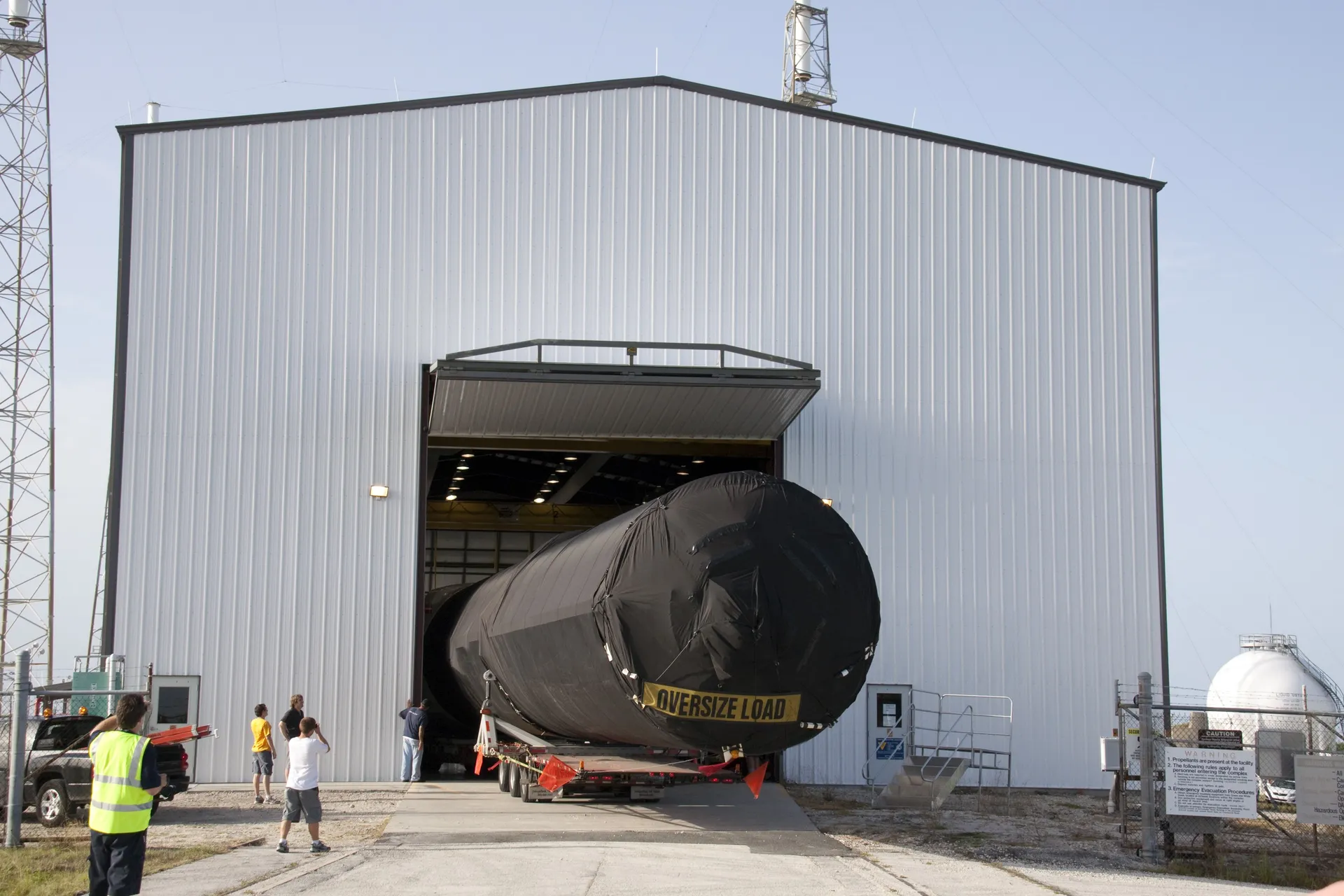
When NASA signed the agreement, SpaceX was still developing Falcon 1, a two-stage rocket burning liquid oxygen and kerosene, 70 feet long and powered by a single Merlin engine. After three failed attempts to reach orbit, Falcon 1 succeeded for the first time on September 28, 2008, from Kwajalein in the Marshall Islands. Hans Koenigsmann, who had been SpaceX’s vice president of guidance and control, called the first failure “heartbreaking”: “We learned a lot of things we did wrong, and learning sometimes hurts.”1
SpaceX had planned a Falcon 5 as the next step. Because of NASA’s station cargo needs, it went instead to Falcon 9, with nine Merlin engines. The first one flew on June 4, 2010, from Space Launch Complex 40 at Cape Canaveral: 227 feet tall, carrying a boilerplate Dragon. SpaceX had moved its launch operations from the Pacific to Florida, both to cut the cost of shipping people and hardware to Kwajalein and to be close to its NASA customer.1
NASA’s project executive for SpaceX, Mike Horkachuck, noticed a different engineering habit. Traditional NASA development designed a vehicle to optimal performance before assembly and testing; SpaceX built extra margin and “robustness” into its first design and optimized it after tests had measured how it actually performed. The company tested every Merlin engine at its McGregor, Texas, site as close to flight conditions as it could, bought time in NASA facilities such as Marshall’s wind tunnels under reimbursable agreements, and moved more and more manufacturing in-house at its factory in Hawthorne, California.1
Two and a half years late, and NASA kept paying for progress
SpaceX’s original schedule proposed finishing every milestone by September 2009. Once the work moved from paper reviews to hardware, it slipped, by a cumulative two and a half years. Article 17B of the agreement allowed termination for failure to perform, and SpaceX feared NASA would use it. The program office decided that as long as SpaceX was making technical progress and had a sound plan, there was no reason to end the partnership. Its manager, Alan Lindenmoyer, observed that “the average time to field a new launch vehicle is at least 27 months longer than initially projected,” almost exactly the delay SpaceX experienced. In fiscal year 2011 Congress added $300 million to the program, and SpaceX received $118 million of it for 18 more milestones aimed at risk reduction, among them thermal-vacuum and electromagnetic-interference tests that had been cut from the original agreement for lack of money.1
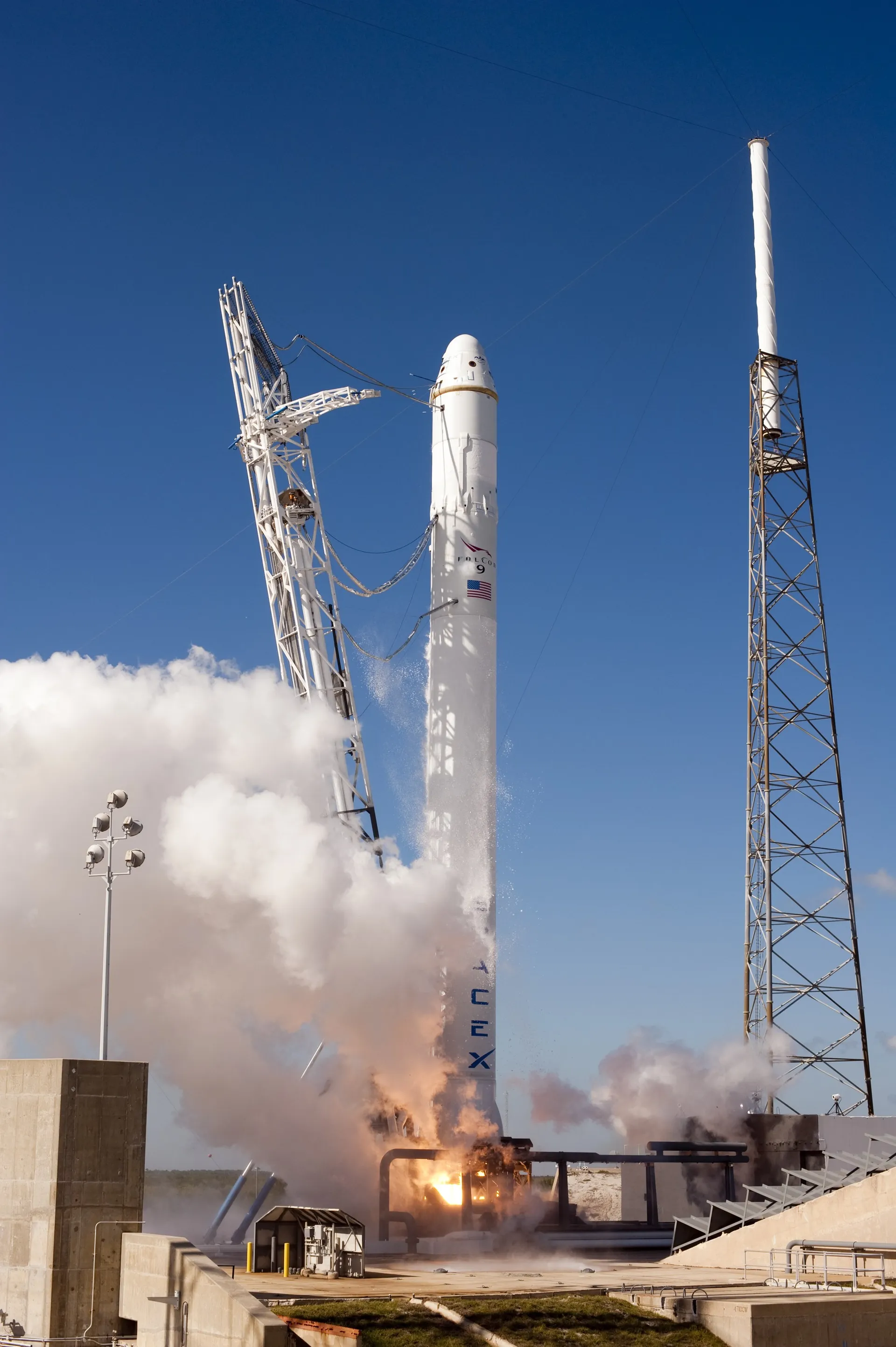
On its second flight, December 8, 2010, Falcon 9 carried the first Dragon spacecraft to orbit for the C1 demonstration. Dragon flew two orbits, reentered, splashed down and was recovered, making SpaceX the first commercial company in U.S. history to return a spacecraft from Earth orbit. NASA deployed the radar it had used to watch for falling foam during Shuttle launches, and the Shuttle’s solid-rocket-booster retrieval ships, to observe the reentry.1
In 2010 SpaceX proposed combining the last two demonstrations, a flyby of the station and a berthing, into one flight. NASA at first saw an attempt to cut cost at an unacceptable risk, then agreed in the summer of 2011 on condition that Dragon stay in orbit longer and complete the flyby checks first.1
The combined C2+ mission launched on May 22, 2012. Just before the final approach, Dragon’s thermal imagers picked up a reflection from the Japanese Experiment Module and disagreed with its laser rangefinder. Engineers in Hawthorne narrowed the rangefinder’s field of view, uploaded the change, and NASA gave the final “go.” Expedition 31 astronaut Don Pettit grappled Dragon with the station’s robotic arm on May 25. After delivering 1,014 pounds of cargo, Dragon splashed down in the Pacific on May 31, completing the agreement.1
- $396M
- NASA’s COTS payments to SpaceX, 2006–20121
- $454M
- SpaceX’s own share of the same development1
- ≈$400M
- Cost to develop and demonstrate Falcon 9; NASA’s cost model had estimated up to about $4 billion1
NASA’s history counts the bill this way: the program paid SpaceX $396 million, the original $278 million plus $118 million in augmentation, while the company financed about $454 million. NASA’s own cost model, which assumed NASA’s methods and culture, had put the cost of developing a Falcon 9 between $443 million and about $4 billion. The final cost of developing and demonstrating it was about $400 million.1
A $1.6 billion cargo contract signed before the rocket had flown
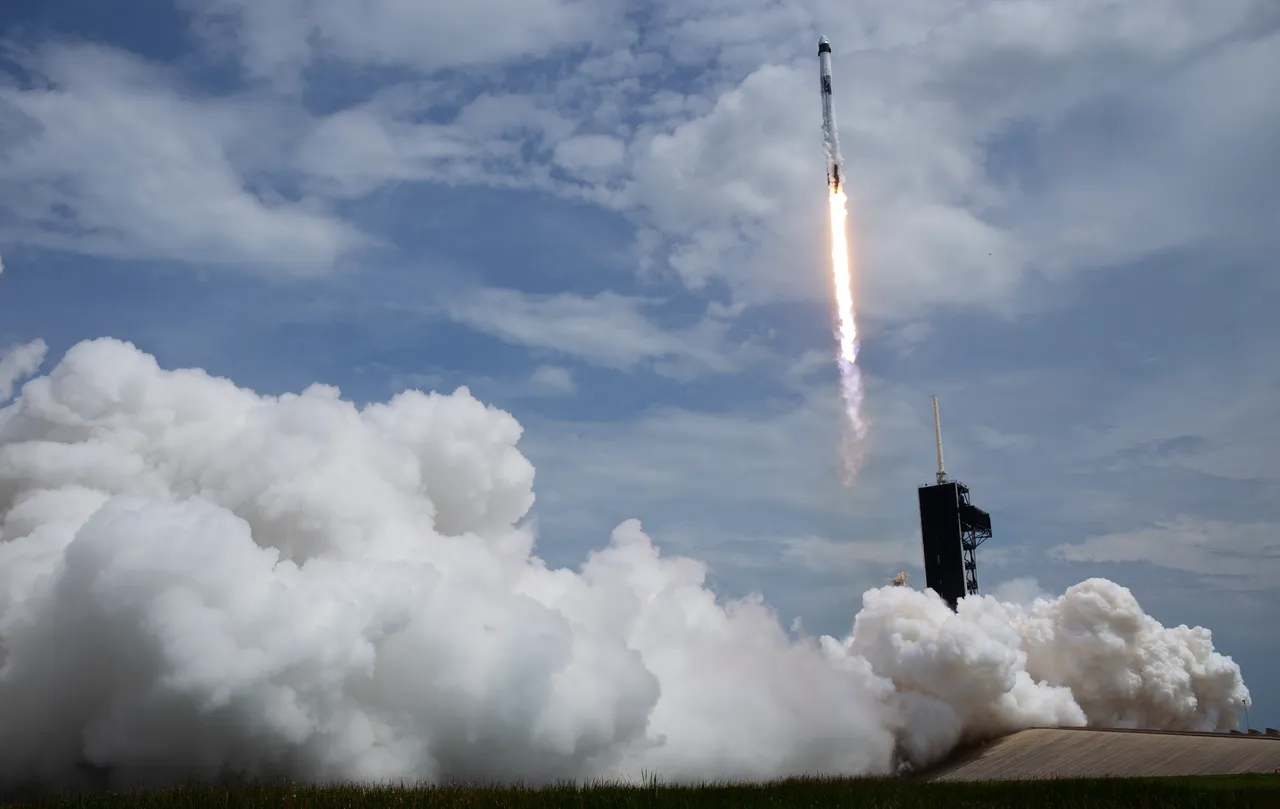
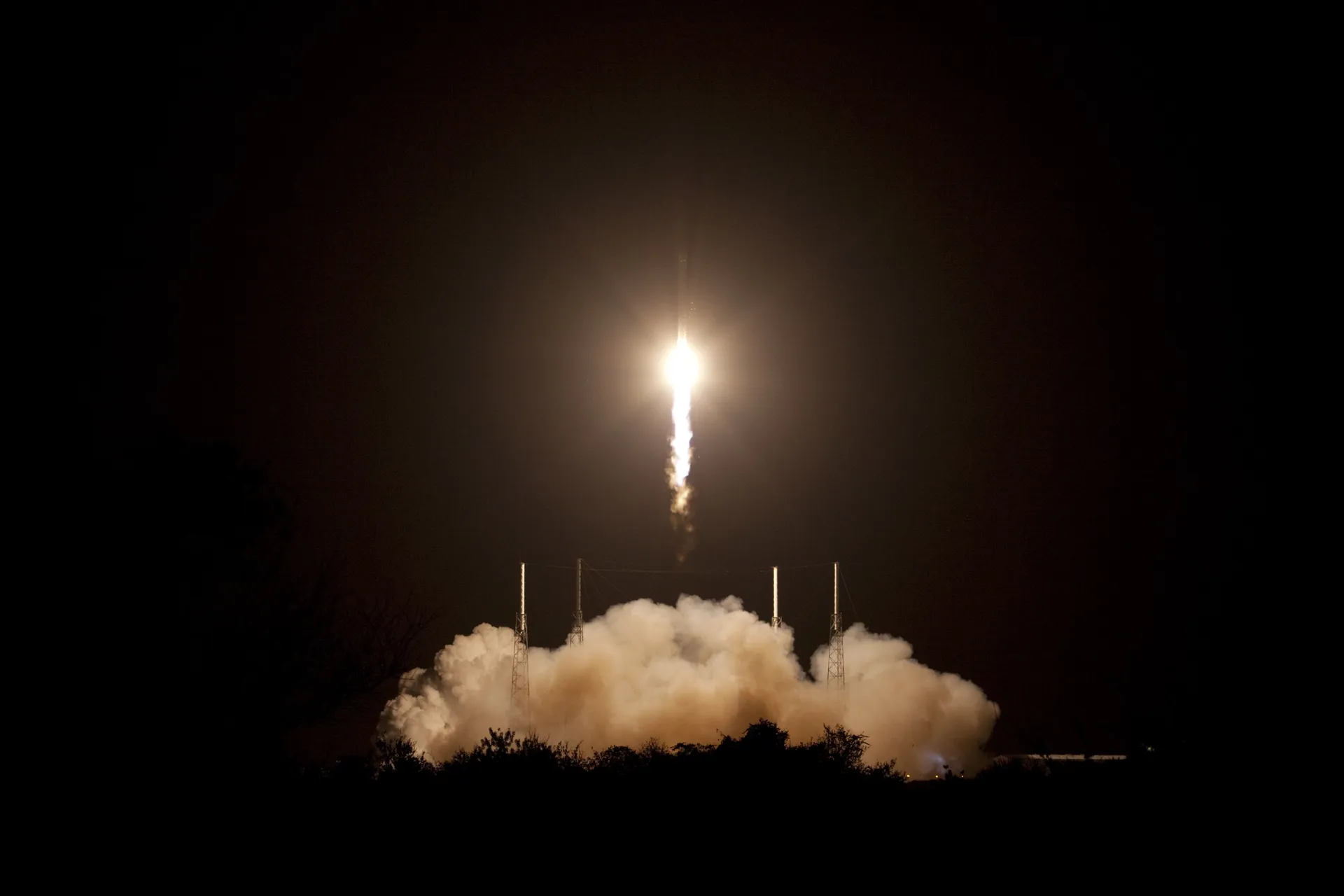
The first contracted cargo flight, CRS-1, lifts off at 8:35 p.m. on October 7, 2012.
NASA did not wait for the demonstrations to finish. It issued a request for proposals for Commercial Resupply Services on April 14, 2008, and awarded the contracts on December 23, 2008, only a few months after Falcon 1’s first successful flight. Bill Gerstenmaier, who led NASA’s Space Operations Mission Directorate, explained the timing: “We absolutely needed this service; we were destined to retire the Shuttle.” Unlike COTS, this was a procurement under the Federal Acquisition Regulations: NASA was buying a definite service. SpaceX received $1.6 billion for 12 cargo flights with Dragon, and Orbital Sciences $1.9 billion for eight.1
By the spring of 2011 NASA was telling Congress that it was “depending on our commercial cargo partners.” In the words of NASA’s history, the providers had become “too important to fail.” Through the first round of contracts NASA eventually awarded 31 cargo missions to the two companies, worth $5.9 billion, an average of $191.3 million a mission.1,3
On June 28, 2015, SpaceX launched its seventh contracted cargo mission, CRS-7, with 4,303 pounds of cargo. About 139 seconds into flight, something failed inside the upper stage’s liquid oxygen tank and the vehicle broke apart. The first stage and all nine engines had worked normally. NASA’s independent review team found it credible that a cast steel rod end in a strut holding a helium bottle broke under ascent loads; the bottle, buoyant in the dense liquid oxygen, shot upward and ruptured the helium plumbing. The team’s key technical finding was a design error: SpaceX had used an industrial-grade part in a critical load path under cryogenic conditions without adequate screening or testing, and without the 4-to-1 safety factor its manufacturer recommended. Before CRS-7, the team noted, Falcon 9 had flown six consecutive successful station missions.2
Bringing the first stage back
On December 21, 2015, six months after the CRS-7 loss, a Falcon 9 first stage flew back to Cape Canaveral and landed upright at Landing Zone 1, the first time the booster of an orbital rocket had done so.16 The landing grew out of the same Falcon lineage NASA’s history traces back to Falcon 1, by way of a low-altitude vertical-landing test vehicle called Grasshopper.1 Recovery changed what a launch contract could include. When NASA’s inspector general reviewed the next round of cargo contracts in 2018, one of its recommendations was that NASA negotiate the discounts the contracts required whenever a company used “a previously flown vehicle.”3
NASA/Kim Shiflett
Two stages, one propellant
Falcon 9 has two stages. Both burn liquid oxygen and rocket-grade kerosene in SpaceX’s Merlin engines, nine on the first stage and one, with a much larger nozzle for the vacuum of space, on the second. The payload, a Dragon spacecraft or satellites under a fairing, rides on top.1,11
Staging
When the first stage’s main engines cut off, it separates. NASA’s launch commentary describes the moment: the nine Merlins “have finished their burn, and the first stage has separated from the rocket. As the second stage continues carrying Dragon on its flight,” the first stage turns back toward a landing.13
The way back
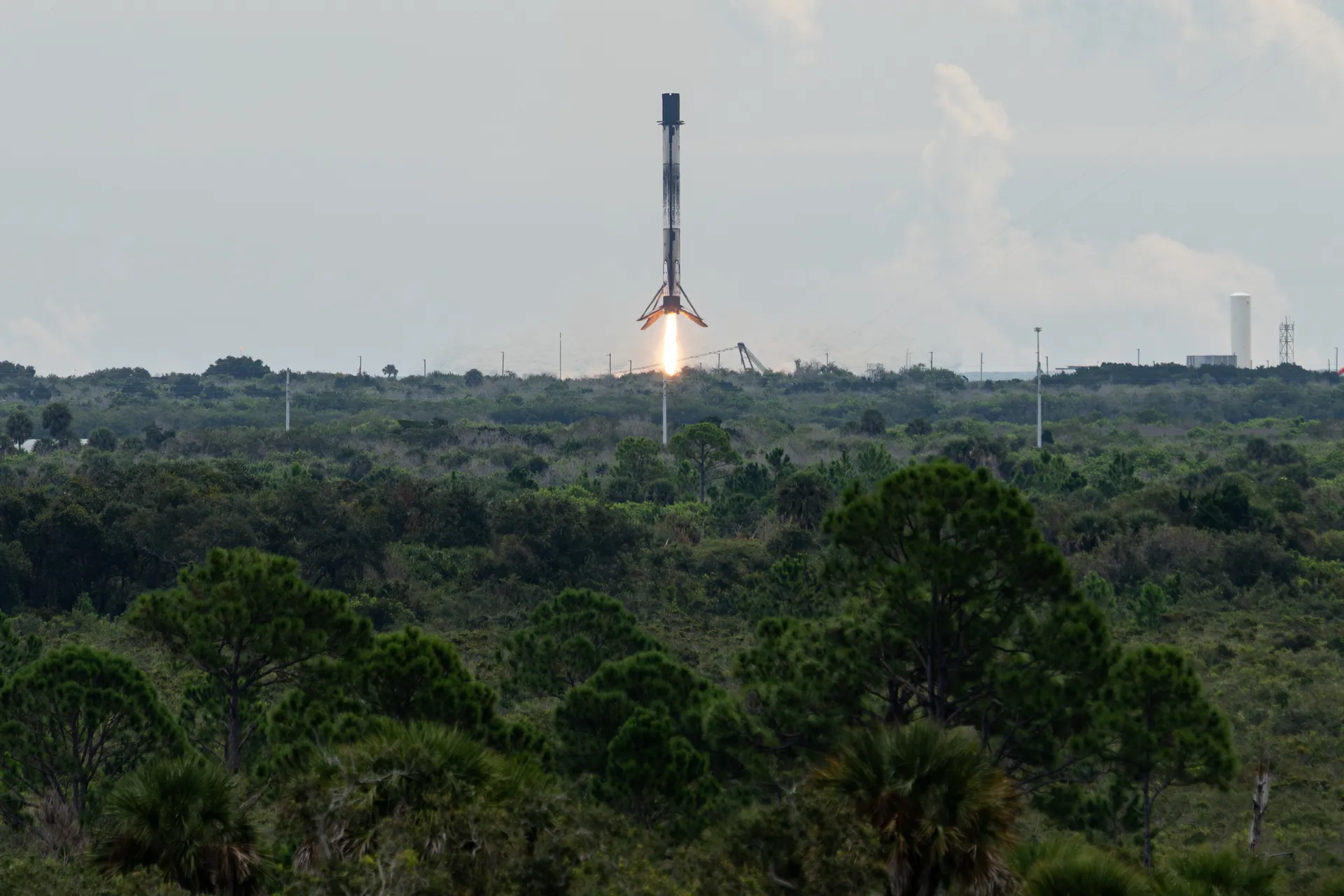
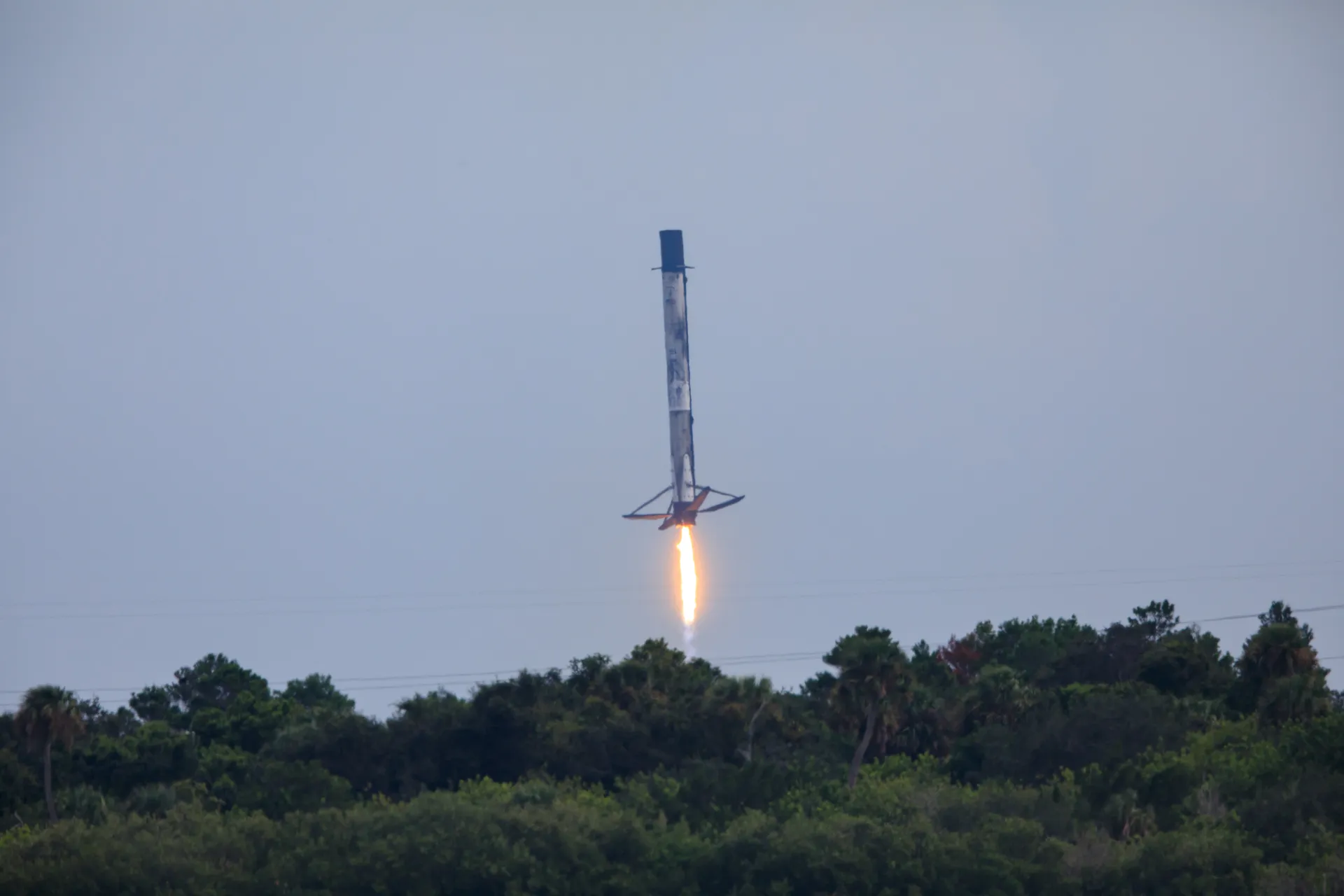
The returning stage relights some of its engines to steer and slow itself, steers with four grid fins near its top, and unfolds four landing legs for the last seconds. It lands either on a pad near the launch site or on an autonomous ship hundreds of miles downrange, depending on how much propellant the mission leaves it.11,13
Landing Zone 1, September 28, 2024
The first stage that launched NASA’s Crew-9 mission comes down at Landing Zone 1 minutes after liftoff.
NASA flew astronauts on reused hardware for the first time in April 2021. The Crew-2 mission launched on a Falcon 9 booster that had launched Crew-1 the previous November, inside the Dragon capsule that had flown the Demo-2 test flight the year before.10 By August 2026 one booster, B1067, had flown 37 times.12
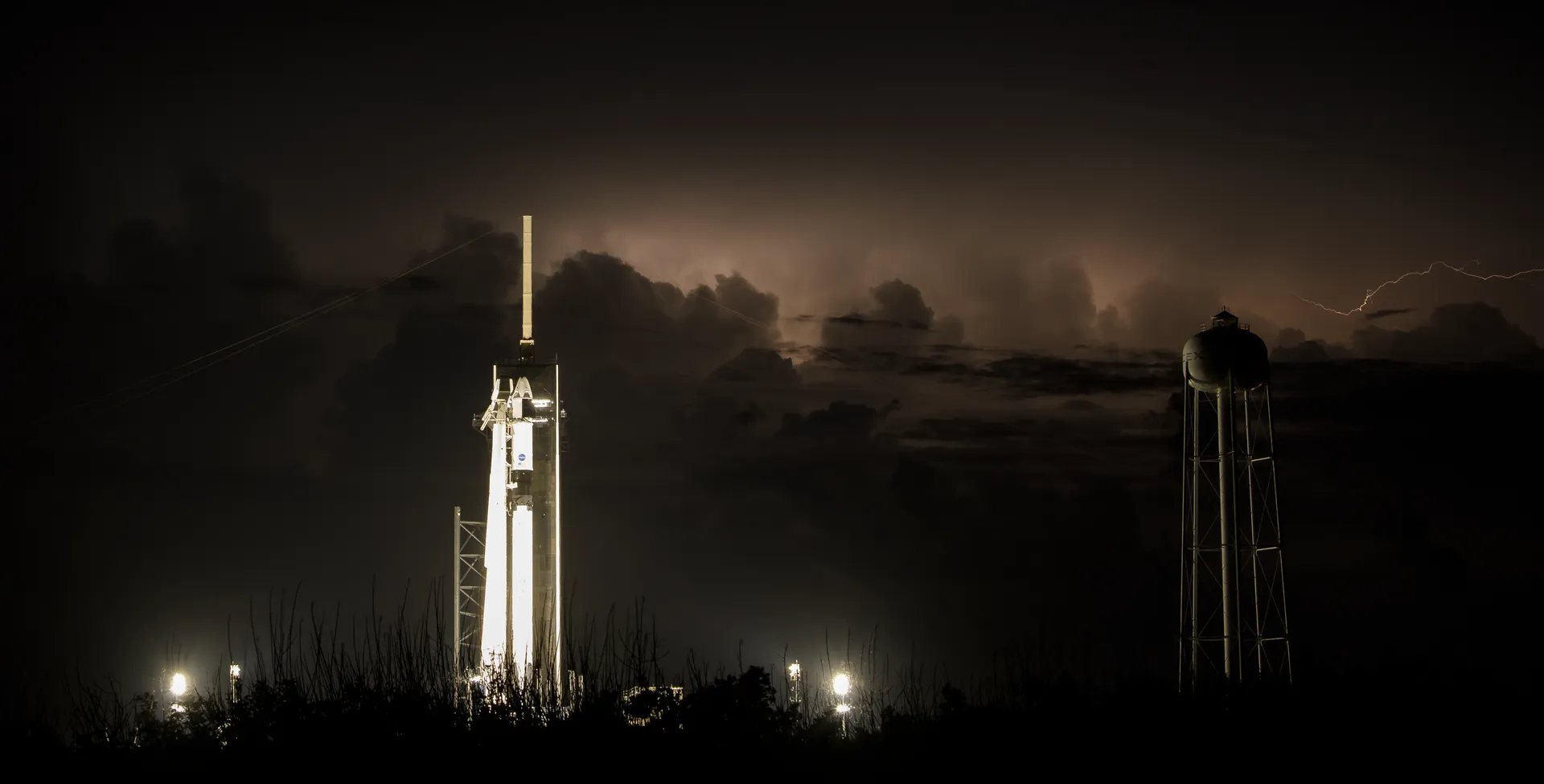
Block 5 and the bar for carrying astronauts
Falcon 9 and Crew Dragon on Launch Complex 39A the night before the Demo-2 launch attempt, May 29, 2020.
NASA chose SpaceX and Boeing to build crew transportation systems in 2014, with fixed-price contracts worth $2.6 billion and $4.2 billion. Under these contracts the companies own the vehicles and NASA buys transportation; before astronauts can fly operational missions, NASA has to certify that a provider’s whole system meets its requirements.6,7
For SpaceX, the rocket that would carry crews was Falcon 9 Block 5, the last major version, which first flew in May 2018.9 The Government Accountability Office listed the program’s top risks for SpaceX in July 2018, and most were in the rocket. Block 5 included a redesigned composite overwrapped pressure vessel, a high-pressure helium bottle, because the older design had been involved in the anomaly that destroyed a Falcon 9 on its pad in September 2016.4,9 It included design changes to stop cracks found in the Merlin’s turbine during development testing, cracks NASA officials had told SpaceX were an unacceptable risk for human spaceflight. And SpaceX planned to load the rocket’s propellant after the astronauts were aboard, which the program and a NASA advisory group had raised as a potential safety risk. SpaceX argued that fueling last reduced the time the crew spent next to a rocket being filled. NASA and SpaceX agreed to demonstrate the loading process five times, in the final crew configuration, before the first crewed flight.4
Bob Behnken and Doug Hurley launched on the Demo-2 test flight on May 30, 2020, from Launch Complex 39A, controlled from the Kennedy firing room that had once run Space Shuttle launches. Hurley had piloted the last Shuttle mission, in July 2011; Demo-2 was the first time NASA astronauts had launched from American soil in a commercially built and operated spacecraft.14 On November 10, 2020, NASA signed the human-rating certification for SpaceX’s crew transportation system: Crew Dragon, the Falcon 9 rocket and their ground systems, the first new crew spacecraft certified for regular flights since the Space Shuttle.5
Boeing’s Starliner, which launches on an Atlas V, has not been certified. NASA’s inspector general reported in June 2026 that SpaceX had completed 12 crewed missions for NASA under the program, that Starliner will likely not be certified until 2027 at the earliest, and that NASA had already spent an extra $17 million to move up SpaceX flights originally planned for Starliner. On September 18, 2026, NASA bought three more SpaceX missions, Crew-15 through Crew-17, for $946 million, bringing SpaceX’s crew contract to $5.92 billion for 17 missions, with the last readiness dates in 2028.6,7
From two launches a year to one every two days
Falcon launches per year9
Show the numbers
| year | Falcon 9 and Falcon Heavy launches |
|---|---|
| 2010 | 2 |
| 2011 | 0 |
| 2012 | 2 |
| 2013 | 3 |
| 2014 | 6 |
| 2015 | 7 |
| 2016 | 8 |
| 2017 | 18 |
| 2018 | 21 |
| 2019 | 13 |
| 2020 | 25 |
| 2021 | 31 |
| 2022 | 61 |
| 2023 | 96 |
| 2024 | 134 |
| 2025 | 165 |
| 2026 | 110 |
In its first five years Falcon 9 flew a handful of times a year. In 2025 it flew 165 times, about half of all orbital launch attempts in the world that year. Most of that growth is SpaceX’s own business: 122 of the 165 flights carried Starlink satellites. Since CRS-7, one Falcon 9 has failed in flight, a Starlink launch in July 2024 whose upper stage did not reach its intended orbit.9
NASA uses the same fleet for science. A Falcon Heavy, three Falcon 9 first stages strapped together, launched Europa Clipper in October 2024 and the Nancy Grace Roman Space Telescope on August 30, 2026.9
When NASA’s history was written in 2014, it described the commercial cargo providers of 2011 as “too important to fail,” because the agency had no other American way to supply the station. Twelve years later the phrase fits the rocket more broadly. With Starliner not yet certified, Falcon 9 is the only American rocket that carries NASA astronauts, and NASA has bought crew flights on it into 2028.1,6,7
Sources
The text above is drawn from these 16 sources. Government works are adapted closely; company and press material is summarized. Numbers in the text point here. Last checked October 1, 2026.
Show all 16 sourcesShow fewer
Continue
Related stories
- Commercial crewHow NASA stopped owning its crew vehicles and started buying rides, why SpaceX’s Dragon has flown every rotation since 2020, and what still stands between Boeing’s Starliner and its first crew.
- ISSHow five space agencies assembled the largest structure ever flown, what it has cost the United States, why its oldest Russian tunnel leaks, and how NASA plans to bring it down after 2030.
- How rockets reach orbitOrbit means moving sideways at about 17,500 mph. The rocket equation explains why that speed costs so much propellant, why rockets drop stages, and why a Moon lander must be refilled in orbit.