Gateway: a station for lunar orbit, paused while its first modules were being built
A small international station that was to circle the Moon once a week. Its power module was nearly built when NASA paused it in March 2026; the hardware is being turned to a nuclear Mars spacecraft and Moon Base tests.
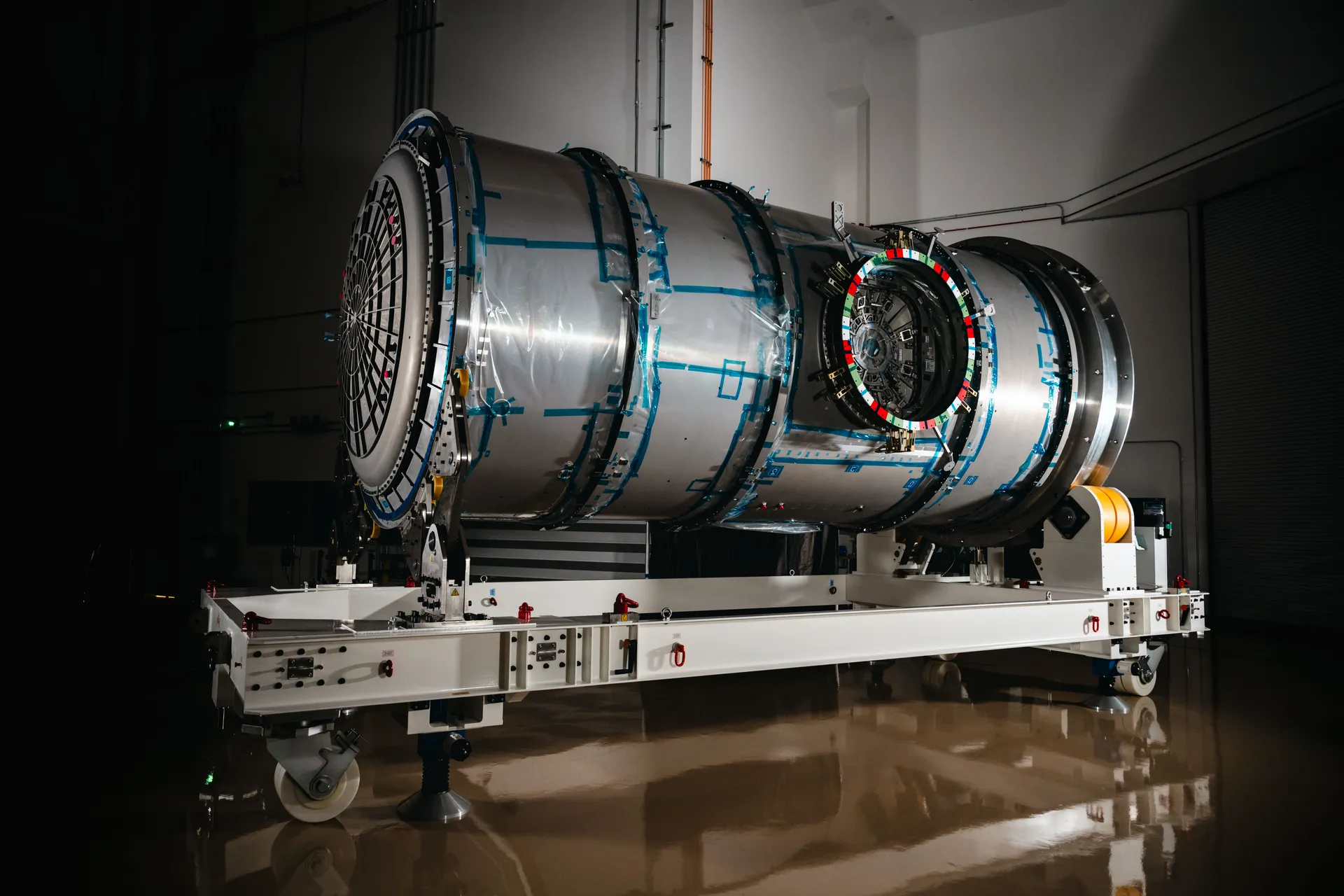
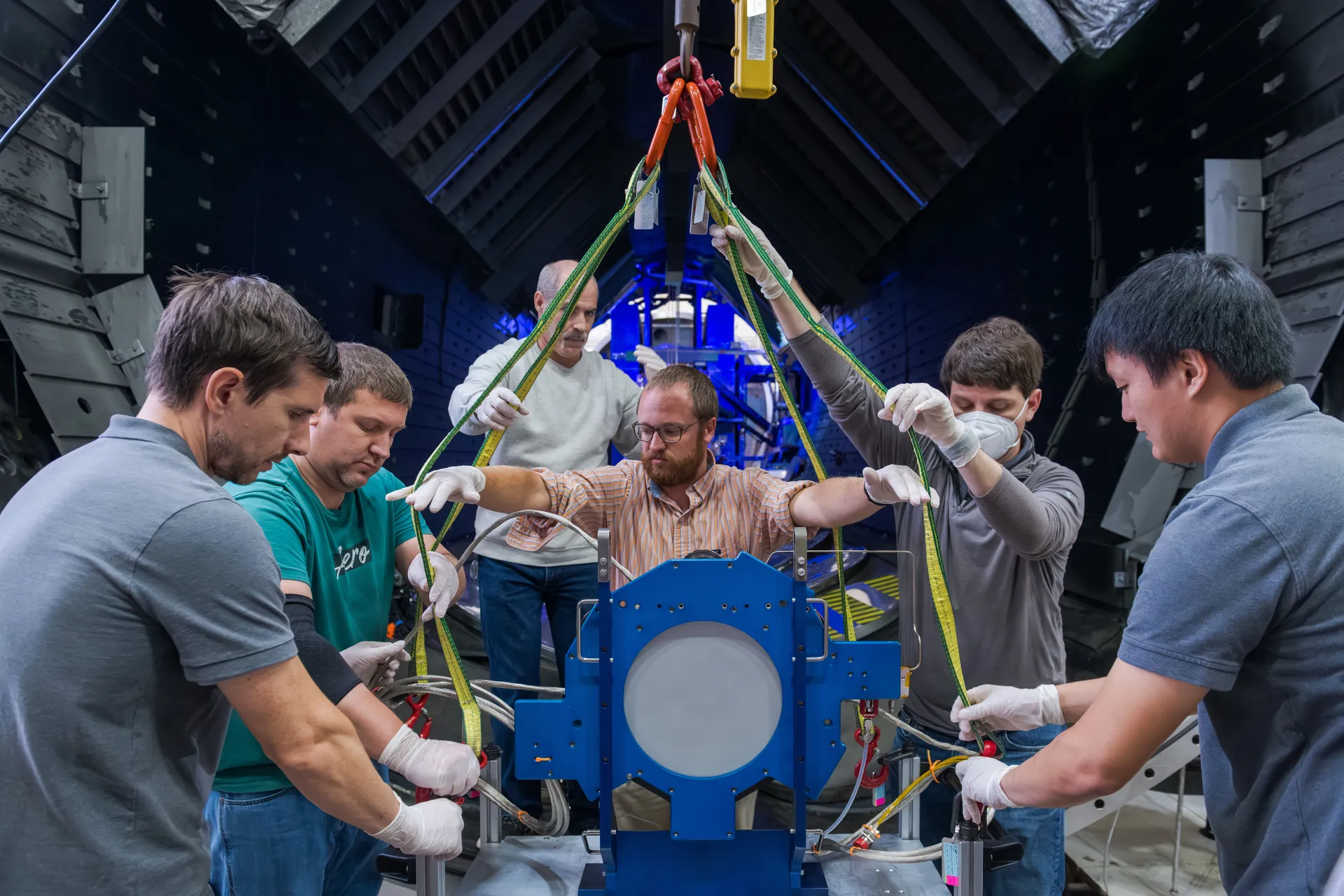
NASA/Josh Valcarcel
Drawn from 22 sources: NASA (12), Spaceflight Now (2), SpacePolicyOnline (2), NASA Office of Inspector General and 5 others. About 8 minutes. Checked October 1, 2026.
Gateway was to be humanity’s first space station around the Moon: a small, NASA-led outpost, built with Europe, Japan, Canada and the United Arab Emirates, where astronauts would live and work in lunar orbit, transfer between Orion and their landers, and test what a sustained presence in deep space requires.1 By early 2026 the power and propulsion module was about 90% assembled, and the living-quarters module was being outfitted in Arizona.10,1
On March 24, 2026, NASA said it intends to pause Gateway “in its current form” and shift its focus to infrastructure that enables sustained operations on the lunar surface, repurposing applicable equipment and using its partners’ commitments toward a Moon Base.11 Administrator Jared Isaacman said the decision did not preclude revisiting an orbital outpost in the future.12 By October 2026, NASA had stopped most work on the living module, and the power and propulsion module had been reassigned to a nuclear-powered spacecraft bound for Mars.10,15
A station for a seven-day orbit around the Moon
Gateway was designed to last at least 15 years as a small, human-tended station, about one-sixth the size of the International Space Station, with astronauts visiting rather than living aboard continuously. NASA planned it as a research platform, a staging point for human and robotic exploration in deep space, and a test bed for technologies needed at Mars.1,2,5,10 Between visits it had to run itself: software called the Vehicle System Manager was to plan activities, manage resources, control the station and handle faults autonomously.1
Its orbit was chosen with care. A spacecraft in low lunar orbit circles close to the surface every two hours; reaching the ground from there is simple, but because of the Moon’s gravity it takes more propellant to maintain the orbit. A distant retrograde orbit is large, stable and circles the Moon every two weeks, but makes it harder to get to the surface. Gateway’s near-rectilinear halo orbit, hanging almost like a necklace from the Moon, takes a week and is balanced between Earth’s and the Moon’s gravity. It periodically brings a spacecraft close enough for simple access to the Moon’s South Pole and keeps an uninterrupted line of sight to Earth for communications.2
The first two elements, the Power and Propulsion Element and the Habitation and Logistics Outpost, called PPE and HALO, were to be joined on Earth and launched together on a SpaceX Falcon Heavy, then spend a year spiraling out to that orbit. Astronauts would first enter Gateway on Artemis IV. Orion was to bring Europe’s I-Hab habitat with it on that flight, Europe’s Lunar View refueling module on Artemis V and the Emirati airlock on Artemis VI, each riding with the crew on the more powerful SLS Block 1B.1
Power and propulsion: built to be the most powerful solar-electric spacecraft
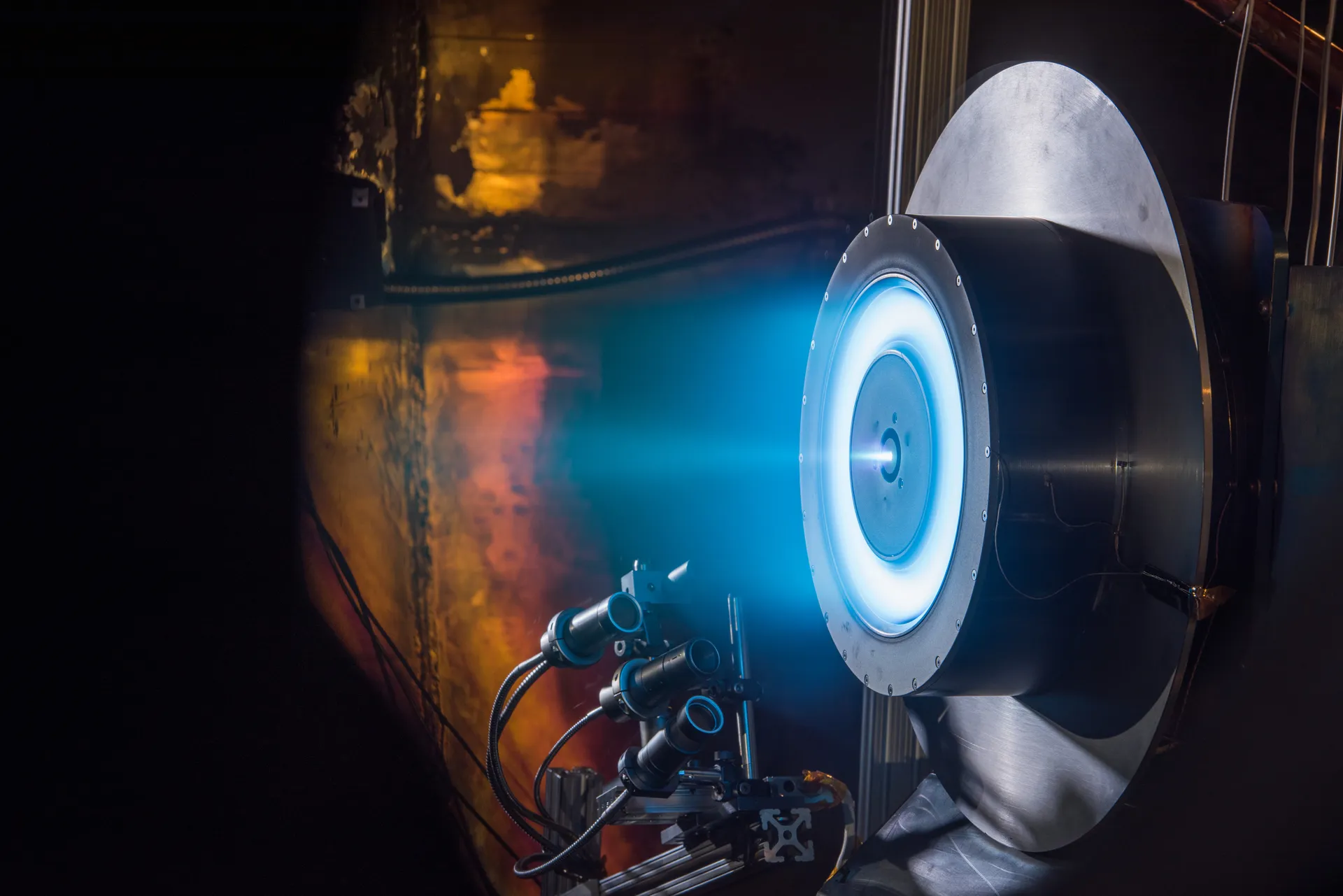
HERMeS, the 12.5-kilowatt Hall thruster developed at NASA’s Glenn Research Center and JPL that became the flight thruster for Gateway’s propulsion module, firing in a Glenn vacuum chamber in 2015.
The Power and Propulsion Element is a 60-kilowatt solar electric propulsion spacecraft that was to supply Gateway with power, high-rate communications, attitude control, orbit maintenance and the ability to move between lunar orbits. It is built on a commercial satellite bus by Lanteris Space Systems, formerly Maxar, of Westminster, Colorado, which NASA selected in May 2019 under a contract worth $375 million including options. NASA then expected to launch it on its own in late 2022.1,3 NASA’s Glenn Research Center in Cleveland manages the project.1
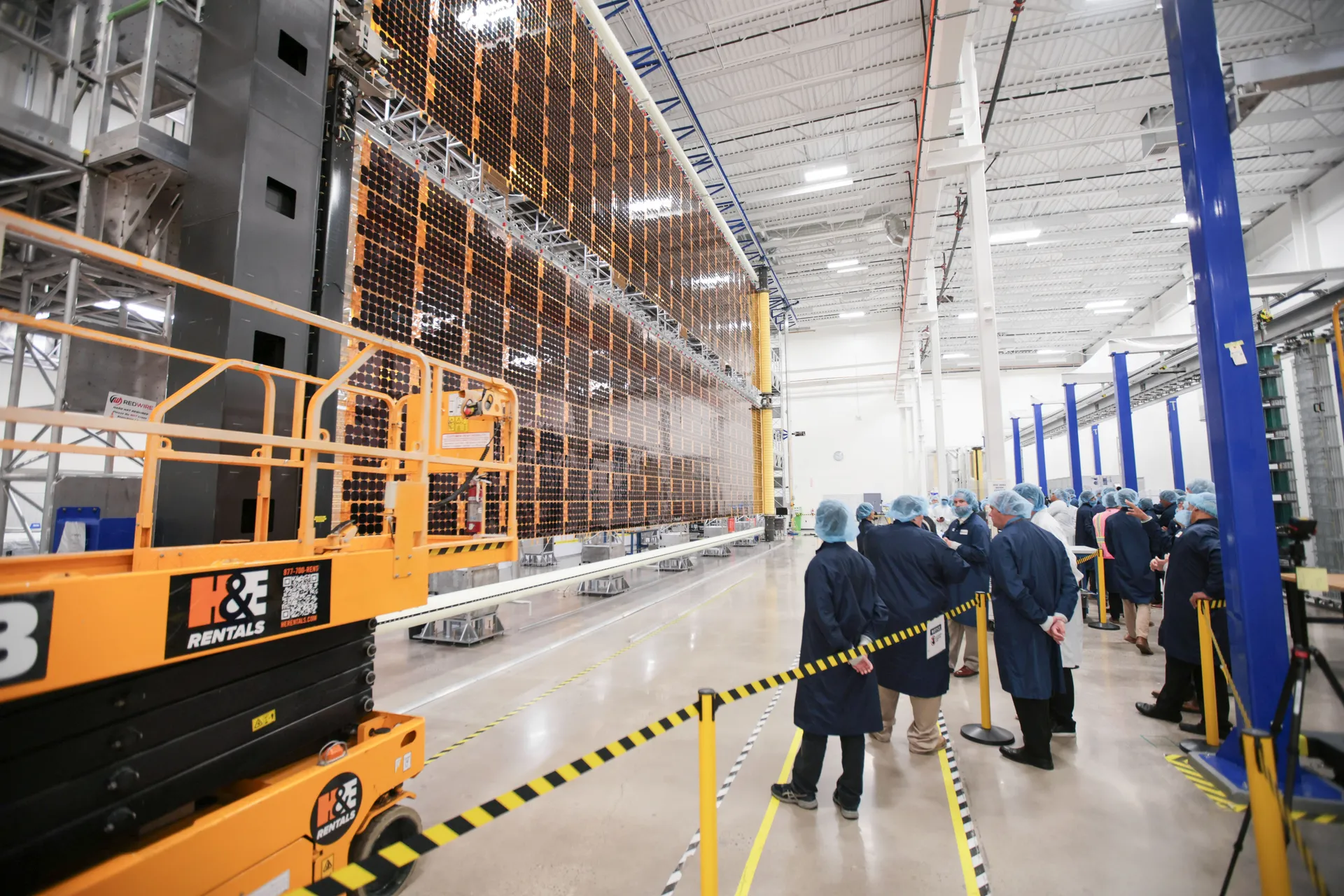
The spacecraft carries the most powerful thrusters of their kind and the largest roll-out solar arrays ever developed, which together were to make Gateway the most powerful solar-electric spacecraft ever flown. The thrusters, the Advanced Electric Propulsion System, descend from HERMeS, a 12.5-kilowatt Hall thruster matured at Glenn and JPL; Aerojet Rocketdyne was contracted to turn it into a flight system.1,7 A Hall thruster ionizes xenon and accelerates it with electric and magnetic fields. Its thrust is small, but it uses far less propellant than a chemical engine. As the PPE project manager put it in 2019, that would allow Gateway to move more mass around the Moon, such as a lander and large modules for living and working in orbit.3
All three flight thrusters had passed acceptance testing at Glenn and reached the PPE by November 2025, and the solar array wings were tested at Redwire in California. By January 2026 assembly of the PPE was about 90% complete.1,10
HALO: a Cygnus-based cabin built in Turin and Arizona
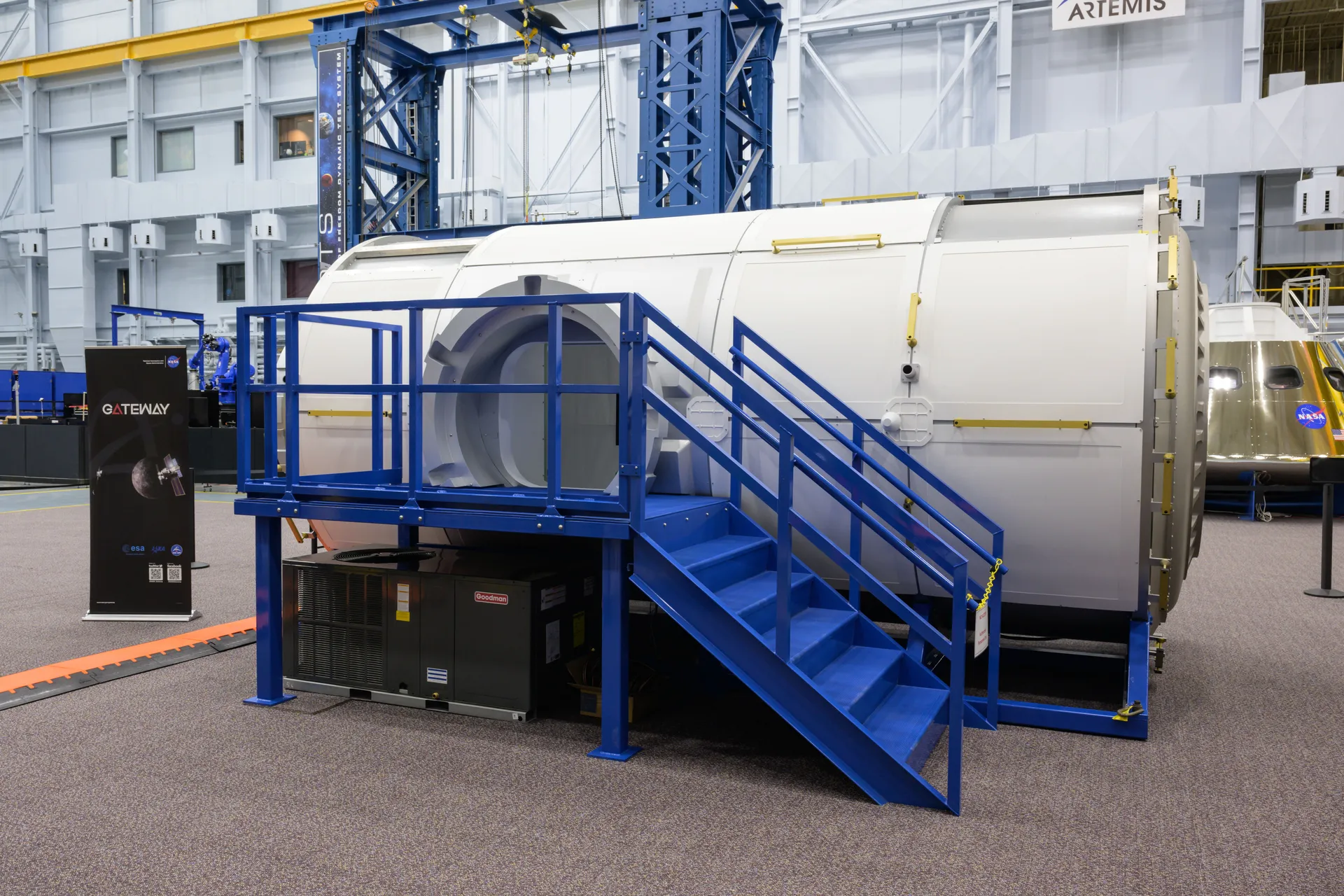
HALO was Gateway’s first habitation module: a pressurized command hub where astronauts would live, conduct research and prepare for trips to the surface, and where the station’s data handling, energy storage, power distribution and thermal control would be housed. Its design is based on Northrop Grumman’s Cygnus spacecraft, which supplies the International Space Station.1,6
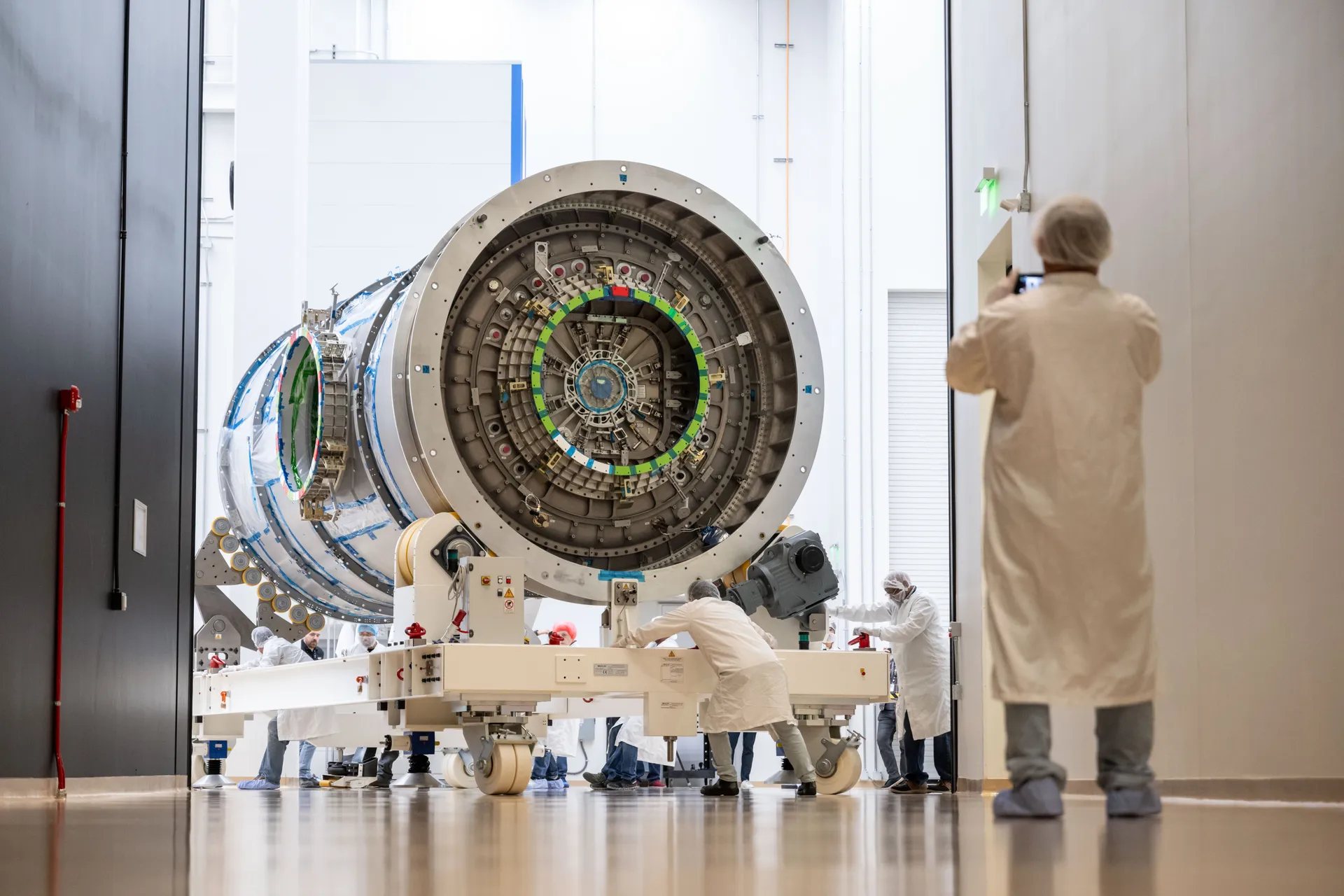
NASA gave Northrop Grumman a sole-source award in 2019 to meet the 2024 landing goal, before Gateway’s requirements were firm, and in July 2021 finalized a fixed-price contract valued at $935 million. Under it Northrop Grumman was to join HALO to the PPE in Gilbert, Arizona, and lead preparations for launch.4,6 Thales Alenia Space welded HALO’s primary structure in Turin, Italy, completing it in October 2023, and the module arrived in Arizona for outfitting on April 1, 2025.1
HALO was also the hub for partner hardware. Japanese batteries were to power it until the PPE’s arrays deployed; Canadian robotic interfaces were to host payloads and give Canadarm3 places to grip; and Europe’s Lunar Link communications system, mounted on HALO, was to relay high-rate data between Gateway and landers, rovers and satellites on and around the Moon.6,1
Four partners built their share into the station
Gateway was the centerpiece of NASA’s effort to bring other nations into Artemis, and each partner’s contribution came with seats on the flights. ESA agreed in October 2020 to provide the Lunar I-Hab habitat, the Lunar View refueling module with six large windows, and Lunar Link, and to supply two more service modules for Orion. Japan agreed in December 2020 to provide I-Hab’s life support and thermal control, batteries and a cargo delivery on its HTV-XG spacecraft. Canada signed in November 2020 to supply Canadarm3, a robotic arm that would move end over end along the station and work with or without astronauts aboard. In January 2024 the Mohammed Bin Rashid Space Centre of the United Arab Emirates agreed to provide the Crew and Science Airlock.1,8 Astronauts from Canada, Europe, Japan and the UAE were to fly to Gateway. Canada’s 2020 agreement also gave it a seat on Artemis II, which Jeremy Hansen flew in April 2026.1,22
$5.3 billion and a launch date that kept moving
Gateway’s schedule began to slip before its hardware existed. In 2020 NASA decided to launch the PPE and HALO together on one commercial rocket instead of separately. The Inspector General found that the change pushed the PPE at least 17 months past its December 2022 launch date, forced Maxar to cancel a SpaceX launch it had already paid about $27.5 million toward. Meanwhile the PPE contract had grown by $78.5 million in 14 months, mostly from changing Gateway requirements; only $3.5 million was for the joint launch.4 In February 2021 NASA bought the joint launch on a Falcon Heavy for about $331.8 million, then targeting no earlier than May 2024; that July it was November 2024.5,6
The joint vehicle also grew heavy. GAO reported in 2026 that the combined spacecraft had exceeded its mass allocation for the launch vehicle, driven mainly by HALO, and that the project had found more than 1,000 kilograms of mass reductions to bring HALO back within limits, at some cost in capability.10 In December 2023 NASA set Gateway’s initial capability baseline at $5.3 billion, covering the PPE, HALO, the launch and integration, with a launch readiness date of December 2027. Weeks later it said the October 2025 target it had been working toward was under review, to align the launch with Artemis IV in 2028.9,10
When Gateway’s first elements were expected to launch
By early 2026 the program’s top risk was meeting that December 2027 date. Program documents showed it would likely slip more than six months, driven by HALO. Just before shipping HALO, the contractor had seen one spot of microscopic corrosion on its primary structure; after delivery the project found more, paused other integration work on the structure and, as of January 2026, had not found the root cause.10
- $5.3B
- Gateway’s initial capability baseline: PPE, HALO, launch and integration, set December 202310
- $935M
- HALO contract with Northrop Grumman, finalized July 20216
- $375M
- PPE contract with Maxar, now Lanteris, including options, May 20193
- $331.8M
- Falcon Heavy launch of PPE and HALO together, February 20215
March 2026: paused “in its current form”
The pause came eight months after Congress set aside money for the station: the budget reconciliation law of July 2025 included $2.6 billion for Gateway.13 At the Ignition event on March 24, 2026, NASA announced that after the first landings it would build a base on the surface near the South Pole, and that it intends to pause Gateway in its current form despite challenges with some existing hardware. Orion crews will now transfer directly to their landers, without stopping at a station.11,12 The administration’s fiscal 2027 budget request, released in April, asked Congress to let NASA repurpose the $2.6 billion toward the lunar base and other priorities.14
In April 2026 NASA directed Northrop Grumman to stop work on HALO except for a limited set of efforts.10 The HALO contract, converted to a cost-plus contract in 2024, then stood at $1.9 billion, according to a June 2026 NASA Inspector General memo reported by Spaceflight Now; the memo said Thales Alenia Space had found widespread corrosion throughout the module.18
The propulsion module goes to Mars, HALO’s systems to the surface
The Power and Propulsion Element will go to Mars instead of the Moon. NASA’s Space Reactor-1 Freedom, announced at Ignition, would repurpose the nearly built PPE as its spacecraft bus and add a fission reactor producing more than 20 kilowatts of electricity through a Brayton power converter. Targeted to launch in December 2028, it is to be the first spacecraft to use a nuclear fission reactor for propulsion beyond Earth orbit. At Mars it will release SkyFall, three helicopters derived from Ingenuity, to look for water ice and scout landing sites.15,16 NASA lists the PPE as generating 48 kilowatts in this role, driving the same Advanced Electric Propulsion System thrusters.16
HALO’s systems are going to the surface. In August 2026 NASA said Northrop Grumman would develop three technology demonstration payloads for delivery to the lunar surface, built on the power and avionics hardware developed for HALO. They will test systems that can survive the multi-day shadow periods of the lunar night and shared surface power for Moon Base equipment.17 Northrop Grumman calls them Lunar Infrastructure Demos 1 through 3, and they are to begin flying during the base’s first phase, which runs through 2029.18
The partners are adjusting their own hardware. In June 2026 ESA said it would continue I-Hab through its critical design review and then assess whether it can be repurposed, slow work on Lunar View while keeping the key technologies it needs for deep space exploration, and study whether Lunar Link could serve as a dedicated communications asset, possibly within ESA’s Moonlight program.19 Canada said in August 2026 that it would redirect Canadarm3 toward logistics on the lunar surface, keeping MDA Space’s roughly C$1 billion contract unchanged.20 The UAE’s space center said it remains committed to Artemis without detailing the airlock’s future.21 Japan, which was to supply I-Hab’s life support, already has a role on the surface: NASA’s base plan counts on a JAXA pressurized rover in its second phase.11
Gateway’s first module crossed the Atlantic in 2025 and stopped in Arizona. The thrusters built to hold it in lunar orbit are now scheduled to fly past Mars in 2029.16
Sources
The text above is drawn from these 22 sources. Government works are adapted closely; company and press material is summarized. Numbers in the text point here. Last checked October 1, 2026.
Show all 22 sourcesShow fewer
- 1Back to the text
- 2Back to the text
- 3Back to the text
- 4Back to the text
- 5Back to the text
- 6Back to the text
- 7Back to the text
- 8Back to the text
- 9Back to the text
- 10Back to the text
- 11Back to the text
- 12Back to the text
- 13Back to the text
- 14Back to the text
- 15Back to the text
- 16Back to the text
- 17Back to the text
- 18Back to the text
- 19Back to the text
- 20Back to the text
- 21Back to the text
- 22Back to the text
Continue
Related stories
- The Artemis planA rocket, a capsule, two commercial landers, new suits and propellant refilled in orbit: who builds each piece, what it costs, and how a 2024 landing became Artemis IV in 2028.
- OrionLockheed Martin builds the capsule, Europe builds the module that keeps it alive, and its heat shield must survive a return at nearly 25,000 mph. How Orion was developed, how it works, and what its first crewed flight showed.
- Artemis IIFrom April 1 to 10, 2026, four astronauts flew Orion around the far side of the Moon and farther from Earth than anyone before them. What the flight tested, day by day, and what NASA found afterward.