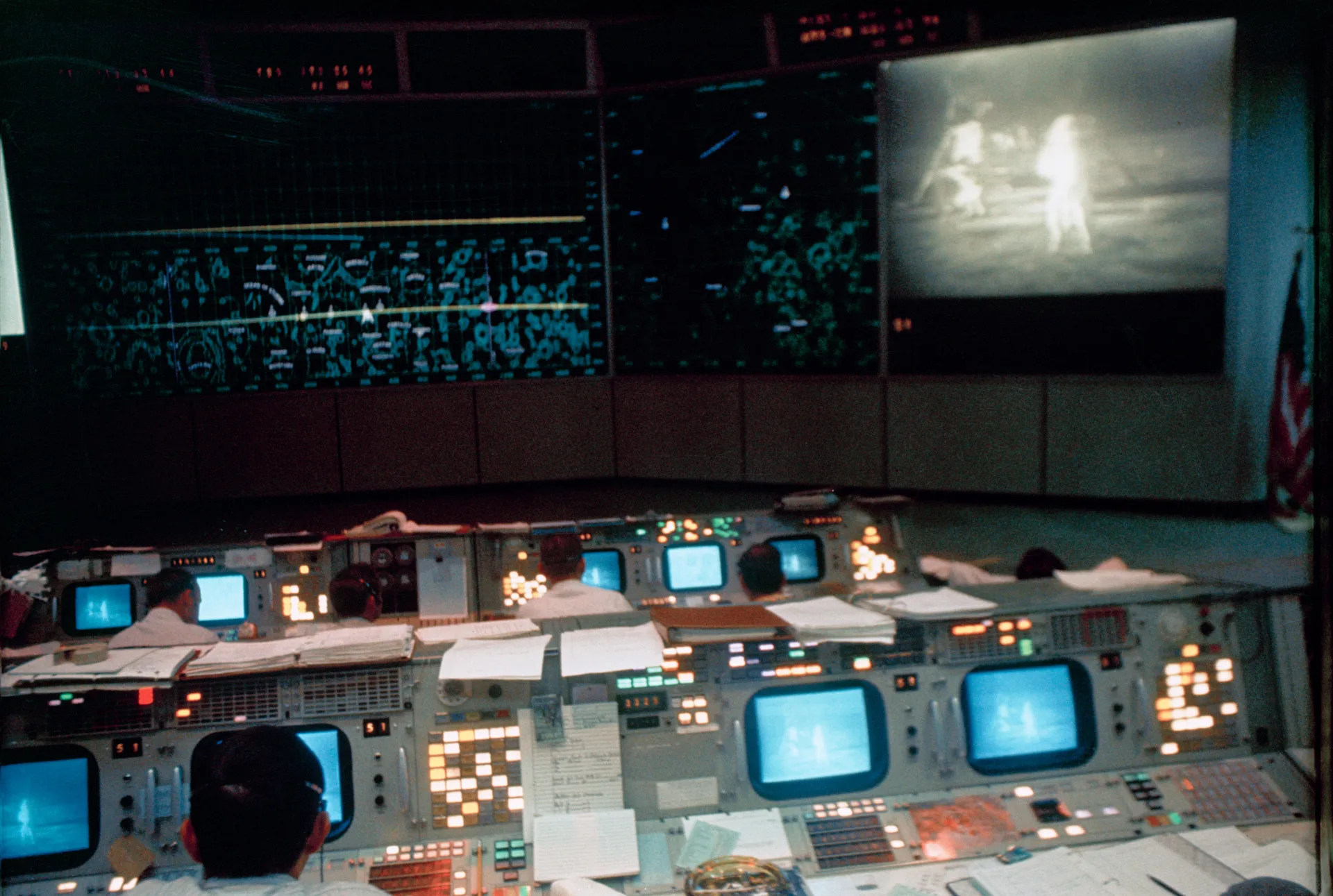
Control rooms and antennas: how NASA keeps in touch with its spacecraft
Every NASA mission depends on a control room and a chain of antennas. Built for Mercury in 1961, the networks now serve more than 100 missions, and the deep-space antennas are booked beyond their capacity.
NASA
Drawn from 11 sources: NASA (6), NASA Space Communications and Navigation (SCaN), NASA Science, NASA Office of Inspector General and 2 others. About 7 minutes. Checked October 1, 2026.
A spacecraft is only half of a mission. The other half is on the ground: a control room where people decide what the spacecraft will do next, and a chain of antennas that carries their commands up and the spacecraft’s data down. Some pieces of that system are older than NASA itself. Today NASA’s Space Communications and Navigation program runs two networks that hand missions off to each other: the Near Space Network, with ground stations and relay satellites for spacecraft in Earth and lunar orbit, and the Deep Space Network, with antenna complexes in California, Spain and Australia for everything farther out. Together they support more than 100 missions.1
Eighteen stations to follow one astronaut
Before NASA existed, the Naval Research Laboratory’s Minitrack network—ten ground stations from Santiago, Chile, to Grand Turk—was already following satellites. It tracked Sputnik in 1957, though its stations could “see” the satellite for only part of each orbit and data moved at 30 bits per second, about the speed of a teletype. When Explorer 1 launched in January 1958, JPL received its signals at portable stations in Nigeria, Singapore and California. NASA absorbed Minitrack when it opened, and with it the principles that guided its communications for decades: ground stations spread around the globe for coverage, redundancy for reliability, and international partners for worldwide reach.1
Human spaceflight demanded far more. For Project Mercury, eighteen ground stations were chosen for the communications network; eleven of them doubled as precision radar tracking sites, two were ships at sea and seven were built in foreign countries. The network spanned three oceans and three continents through about 177,000 miles of communications circuits, and in November 1959 its cost was estimated at $41 million. By the end of the program the tracking network accounted for a third of Mercury’s $384 million cost.2 The Mercury Space Flight Network was completed in July 1961, in time to keep contact with astronauts orbiting at 17,500 miles per hour.1
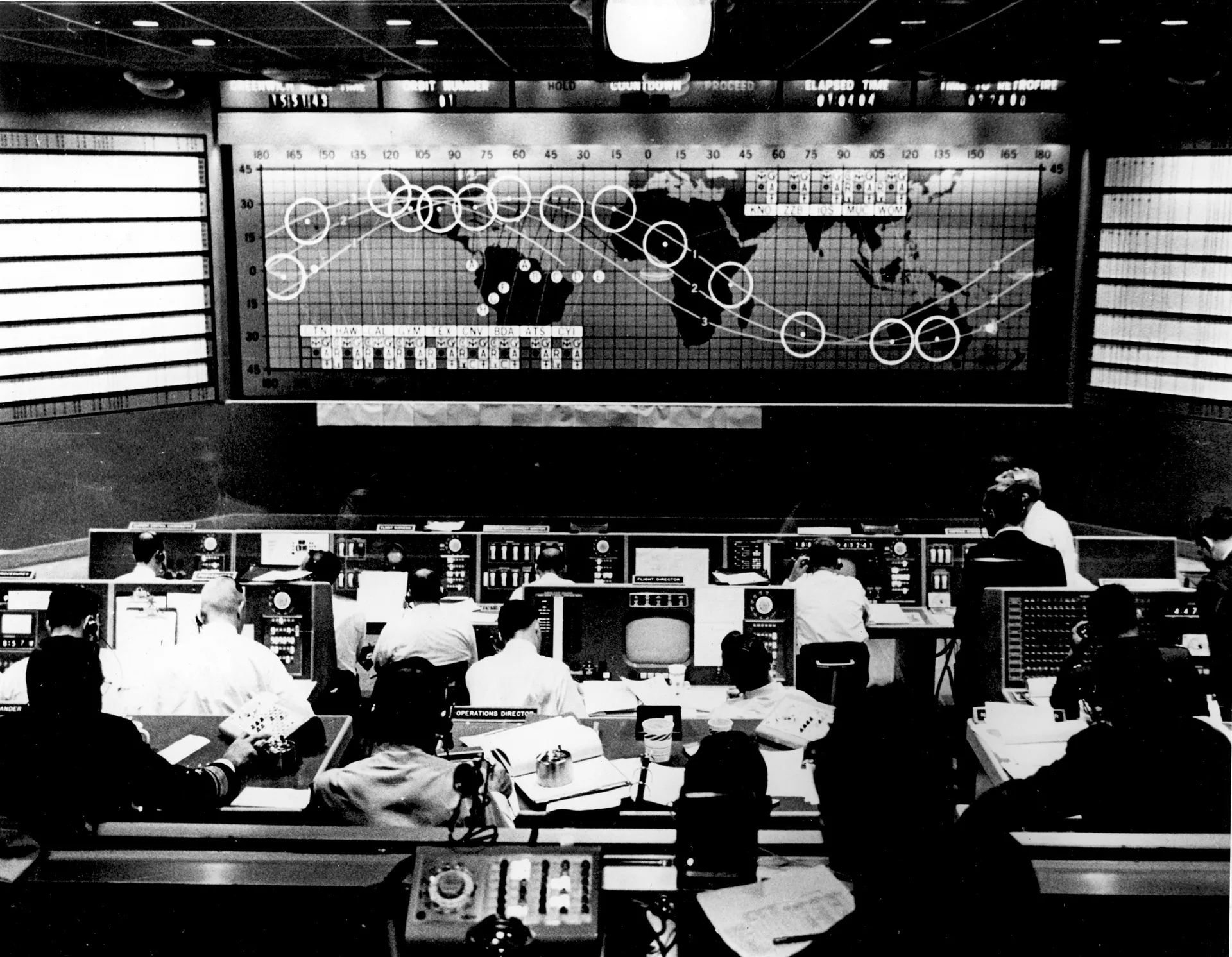
Mercury Control directed the flights from Florida
Mercury Control during the first orbit of John Glenn’s Friendship 7, February 20, 1962. The wall map traces his three orbits over the tracking stations.
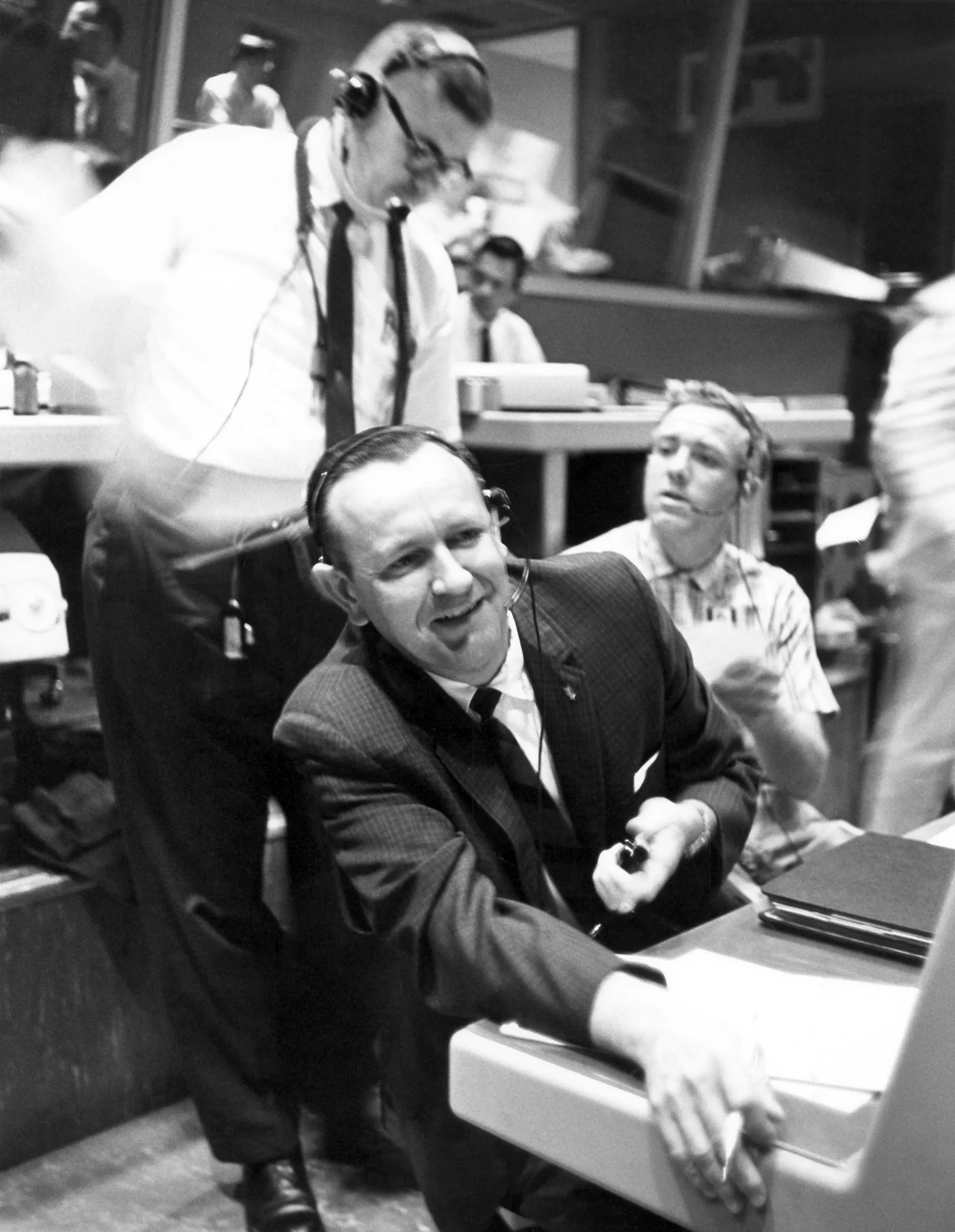
The flights were directed from the Mercury Control Center at Cape Canaveral. When Mercury ended, NASA’s engineers listed the growth of mission control among the program’s three main lessons: integrating the astronaut with flight monitors and directors around the world now demanded the fullest use of real-time telemetry, tracking, computing and displays. Two new acronyms came into use: MCC, for a new Mission Control Center in Houston, and GOSS, for the Ground Operational Support Systems behind it.2
Houston takes over mission control in 1965
On September 19, 1961, NASA announced that a new Manned Spacecraft Center would be built near Houston. It would develop crewed spacecraft and hold operational control of all crewed missions.4 The Cape control room was enlarged for Gemini to ten flight-controller consoles, but the new Mission Control Center in Houston took over with Gemini 4 in June 1965. More than a thousand reporters came to Houston for that flight, drawn partly by the knowledge that the new control center would operate for the first time.3,11
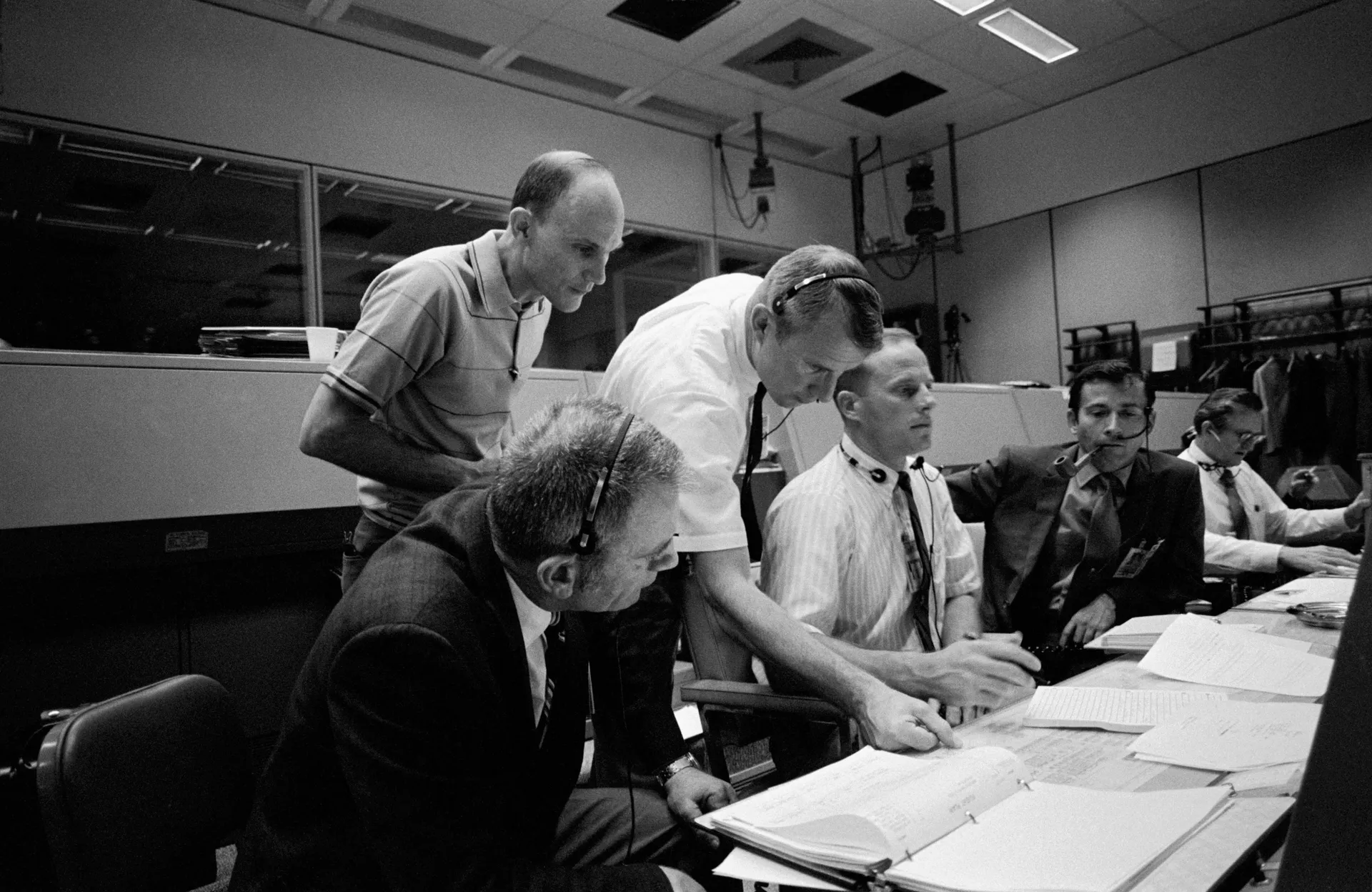
Flight director Christopher Kraft, who had led Mercury’s control team, took the Gemini team through the first rendezvous and then turned to preparing for Apollo. One area he focused on was the computer complex: the IBM 7094 machines were adequate for Gemini but better suited to scientific work, and Apollo needed a second-generation system able to support real-time operations. He was proved right when, in the middle of Apollo 13, flight controllers were able to change the mission from a lunar landing to a flight around the Moon and prevent a tragedy.3
The network grew with the missions. For Gemini and Apollo it became the Manned Space Flight Network of 29 ground stations and five tracking ships. The Unified S-Band system, first flown on Apollo 4 in 1967, combined tracking, ranging, telemetry, voice, command and television into one system, with ranging precise to about 15 meters at 250,000 miles.1
On July 20, 1969, three stations received the first steps on the Moon at once. When Goldstone’s television feed had equipment problems and the Moon rose higher in the Australian sky, Houston switched to video from Honeysuckle Creek near Canberra and then from the Parkes radio telescope in New South Wales, combining it with Goldstone’s audio. After the explosion on Apollo 13 in April 1970, engineers at Parkes reconfigured their equipment in roughly 12 hours instead of the usual week to help track the crew home.1
Relay satellites replaced most of the ground stations
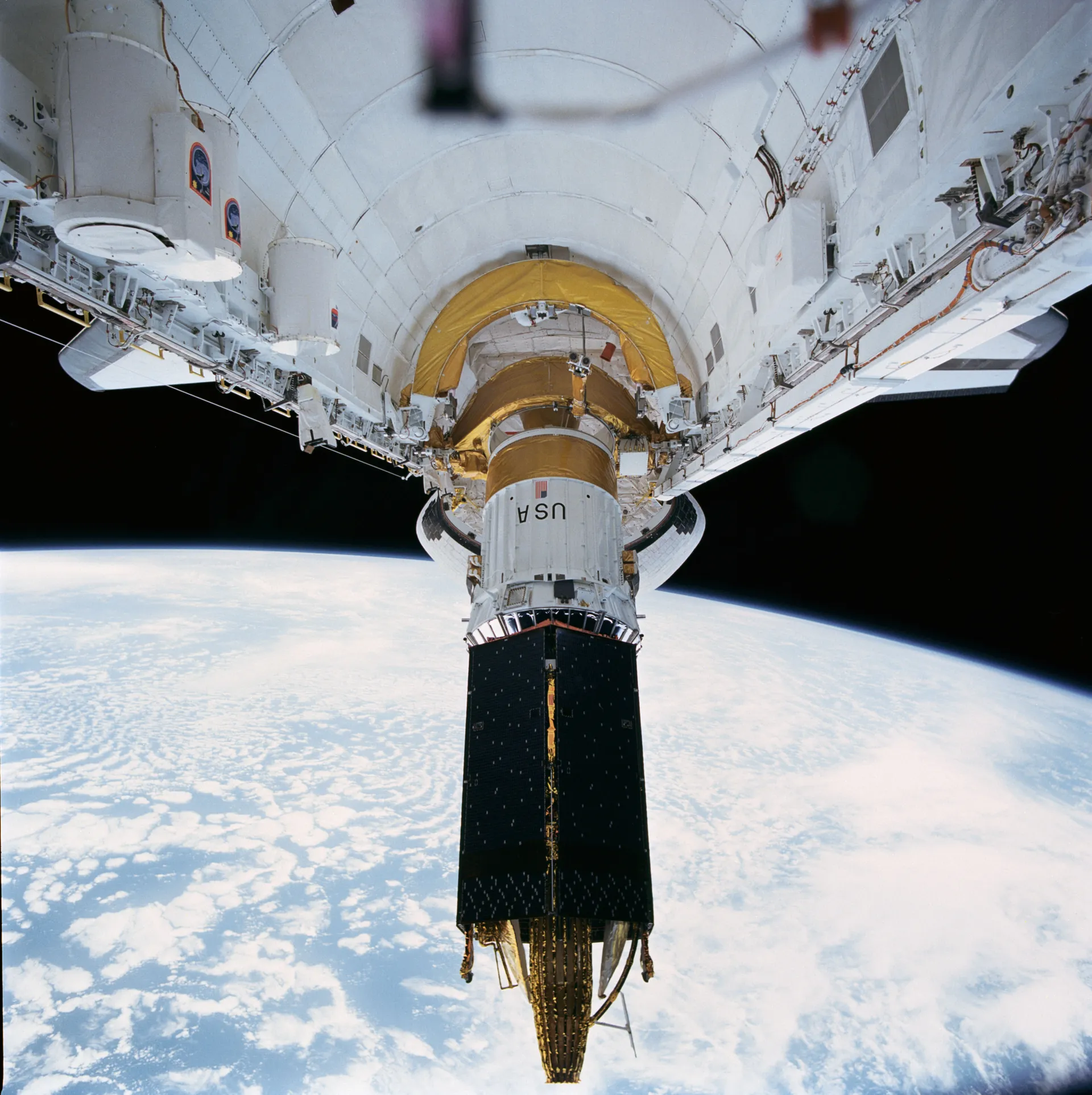
A ground station can talk to an Earth-orbiting spacecraft only while it passes overhead, so early crews and satellites spent most of each orbit out of contact. Relay satellites in high orbit changed that.1
From ground stations to relay satellites
1975
ATS-6 relays Apollo–Soyuz1
A single relay satellite raises coverage from 15 percent to over 50 percent.
1983
TDRS-1 rescued1
After its upper stage failed, engineers used tiny thrusters to nudge it 8,600 miles higher to geostationary orbit. It served for 26 years.
1989
Three TDRS satellites in place1
Near-Earth coverage reaches 85 percent, against the ground network’s 15.
1998
Guam ground terminal1
Closes the gap over the Indian Ocean; coverage passes 99 percent.
2024
TDRS stops taking new missions1
The transition to commercial communications providers begins.
2025
Commercial Near Space Network1
Four companies receive contracts worth up to $4.82 billion to provide services through 2034.
The Deep Space Network: three sites spaced around the world
Beyond Earth orbit, NASA relies on the Deep Space Network, the largest and most sensitive scientific telecommunications system in the world. It has three complexes placed about 120 degrees apart: at Goldstone in California’s Mojave Desert, at Robledo near Madrid, and at Tidbinbilla near Canberra. The spacing lets the network keep a spacecraft in view constantly as Earth rotates: before a distant spacecraft sinks below the horizon at one site, another can pick up the signal and carry on communicating.5,6 The network was established in 1963, when the stations were linked to JPL’s new Space Flight Operations Facility. JPL manages it under NASA’s contract with Caltech, and NASA’s agreements with the Australian and Spanish governments cover day-to-day operations at the foreign sites.1,7
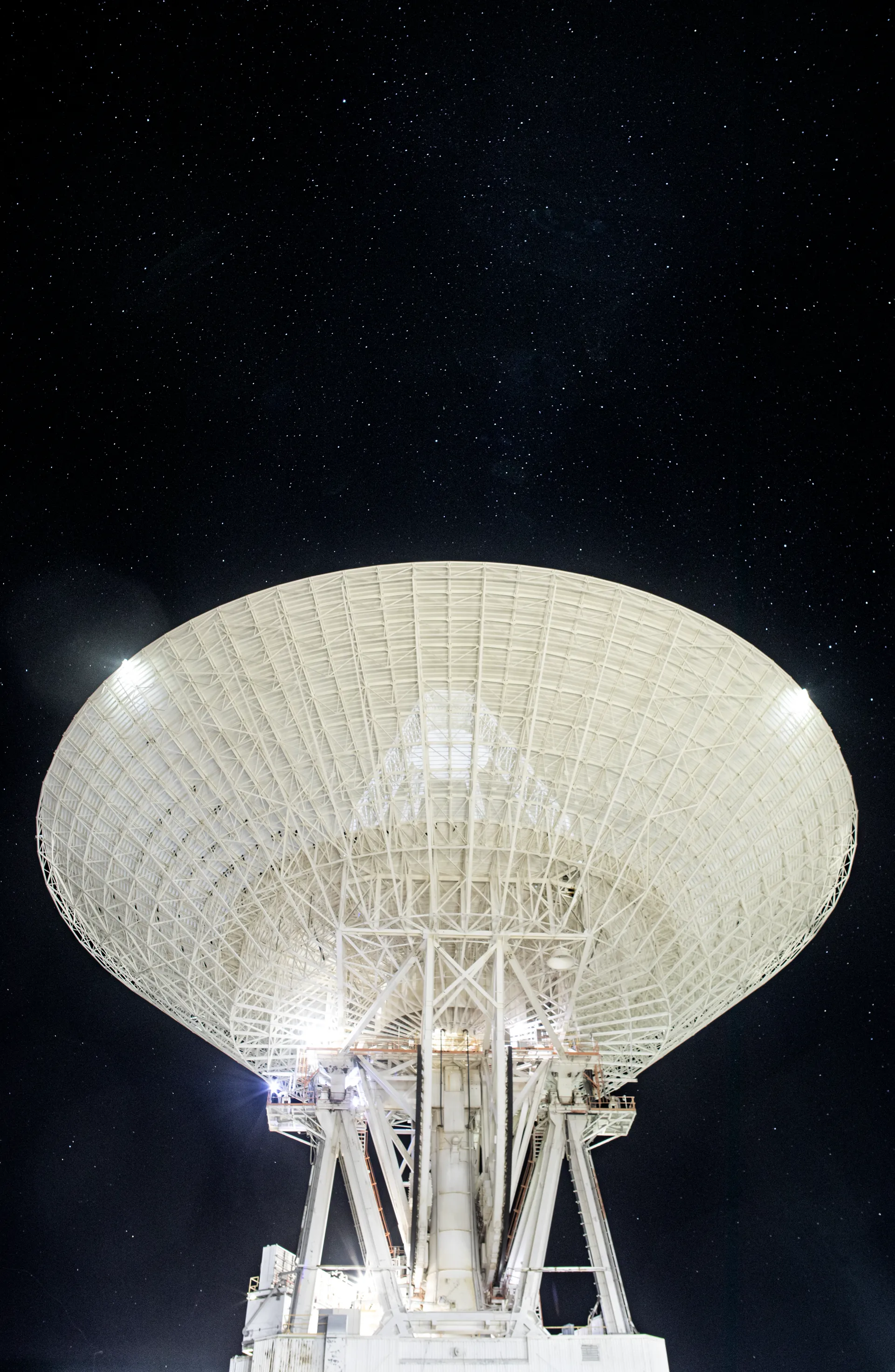
Each complex has its own record. Goldstone’s 70-meter antenna, DSS-14, has the world’s only planetary radar system. The Apollo station at Fresnedillas, near Madrid, whose antenna later moved to the Robledo complex, received Neil Armstrong’s words “Houston, Tranquility Base here. The Eagle has landed.” Canberra’s DSS-43 is the only antenna on Earth that can send commands to Voyager 2. In 1987 and 1988 all three large dishes were enlarged from 64 to 70 meters to stay in contact with Voyager 2 at Neptune, 2.9 billion miles away.1
The antennas carry more than voice and pictures. Measuring the Doppler shift of a spacecraft’s signal gives its velocity along the line of sight to within fractions of a millimeter per second; ranging tones sent up and returned by the spacecraft give its distance to within about a meter. Navigators use those measurements to determine a spacecraft’s trajectory, and the network uses the navigators’ predictions to point its antennas. Telemetry comes down; commands and new flight software go up.5
A deep-space network booked beyond its capacity
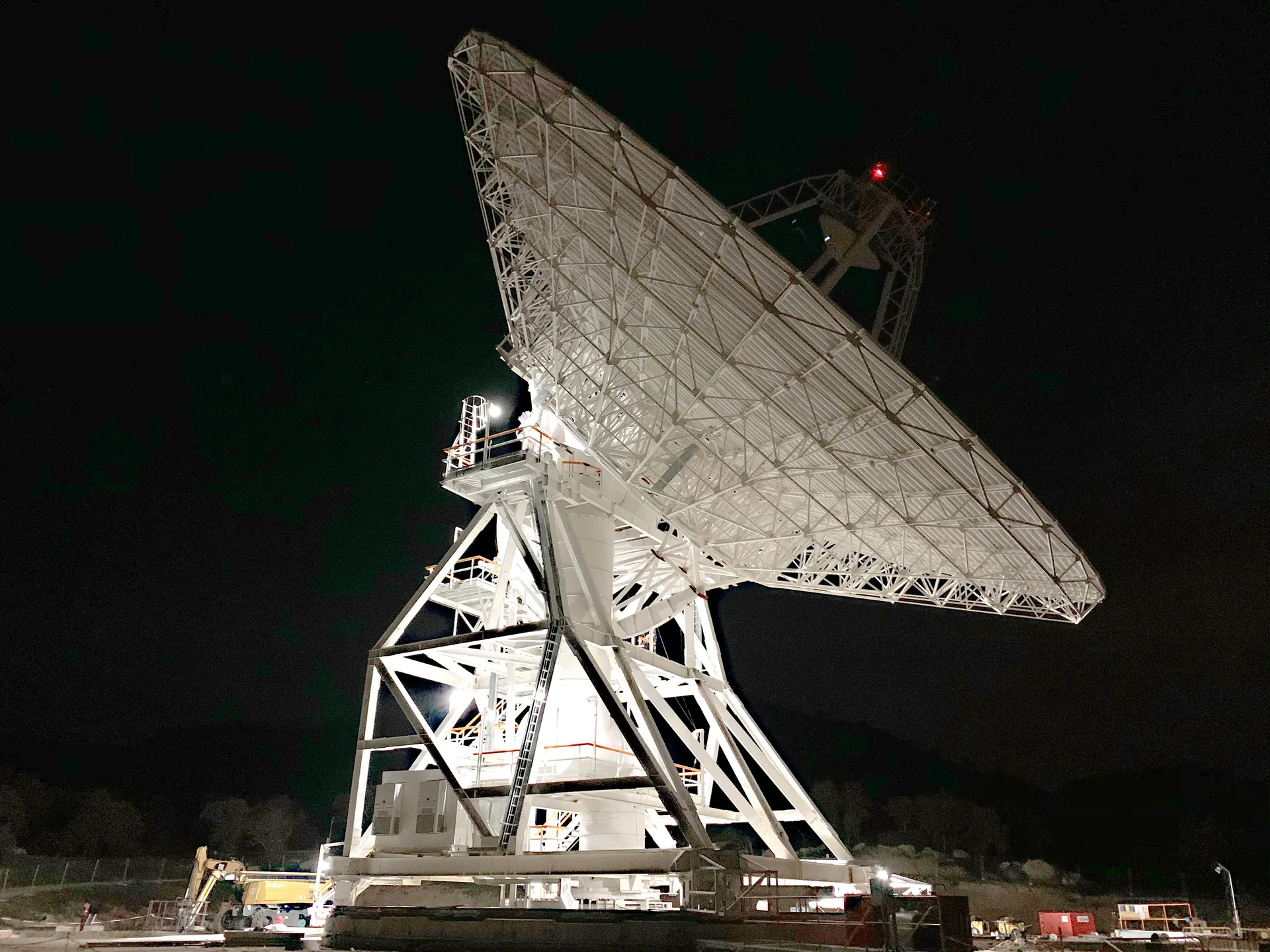
DSS-53 at Madrid, the fourth of six new 34-meter antennas, went online in February 2022.
In July 2023, NASA’s Inspector General found the Deep Space Network operating at capacity and oversubscribed: missions requested more antenna time than the network could provide, with demand exceeding supply at times by as much as 40 percent. The network was supporting nearly 60 NASA and partner missions, and NASA’s own studies projected excess demand of about 50 percent by the 2030s. In the previous five years, missions had received between 8,500 and 15,000 fewer tracking hours than they requested.7
- 40%
- how far demand for Deep Space Network time has exceeded supply at peak times7
- $706M
- cost of the antenna upgrade project, up 68 percent from $419 million7
- 2029
- when the last of six new 34-meter antennas is due, in Canberra8
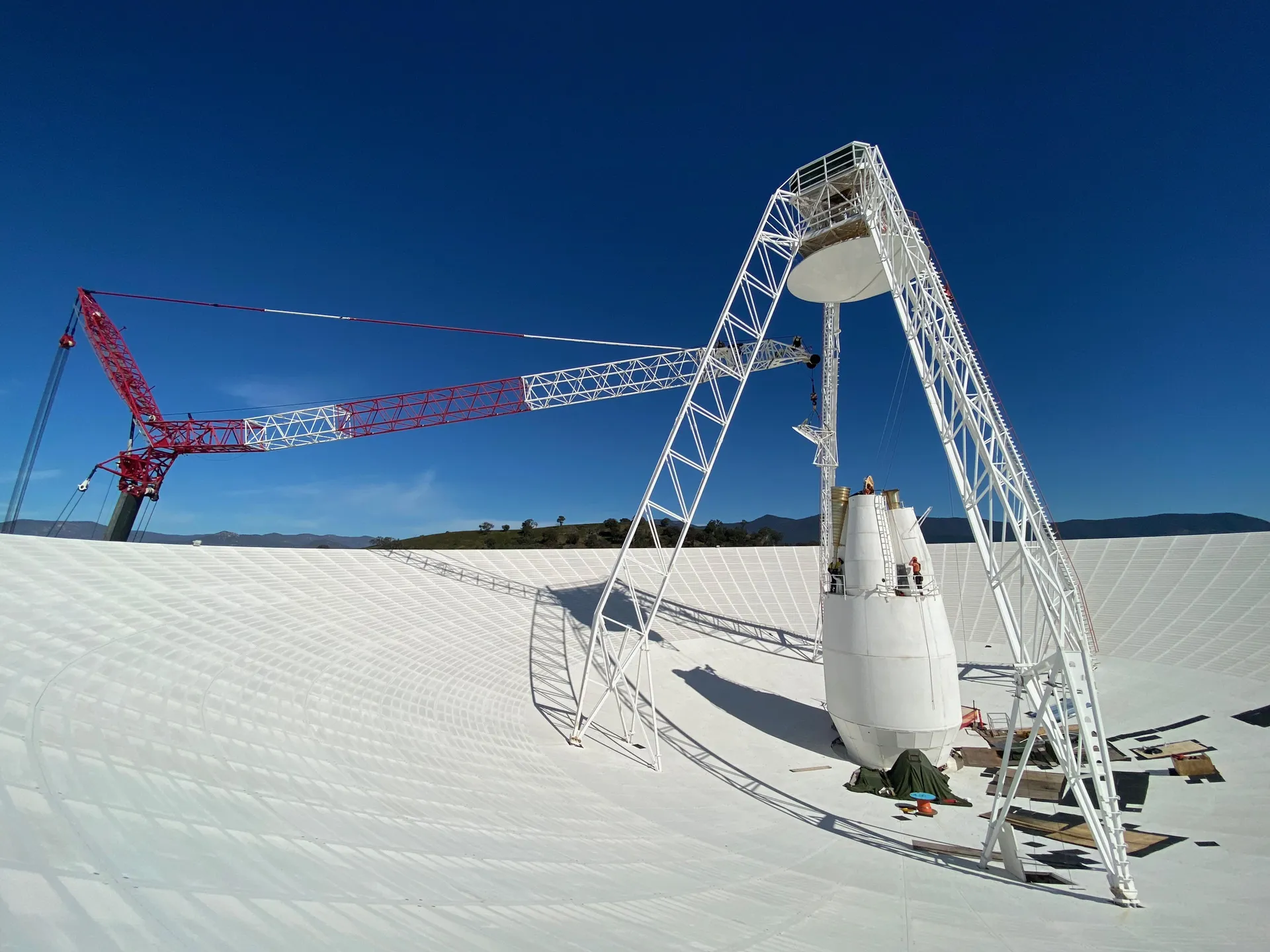
The strain will grow when the largest users—the Perseverance rover, the James Webb Space Telescope and the Artemis missions—sit in the same part of the sky competing for the same antennas. Missions negotiate antenna time among themselves; in 2023, unlike the Near Space Network, the Deep Space Network had no priority list. NASA’s answer, begun more than 15 years ago, was the Deep Space Network Aperture Enhancement Project, which is adding six new 34-meter antennas. Changes to its scope raised its expected cost from $419 million to $706 million, and NASA did not expect the three sites to have fully functional antennas until at least 2029, nearly five years late.7,8
The fifth of those antennas, Deep Space Station 23 at Goldstone, began operations on August 3, 2026, tracking the Chandra X-ray Observatory, and has since worked with missions including the Mars Reconnaissance Orbiter, Psyche, Juno and Voyager 1. Construction began in February 2020. Its beam-waveguide design sends signals down to a stable underground room rather than carrying sensitive electronics on the moving dish.8
The sixth, Deep Space Station 33 in Canberra, is due in 2029. It will bring the network’s total of 34-meter antennas to 13. The network now supports more than 40 spacecraft exploring the solar system and interstellar space.8
Artemis II: two networks, one control room, a planned 41-minute silence
The Artemis missions use both networks. For Artemis II, the Mission Control Center at Johnson Space Center in Houston tracked the rocket, its upper stage and Orion through coordinated handoffs between assets on Earth and in space. The Near Space Network, managed by Goddard, covered launch and the hours in Earth orbit; after the burn that sent Orion toward the Moon, primary support moved to the Deep Space Network.9
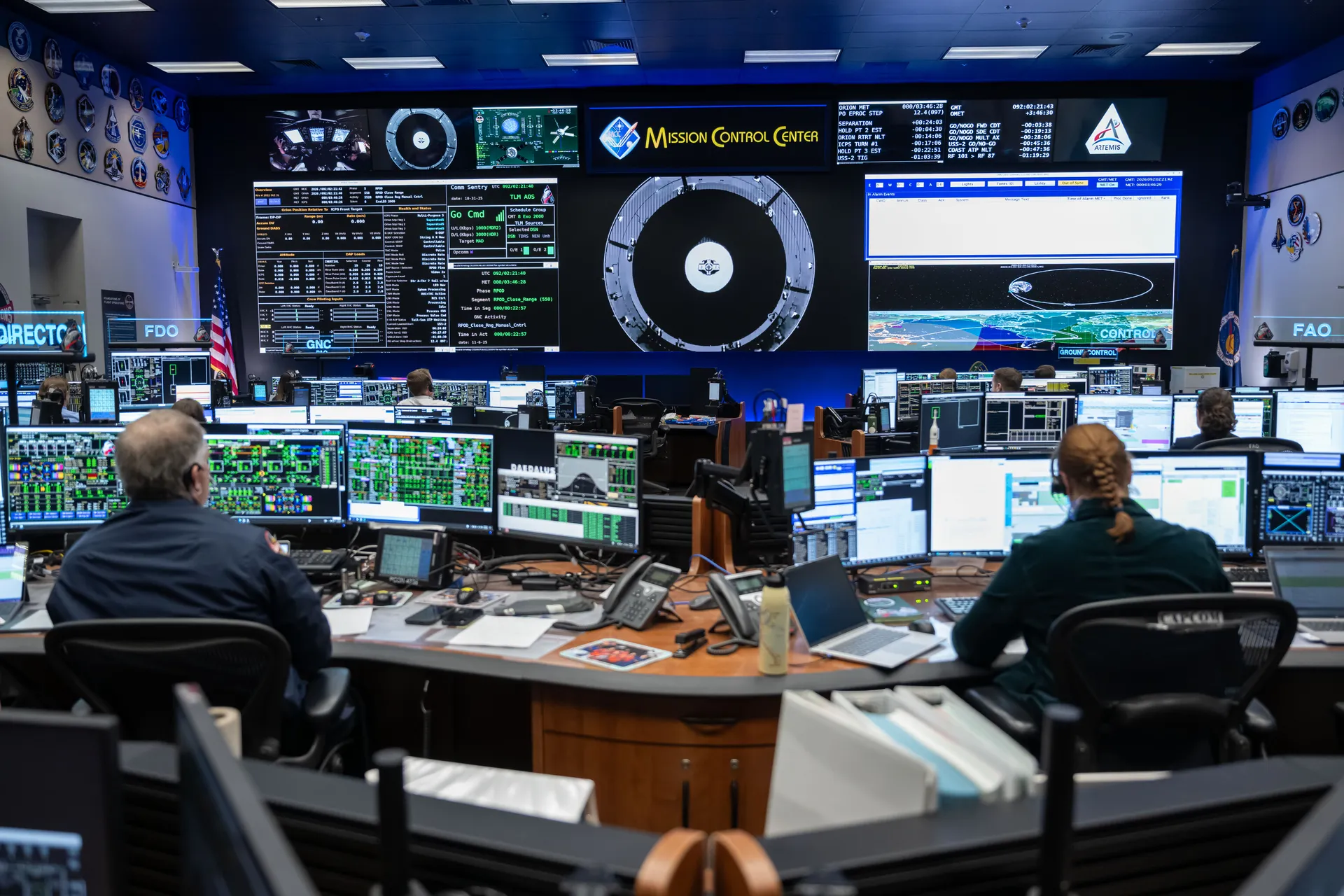
The flight, from April 1 to 10, 2026, took the four astronauts 252,756 miles from Earth at their farthest point.10 NASA planned a communications blackout of about 41 minutes as Orion passed behind the Moon, cutting off radio signals to and from Earth; similar blackouts occurred during Apollo. Orion also carried a laser communications terminal to send crew and science data over laser links, and data from the spacecraft was compressed after reaching Earth to give priority to crew communications and mission data.9
Those blackouts remain part of every mission on or around the far side of the Moon, as long as the antennas are all on Earth. NASA’s Lunar Communications Relay and Navigation Systems project is working with industry to place relay satellites around the Moon, which would do for lunar missions what the relay satellites of the 1980s did for spacecraft in Earth orbit.9
Sources
The text above is drawn from these 11 sources. Government works are adapted closely; company and press material is summarized. Numbers in the text point here. Last checked October 1, 2026.
Show all 11 sourcesShow fewer
Continue
Related stories
- Mercury & GeminiMercury’s six flights showed a person could ride to orbit and come home. Gemini’s ten taught maneuvering, rendezvous, docking, spacewalks and two-week flights—at about double the first estimate.
- ApolloKennedy’s 1961 goal became a program of 400,000 people and more than 500 contractors. It chose a risky route to the Moon, survived a fire on the pad, and landed six crews before Congress ended it.
- Artemis IIFrom April 1 to 10, 2026, four astronauts flew Orion around the far side of the Moon and farther from Earth than anyone before them. What the flight tested, day by day, and what NASA found afterward.