Starship HLS
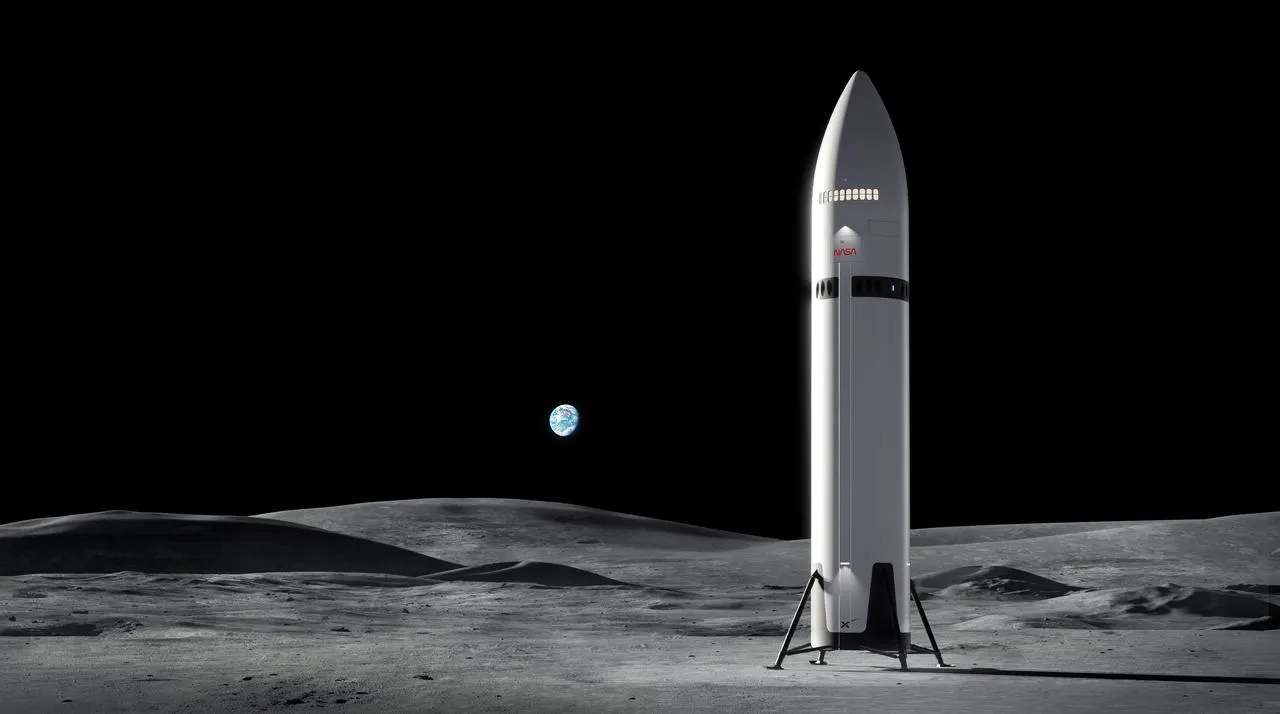
The lunar version of Starship, chosen by NASA to land astronauts—refilled in orbit before every trip.
- Type
- Lunar lander
- Status
- In development
- Height
- 52 m (171 ft)
- Built by
- SpaceX
- $4.5B
- potential contract value, including about 6% growth since the 2021–2022 awards, NASA Inspector General (March 2026)
- 10+
- tanker flights to fill an orbiting depot before each crewed landing
- 2021
- selected by NASA
- 2027
- docking test with Orion in Earth orbit on Artemis III
How SpaceX won NASA’s first Moon lander, and what it must still prove
Drawn from 16 sources: NASA (9), NASA Office of Inspector General (2), NASA Marshall Space Flight Center, U.S. Government Accountability Office and 3 others. About 11 minutes. Checked October 1, 2026.
NASA’s Artemis campaign aims to return astronauts to the Moon for the first time since Apollo 17 and to lay the framework for a lasting presence there. The vehicle that carries them the last stretch is the Human Landing System. It must take two crew members from lunar orbit down to the surface, serve as their living quarters while they live and work there, and lift them back to orbit. NASA has bought two: SpaceX’s Starship lander and Blue Origin’s Blue Moon.1
NASA does not own either one. It buys the landers as a service, under firm-fixed-price contracts that pay the companies only after NASA determines that a milestone has been met, and the companies design, build and own the vehicles. Since the program began in 2019, NASA has obligated $6.9 billion for lander development, and it expects to spend $18.3 billion through fiscal year 2030.1 The first and largest of these contracts went to a version of SpaceX’s Starship that never returns to Earth and must be refilled in Earth orbit before every trip.
One lander instead of two: the April 2021 selection
In March 2019 NASA committed to landing humans at the Moon’s South Pole by 2024 instead of 2028, as it had planned.2 In September of that year it asked industry to propose an initial lander. Five companies did, and in May 2020 NASA awarded firm-fixed-price contracts to three of them to begin design: Blue Origin received more than $480 million, Dynetics nearly $240 million and SpaceX nearly $135 million for a 10-month base period.1
The plan was to carry at least two of the three into full development, so that competition would hold down cost. Then Congress gave the program $850 million for fiscal year 2021, against the $3.4 billion NASA had requested, and NASA could afford only one.2,1 On April 16, 2021, it chose SpaceX, under a firm-fixed-price, milestone-based award worth $2.89 billion, known as Option A. The mission it described was this: SLS would launch four astronauts in Orion to lunar orbit, where two would transfer to the SpaceX lander for the final leg to the surface. After about a week exploring, they would board the lander for the short trip back to orbit, return to Orion and their colleagues, and head home. NASA noted that the design leaned on SpaceX’s tested Raptor engines and the flight heritage of Falcon and Dragon, and offered a spacious cabin and two airlocks for moonwalks.3 The award also required an uncrewed demonstration landing before the crewed one.1
The losing bidders challenged the award at the Government Accountability Office, Blue Origin then sued in federal court, and each challenge stopped work on the contract.4
The 2021 protests
April 16, 2021
SpaceX selected3
NASA picks SpaceX alone for the first crewed landing, at $2.89 billion.
April 26, 2021
Protests filed at GAO4
Blue Origin Federation and Dynetics challenge the selection; NASA tells SpaceX to suspend work.
July 30, 2021
GAO denies both protests4
NASA awards the Option A contract to SpaceX.
August 13, 2021
Blue Origin sues4
A bid protest in the U.S. Court of Federal Claims; NASA and SpaceX agree to stop work until as late as November 8 to allow an accelerated schedule.
November 4, 2021
Court denies the protest4
The court upholds NASA’s selection, and work resumes.
The protests cost six months: in December 2021 the date for delivering the lander moved from December 2024 to June 2025.1
Option B, a second provider and a contract worth about $4.5 billion
In March 2022 NASA said it would add work to the SpaceX contract, and on November 15, 2022, it awarded Option B, a modification worth about $1.15 billion. Under it SpaceX is to develop a lander that meets NASA’s requirements for “sustaining” missions after the first landing, including docking with the Gateway station, carrying four crew members and landing more mass on the Moon, and to demonstrate it on Artemis IV.5,4 Counting every option and order, NASA’s inspector general put the potential value of SpaceX’s contract at about $4.3 billion. To keep a second lander available, NASA ran a separate competition in 2022, which Blue Origin won in May 2023.1
The fixed prices have held. By December 2025 SpaceX’s potential contract value had grown 6 percent, about $253 million, partly because of government-driven changes such as new requirements for how the lander connects with the spacesuits, which added $26.2 million in 2023. When SpaceX asked for more time, NASA did not pay more; it traded the delay for added work. In 2023, in exchange for permitting a schedule delay, SpaceX added a lunar ascent test, with a liftoff from the surface and an engine relight, to its uncrewed demonstration landing. Under a cost-plus contract, the inspector general noted, a delay typically means NASA keeps paying the contractor’s labor.1 SpaceX said in October 2025 that it had been paid about $2.7 billion for 49 completed milestones, which it said included showing how the lander’s docking, landing, life-support and thermal-control systems would work.15
- $2.89B
- Option A, April 2021: development, an uncrewed demonstration landing and the first crewed landing3
- $1.15B
- Option B, November 2022: an upgraded lander for a second crewed landing5
- 6%
- Growth in the contract’s potential value by December 2025, to about $4.5 billion1
- $18.3B
- NASA’s expected spending on both companies’ landers through fiscal 20301
Refill, dock, descend: the lander’s mission step by step
SpaceX intends to use three configurations of Starship for Artemis. The lander delivers astronauts to the surface; tankers carry propellant to low Earth orbit; a storage depot holds it there until it is passed to the lander.1 The model follows one landing mission from launch to the surface.
A Starship that never comes home
The lander stands about 171 feet tall and launches from Earth on SpaceX’s Super Heavy booster; both stages burn liquid oxygen and liquid methane in Raptor engines. It flies without a crew. Because it never returns through Earth’s atmosphere, it is built around what a lunar mission needs: a crew compartment, docking hardware, solar arrays, landing legs and thermal and micrometeoroid protection tiles, all of which SpaceX has tested in development.1,6
More than ten tankers, one every six days
Before each landing SpaceX will launch a storage depot to low Earth orbit, followed by more than 10 tankers. Each rendezvouses with the depot, docks and transfers its propellant. This aggregation starts more than 200 days before the crew launches, at a target of one tanker every six days, from Starbase in Texas and Kennedy Space Center in Florida. When the depot holds enough, the uncrewed lander lifts off from Kennedy, docks with it, refuels and leaves for the Moon.1
Waiting in lunar orbit for Orion
In a high, looping lunar orbit the lander gets a full checkout of its systems before the crew launches; fueled, it can loiter up to 100 days. Orion arrives and docks. SpaceX’s docking system is based on the one flown on Dragon and was qualified in tests of more than 200 docking scenarios at different angles and speeds. Two astronauts move into the lander; two stay in Orion.1,6,8
A braking burn and a landing on legs
After leaving low lunar orbit, the lander slows with a braking burn of its Raptor engines before the final descent. Those vacuum engines must restart after a long stay in the cold of deep space; in August 2023 SpaceX started one in extreme cold to show it could meet the demands of a descent. Near the ground the exhaust throws up dust and rock, and NASA’s models of that still rest largely on Apollo.8,6,1
An elevator from 115 feet up
The crew compartment sits near the top. To reach the surface, astronauts leave through an airlock deck and ride an elevator basket down a vertical rail. The elevator sits about 115 feet above the ground, taller than the Statue of Liberty from heel to head, and also carries equipment and samples. Suited crews have tested a subscale mockup and a full-scale basket with its gate and ramp.1,7,6
A cabin for a week on the Moon
Two astronauts would stay about six and a half days and walk on the surface in Axiom Space suits. SpaceX built a full-scale cabin mockup to test life support and thermal control with four people working inside, and in 2026 it was building a flight-like cabin at Starbase for integrated testing and crew training. When the stay ends, the lander lifts off, climbs back to orbit and docks with Orion.1,6,13
Milestones met, and the test that has not flown
By NASA’s count, SpaceX had completed more than two dozen lander-specific milestones by 2024, designing and testing hardware for power generation, communications, guidance and navigation, propulsion, life support and protection from the space environment. In November 2023 the program passed Key Decision Point C, NASA’s approval to proceed to final design and fabrication. In February 2024 SpaceX showed at a design review for the integrated lander that the design met NASA’s requirements within acceptable risk and schedule margins.6
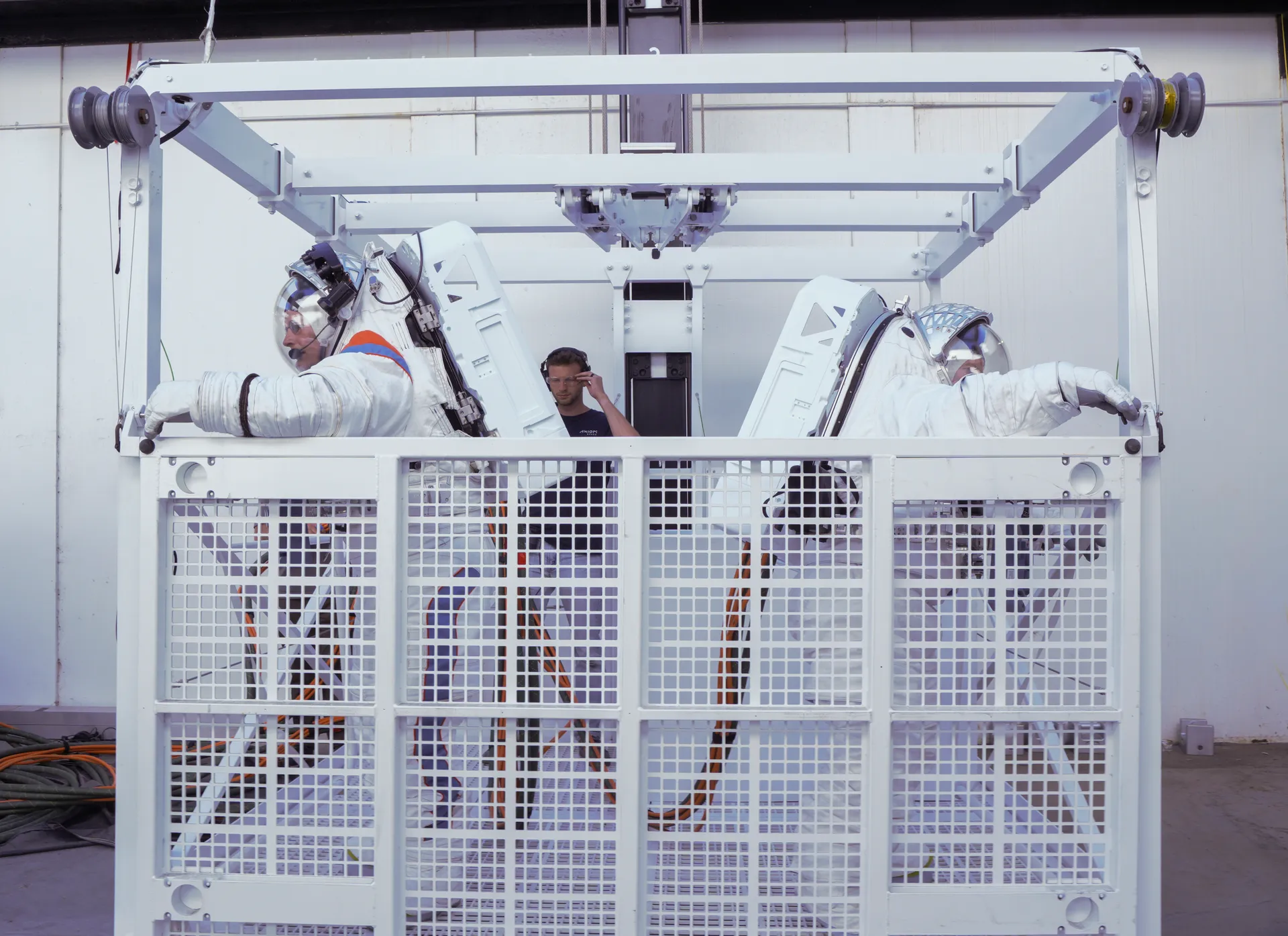
Astronauts have worked in the hardware. In late 2023 NASA astronauts Nicole Mann and Doug Wheelock tested a subscale mockup of the elevator, built at SpaceX in Hawthorne, California, and reported on its controls, gate latches, ramps, cargo space and ride along the rail.7 In 2024 Wheelock and Axiom Space astronaut Peggy Whitson put on pressurized suits and worked in a full-scale mockup of the airlock, hatch and elevator basket, checking handrails, clearances and whether controls could be worked in spacesuit gloves.6
August 2023
Raptor cold start6
A vacuum Raptor is started at SpaceX’s McGregor, Texas, site in conditions that included extreme cold, like those a lander’s engines meet after a long wait in space.
2023
Docking system qualified9
Full-scale tests of more than 200 docking scenarios for the system that connects the lander to Orion or Gateway.
November 2023
Approval for final design6
Key Decision Point C. In February 2024, a design review for the integrated lander.
March 14, 2024
Propellant moved inside one ship6
On Starship’s third flight, liquid oxygen is transferred between two tanks during the coast, a NASA-funded demonstration.
2024
Suited tests in a full-scale airlock6
Pressurized crew evaluate the airlock, hatch and elevator basket.
2025
Four ships lost10
Three Starships are lost in flight tests and a fourth in ground testing before successful flights in August and October.
September 28, 2026
First orbit16
Starship’s 14th flight reaches orbit, deploys 26 Starlink satellites and splashes down after about three hours.
Most of the visible progress has come from Starship’s own test flights, which serve SpaceX’s other plans as well as the lander. On the third flight, in March 2024, SpaceX moved thousands of pounds of super-cold liquid oxygen between a header tank and a main tank inside one ship, under a NASA Tipping Point award, and NASA engineers studied how the propellant sloshed and how it could be settled for transfer and engine restarts.14,6 That was a precursor. The next step was to be a larger, long-duration transfer between two ships in low Earth orbit: a “target” Starship launched first, then a “chaser” that docks with it and transfers cryogenic propellant into it.6
NASA’s lander program considers that transfer one of the most significant technical challenges SpaceX faces, because the technologies and processes are entirely new and have never been done between vehicles. It was planned for March 2025 and slipped to March 2026. NASA also tracked a risk that SpaceX could not turn its launch pad around in the 12 to 24 days the tanker cadence requires. The transfer was to use the third version of Starship; after SpaceX moved from the first version to the second, three of the next five flights ended with the loss of the ship, and each mishap cost one to three months.1 The third version first flew in May 2026, and on September 28, 2026, a Starship reached orbit for the first time.1,10,16 As of October 1, 2026, no propellant had been moved between two ships.16
What the inspector general flagged: tipping, the elevator, manual control, rescue
Of all the systems needed for an Artemis mission, NASA’s inspector general wrote in March 2026, the lander carries the highest probability of crew loss. NASA’s own estimates for Starship on the first two landings met the agency’s thresholds, no more than a 1-in-40 chance of losing the crew during lunar operations and 1-in-30 over the whole mission, but the lander was still the largest contributor to that risk, driven by possible failures in avionics, main engines, propulsion, landing legs and electrical power.1
How high the crew rides: lander heights in feet1
Show the numbers
| Lander | Height above the surface |
|---|---|
| Apollo lunar module | 23 ft |
| Blue Moon crew lander | 52 ft |
| Starship elevator, top | 115 ft |
| Starship lander | 171 ft |
Tipping over. NASA chose the South Pole for its science, but the terrain there is rugged, strewn with rocks more than 65 feet across, cut by deep craters and sloped as steeply as 20 degrees. Given Starship’s height of 171 feet, about a 14-story building, there is a risk that its momentum will continue after landing and tip it over. NASA set a limit of 8 degrees of tilt for both landers to support the crew’s work after landing; beyond it, equipment such as the hatch may not work. The Apollo lunar module stood 23 feet tall.1
The elevator. Starship’s elevator sits just below the crew compartment, about 115 feet above the ground, and there is currently no other way for the crew to get back into the vehicle from the surface if it fails. NASA requires that the lander tolerate at least a single failure without catastrophe. SpaceX is building the elevator with redundant mechanisms, but NASA tracks it as a top risk and is working with SpaceX on another way in should it jam while the crew is outside. Blue Moon, like the Apollo lunar modules, uses stairs about 6 feet above the ground.1
Manual control. NASA’s rules for rating a vehicle safe for crew require that astronauts be able to take manual control in every phase of flight, especially descent and landing. On every one of Apollo’s seven planned crewed landings, astronauts used the backup manual control, and in June 2024 the crew of Boeing’s Starliner held their position near the space station by hand after thrusters failed. NASA and SpaceX disagree on whether SpaceX’s proposed approach to landing meets the intent of the requirement, and NASA’s tracking of the risk showed a worsening trend. If no solution is agreed before the critical design review, the inspector general warned, automation could be locked in as the only way to land.1
Testing and rescue. The uncrewed demonstration landing must show a precision landing, two hours of reports on the lander’s health and an ascent from the surface, but NASA did not require it to carry the life-support system, the airlocks or the elevator. A lighter test vehicle needs fewer tanker flights, so the full propellant campaign will not be flight-tested before a crew depends on it, and the elevator will not be tried on a tilted lunar surface. Should astronauts be stranded on the surface or in lunar orbit, NASA does not have the capability to rescue them.1
A warning in fall 2025 and a request for faster plans
The inspector general found SpaceX’s Artemis III lander at least two years behind its 2021 schedule. In 2023 SpaceX asked for a 15-month extension of its June 2025 delivery date, to September 2026; in December 2024 NASA moved the crewed landing to no later than June 2027. The critical design review slipped to August 2026, and the uncrewed demonstration landing was expected to slip to the end of 2026, leaving about six months before the crewed one.1 The date of the first crewed landing has now moved four times since it was set in 2019.2,11,12
How the first landing and the transfer test slipped1
In fall 2025 SpaceX told NASA it might not be able to meet the June 2027 date because it needed more time to finish the third version of Starship. In October 2025 NASA issued task orders to both SpaceX and Blue Origin asking how each could speed up its lander for a landing in 2028. The proposals were due in December 2025.1 SpaceX said it had proposed “a simplified mission architecture and concept of operations” that it believed would mean a faster return to the Moon and better crew safety.15 GAO reported in July 2026 that a NASA team drawn from the lander and Orion programs, the Moon to Mars office and flight operations was evaluating both companies’ proposals, that NASA planned to decide on the new mission architecture in summer 2026, and that lander maturity and readiness would determine which company carries the first crew. Program officials told GAO that NASA could attempt two crewed landings in 2028, one with each company’s lander.10 As of late September NASA had not said which lander would fly Artemis IV.16
By then NASA had restructured Artemis. On February 27, 2026, it made Artemis III a crewed test in low Earth orbit in 2027, with Orion docking with one or both landers, and moved the first landing to Artemis IV in 2028.12 For that test SpaceX will fly a Starship Version 3 with a docking system added to its nose. Orion will dock with it nose to nose, and the Starship will control the joined spacecraft while teams measure how they move together. Astronauts will not go inside.9 NASA’s notional plan for that 2027 flight also lists supporting missions to demonstrate a lander’s propellant transfer and aggregation in Earth orbit, the step the whole landing campaign rests on.13
Sources
The text above is drawn from these 16 sources. Government works are adapted closely; company and press material is summarized. Numbers in the text point here. Last checked October 1, 2026.
Show all 16 sourcesShow fewer
Continue
Related stories
- Refilling in orbitBoth of NASA’s crew landers reach the Moon only after tankers refill them in Earth orbit. Why that is, how the transfer is meant to work, why super-cold propellant fights back, and where the first test stands.
- StarshipSpaceX built the largest rocket ever flown by launching prototypes and fixing what broke. NASA’s Moon landings depend on the step it has not yet taken: moving propellant between ships.
- The Artemis planA rocket, a capsule, two commercial landers, new suits and propellant refilled in orbit: who builds each piece, what it costs, and how a 2024 landing became Artemis IV in 2028.