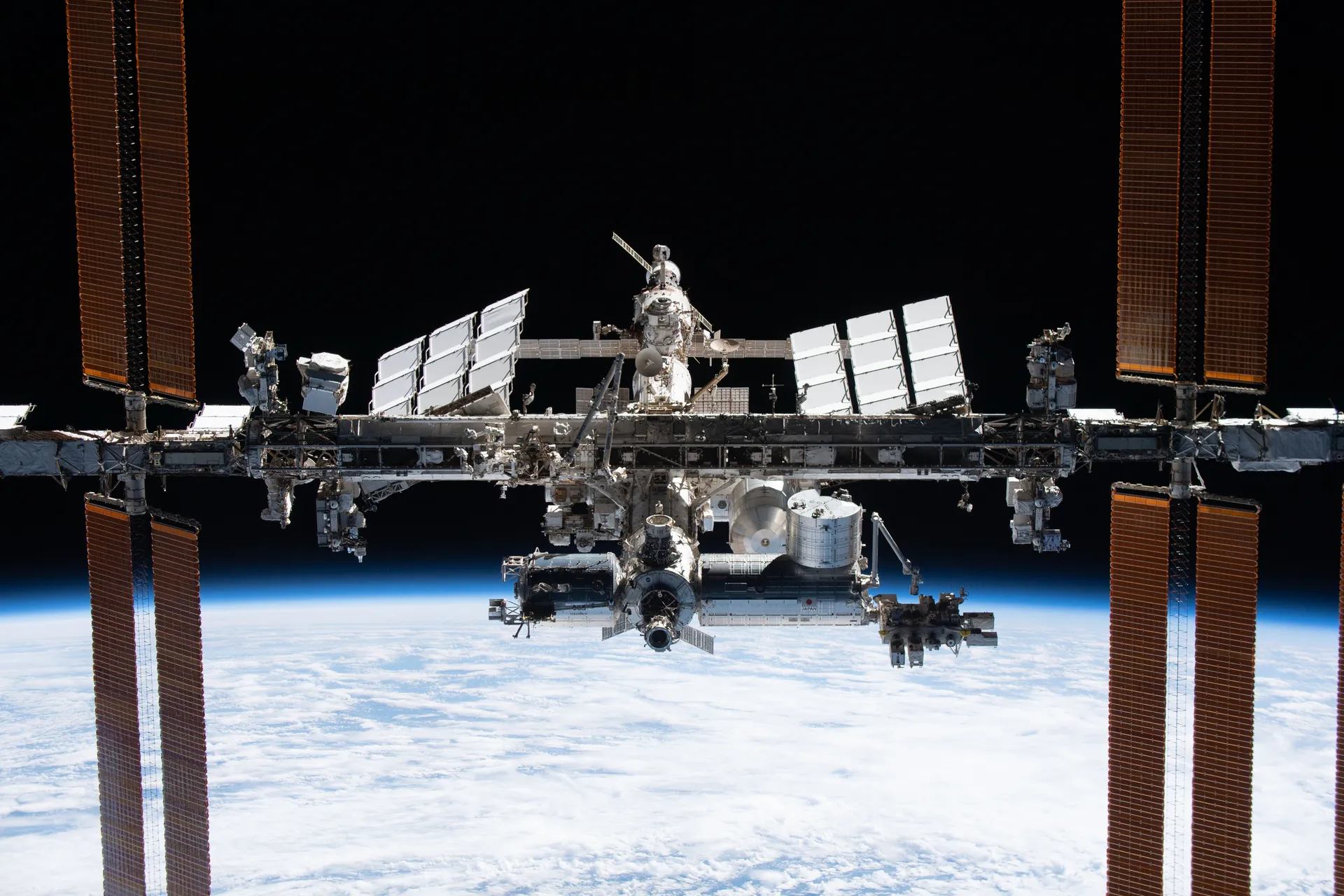
How seven people sleep, eat, exercise and work aboard the space station
Twenty-five years of continuous occupation have given the station a daily routine: private sleep stations, a pantry without a refrigerator, two and a half hours of exercise, recycled water, spacewalks and experiments on the crew.
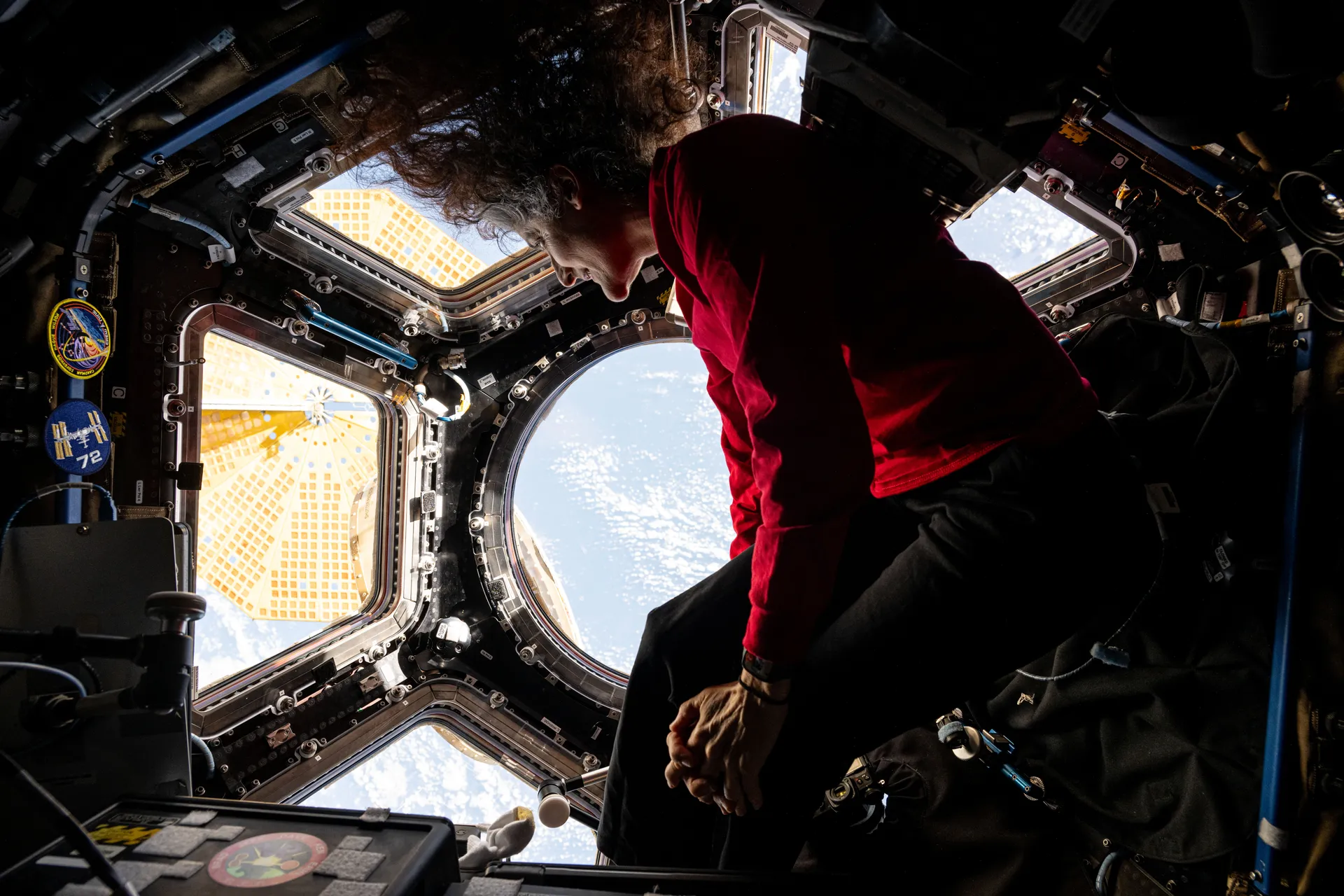
NASA · Expedition 72, March 9, 2025
Drawn from 30 sources: NASA Space Station Blog (12), NASA (7), NASA Johnson Space Center (4), NASA Space Station Research Integration Office (2) and 5 others. About 10 minutes. Checked October 1, 2026.
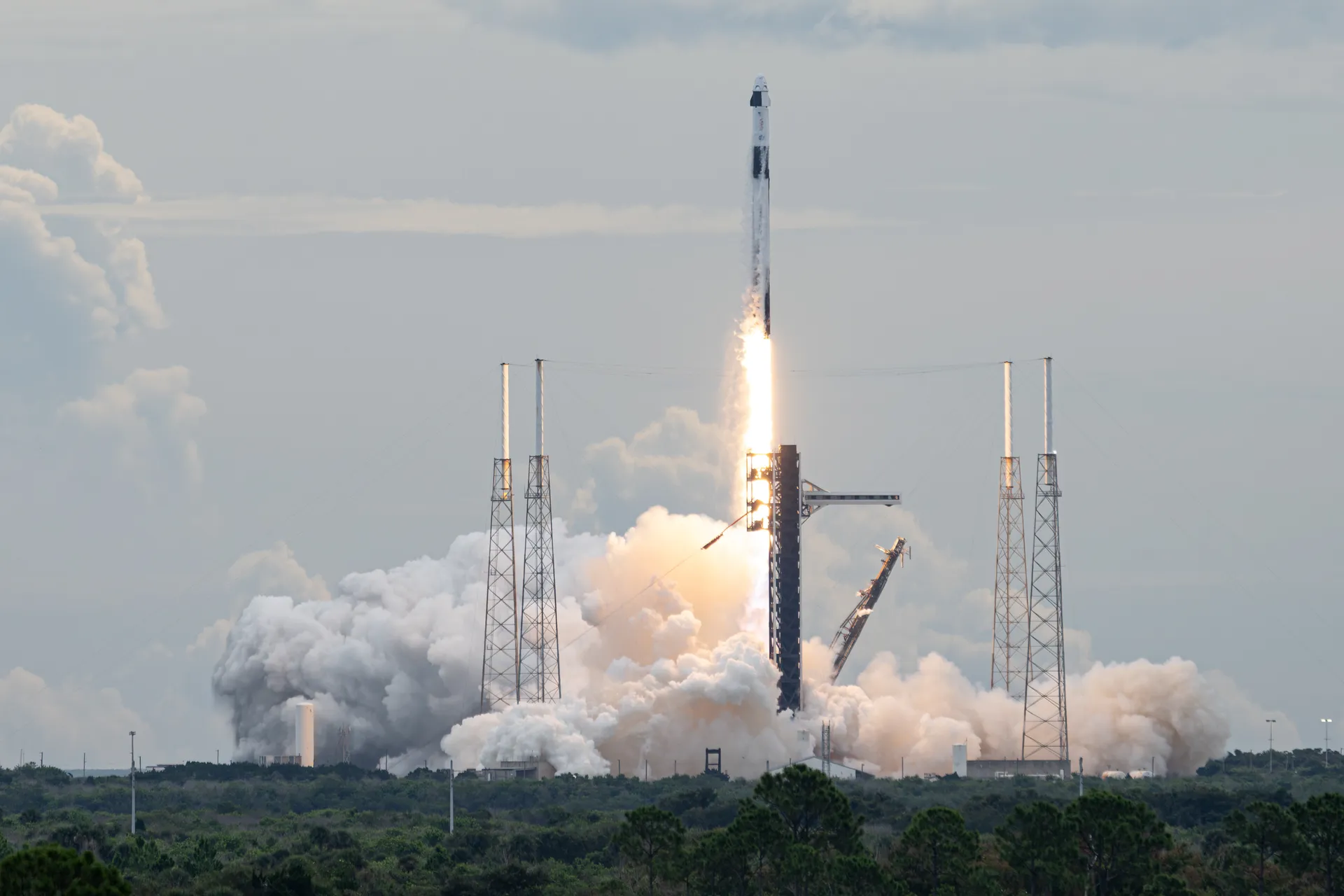
At 11:10 a.m. EDT on October 1, 2026, a Falcon 9 rocket lifted off from Cape Canaveral Space Force Station carrying NASA’s SpaceX Crew-13 mission: NASA astronauts Jessica Watkins and Luke Delaney, Canadian Space Agency astronaut Joshua Kutryk and Roscosmos cosmonaut Sergey Teteryatnikov. Their Dragon was to dock autonomously to the forward port of the station’s Harmony module at about 7 p.m., the fastest launch-to-docking by a U.S. spacecraft in the station’s history. The four join the Expedition 75 crew. After a brief handover, Crew-12—NASA astronauts Jessica Meir and Jack Hathaway, ESA astronaut Sophie Adenot and Roscosmos cosmonaut Andrey Fedyaev—returns to Earth after nearly eight months in space.1,3
On November 2, 2025, NASA marked 25 years of continuous human presence aboard the International Space Station. At least 290 people from 26 countries have visited. A typical mission lasts about six months, though it varies with visiting spacecraft schedules and mission priorities. The people living and working aboard are also part of the research being conducted there.5,9
- 25 years
- of continuous human presence, marked on November 2, 20255
- 290+
- people from 26 countries have visited the station5
- 4,000+
- research investigations, by more than 5,000 researchers26
- 284
- spacewalks for station assembly, maintenance and upgrades through September 1, 202620
One working day, from sleep station to sleep station
NASA’s daily station reports record how the crew’s time is spent. In the last weeks of September 2026, seven people were sharing the work of a laboratory, a home and a spacecraft while they waited for their replacements.2,3
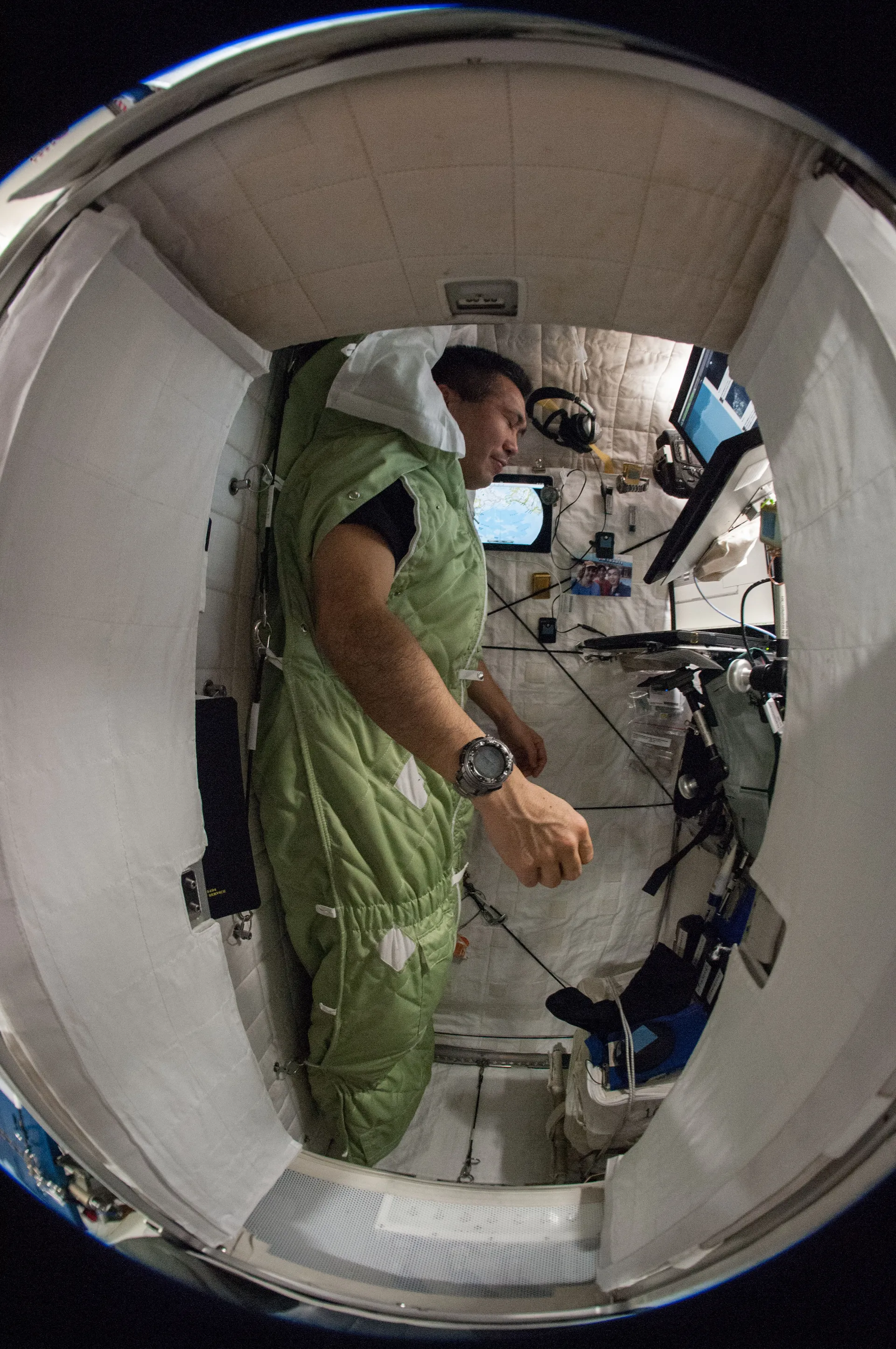
NASA/Koichi Wakata · January 2014
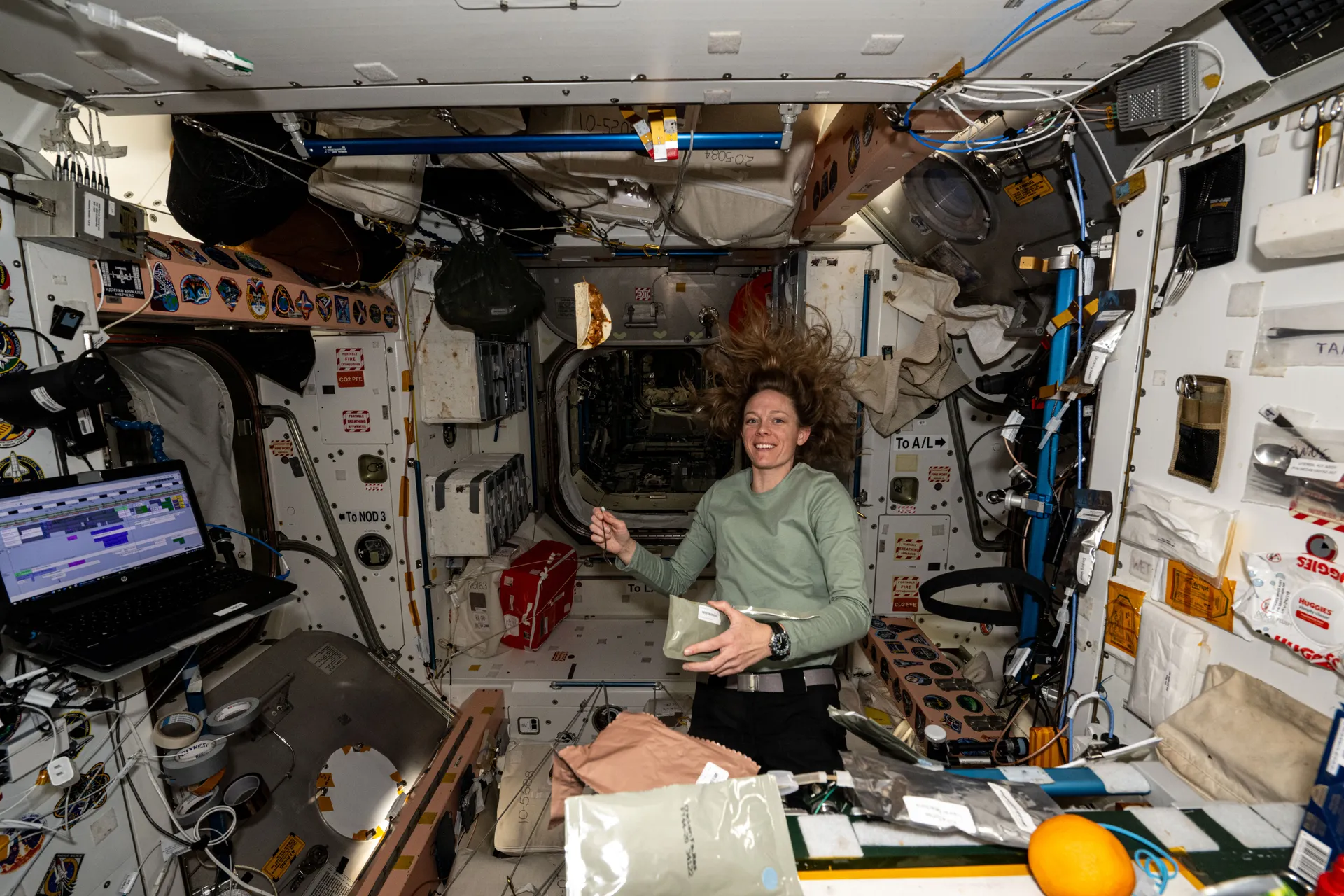
NASA · April 21, 2025
NASA · September 4, 2026
NASA · October 29, 2024
NASA · May 21, 2025
Seven private sleep stations
In 2021 NASA counted seven permanent crew quarters, personal spaces where astronauts sleep and work: four in the U.S. Harmony module, one in Europe’s Columbus module and two in Russia’s Zvezda service module. Each is a small pocket of privacy, with a sleeping bag fastened to the wall. When more people are aboard than there are quarters, as during a handover, crews pick temporary “campout” spots in quiet modules such as the Quest airlock or Kibo, and sometimes in a docked spacecraft.6,29
About 200 menu items and no refrigerator
Crew members choose from about 200 items on the standard U.S. menu and add personal choices, including off-the-shelf foods. With no dedicated refrigerator or freezer for food, everything is freeze-dried or thermostabilized to keep at room temperature. Tortillas, which make no crumbs, have been standard fare since 1985. Fresh fruit and vegetables arrive with visiting cargo ships and are eaten quickly. Each astronaut logs meals on a tablet, and dietitians on the ground review the data weekly.8,9
A shift of medicine and housekeeping
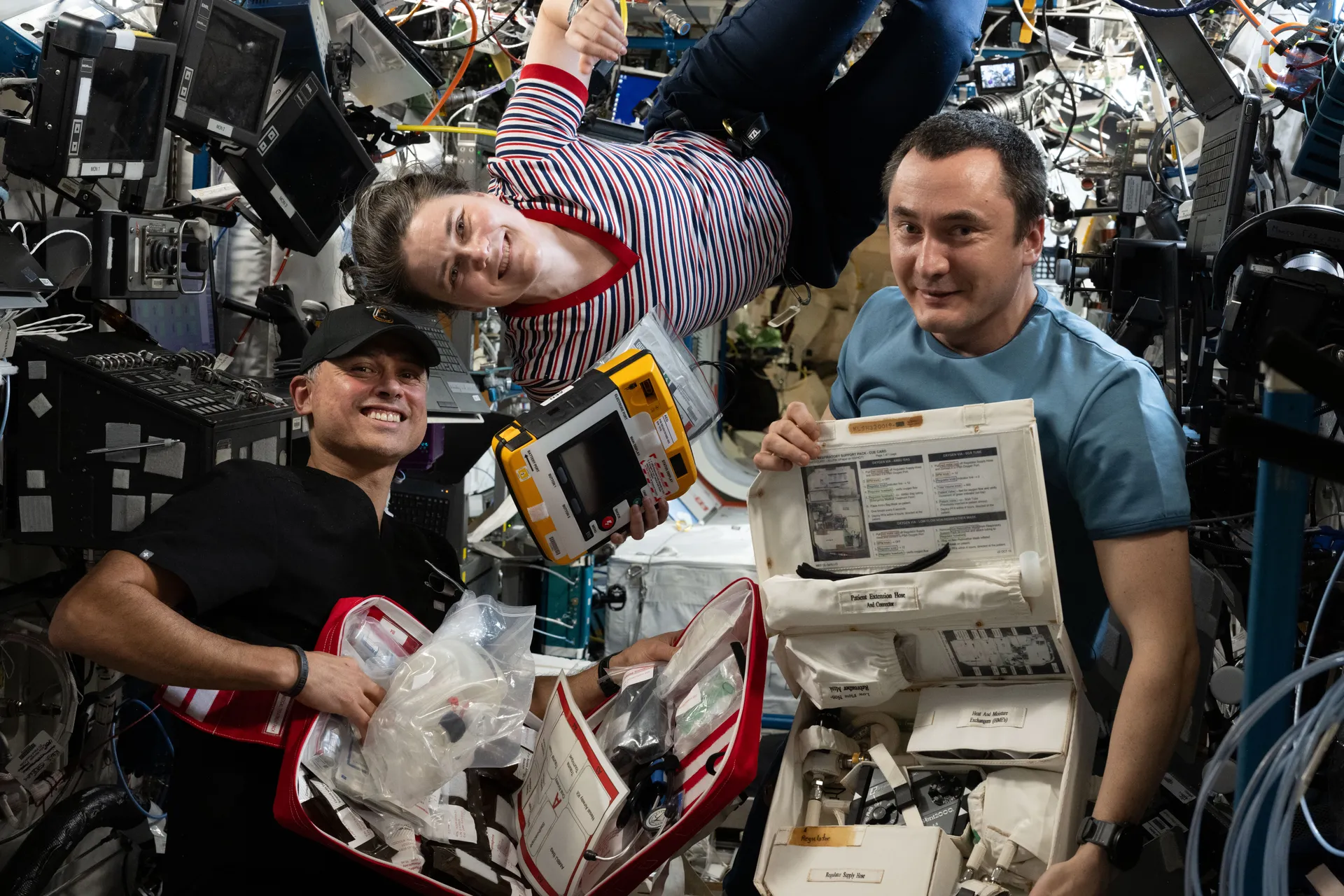
On Monday, September 28, station commander Jessica Meir scanned Anil Menon’s jugular vein with an ultrasound device and measured his blood pressure for a study of blood conditions caused by spaceflight. Jack Hathaway spun a blood sample in a centrifuge, collected water samples for microbial analysis and cleaned his crew quarters. Anna Kikina photographed southern Russia through a window in Zvezda. Earlier that month Menon, Kikina and Pyotr Dubrov had practiced CPR and located medical gear in an emergency drill.3,4
Two and a half hours of exercise
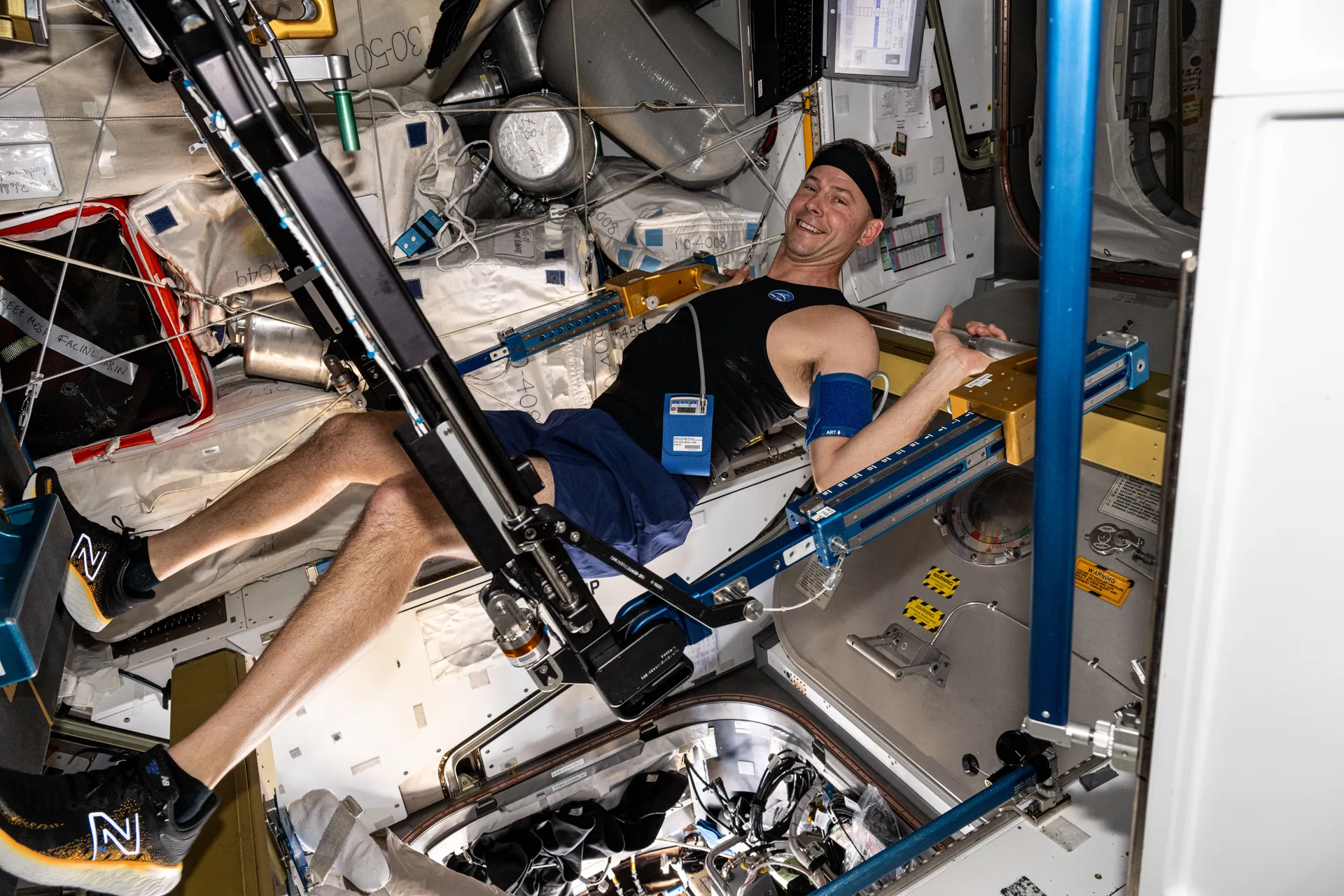
Each crew member is scheduled for two and a half hours of exercise a day to support muscle, bone, aerobic and sensorimotor health. The machines are ARED, the Advanced Resistive Exercise Device, which mimics weightlifting; a treadmill called T2; and a cycle ergometer called CEVIS. In September Sophie Adenot wore motion-capture markers on ARED so researchers could measure the muscle forces and bone stresses of a workout, and tested Europe’s new E4D exercise device, built to keep crews fit inside spacecraft on long missions to the Moon and Mars.9,28,2
Off duty at the cupola
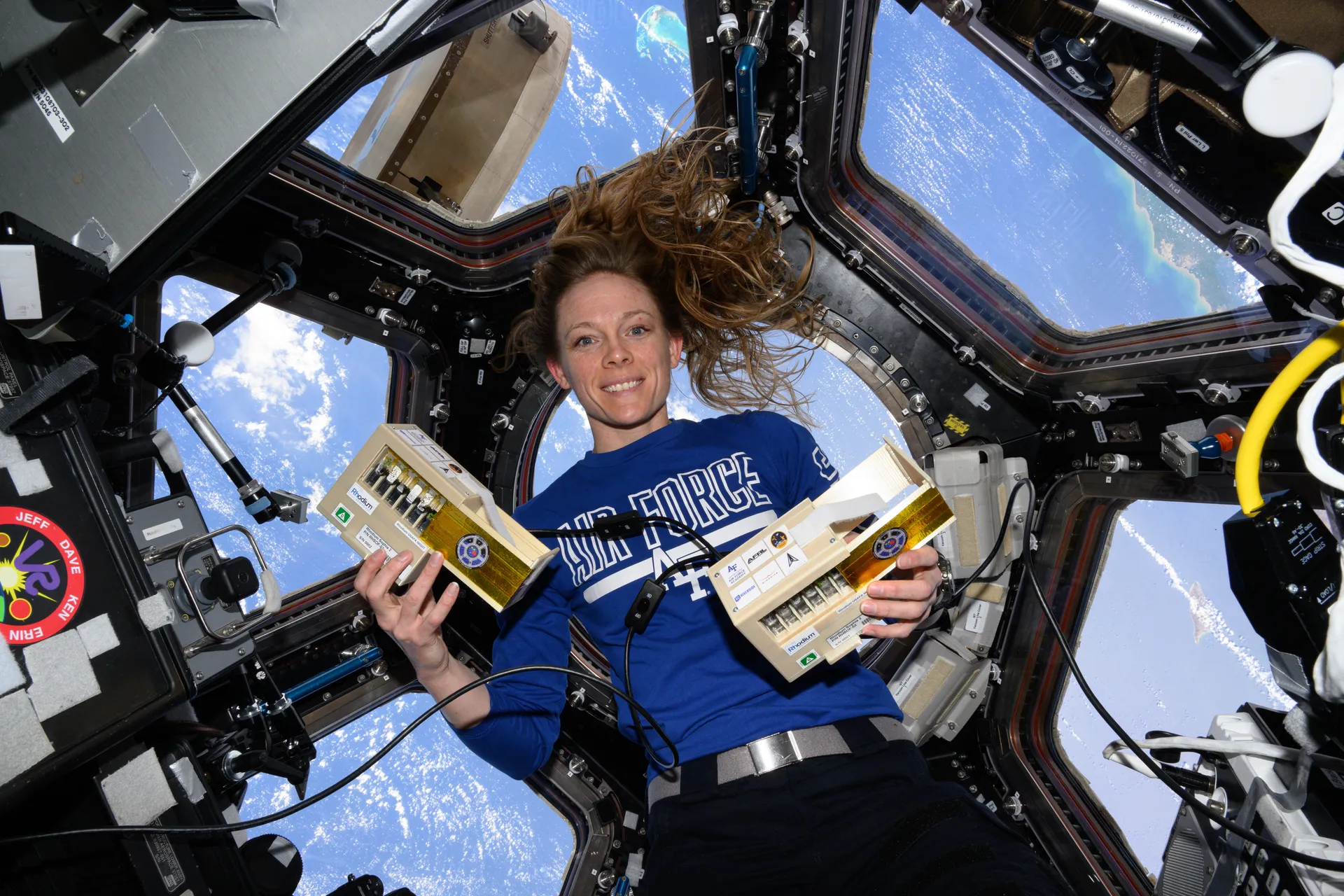
Astronauts can email, call and video-conference with family and friends, receive care packages on NASA cargo flights and talk with a psychologist if they need to. Many spend much of their free time photographing Earth from the cupola, the station’s seven-windowed “window to the world.” Those photographs support research on the ground, and researchers found that taking them also improves the crew’s well-being. On September 18 Menon and Hathaway cleaned all seven windows.9,15,27
Sixteen sunrises a day make sleep a scheduled task
The station orbits Earth every 90 minutes, so its crew can see 16 sunrises in a day. That frequent change from darkness to light makes it hard for the body to keep a natural circadian rhythm, and circadian misalignment and sleep deficiency occur on both short and long flights. Crew members typically get eight hours of sleep time after a long mission day, and they follow a strict sleep and wake schedule for at least two days before launch and throughout the flight. The schedules include lighting instructions, diet, exercise and sleep-aid information.7,29
The lights are part of the treatment. Solid-State Light Assemblies began replacing the station’s older General Luminaire Assemblies and let crews adjust the color spectrum and intensity of the light, to promote alertness or to prepare for sleep. Temperature, airflow, noise, carbon dioxide and the restraints that keep a sleeper from floating away all affect sleep aboard. When scheduling and light are not enough, crew members can use melatonin, caffeine, cognitive behavioral techniques and, after flight surgeons have tested each astronaut’s response on the ground, sleep and alertness medication.7 A European study under way in 2024 tested an LED panel in a crew cabin that changes its spectrum gradually from day to day to mimic natural conditions on Earth.15
Bone and muscle are lost without a daily load
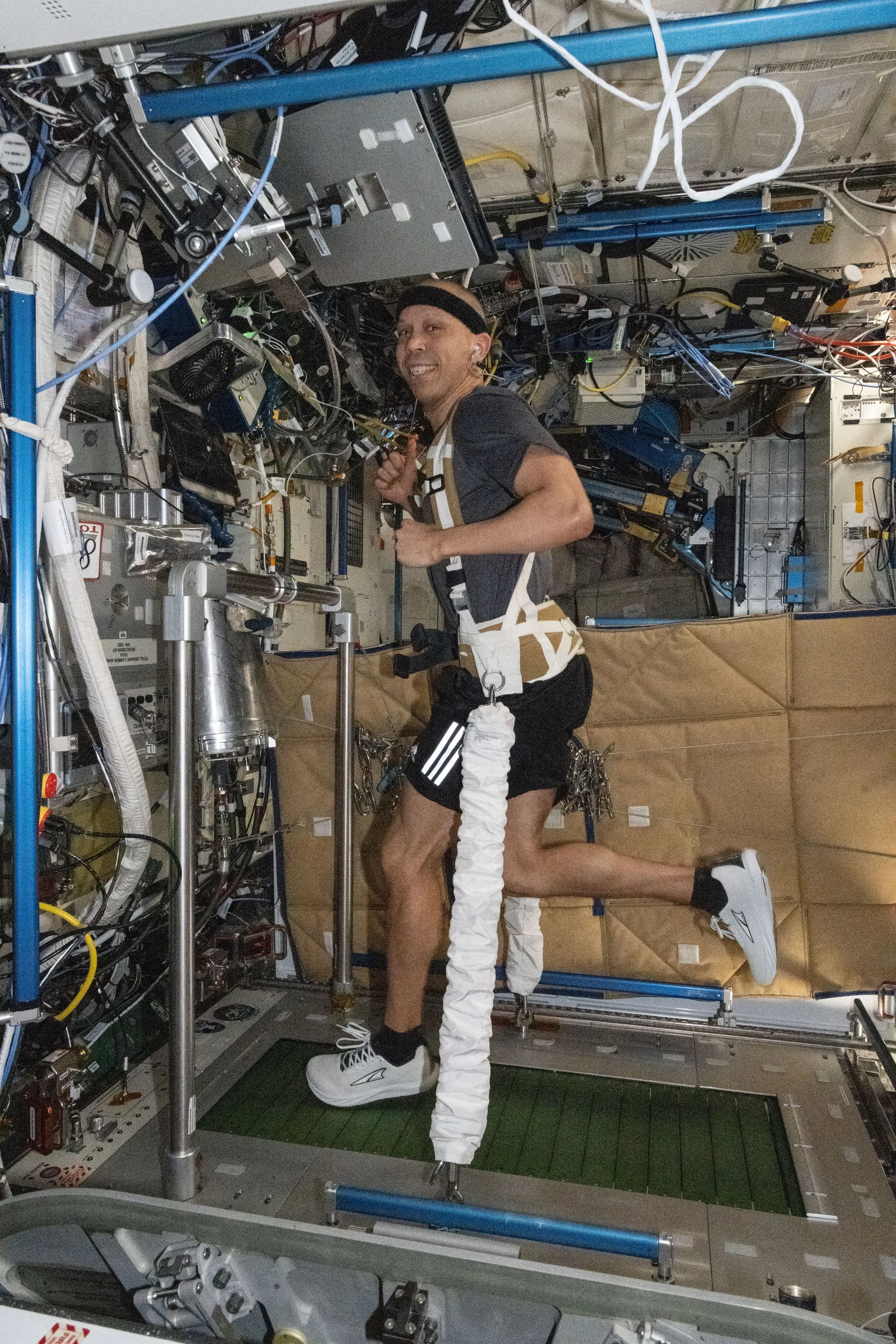
In weightlessness, without the continuous load of Earth’s gravity, bone tissue reshapes itself. The cells that build new bone slow down while the cells that break down old bone keep their normal pace, so breakdown outpaces growth. For every month in space, astronauts’ weight-bearing bones become roughly 1% less dense if they do not take precautions. Muscles, which on Earth work simply to move a body around, weaken because they no longer need to work as hard.10
Exercise is the main countermeasure. One of the first missions to the station flew a treadmill with a harness that tethered the runner to the machine and added a gravity-like force; ARED lets astronauts mimic weightlifting. Even so, International Space Station data show average losses in strength and aerobic fitness of 10 to 12% of pre-mission levels, and depending on how it is measured, 12 to 38% of crew members lose more than a fifth of their fitness. Strength loss affects more crew members than the decline in aerobic fitness.10,11
Those losses matter most at the end of a flight. Recovery begins on the first day back on Earth, and most crew members return to their preflight fitness within 45 days.9 In the week before Crew-13 arrived, the four departing Crew-12 members tested specialized suits that may help them keep adequate blood pressure to the brain and avoid dizziness once on the ground, and Fedyaev wore a Russian lower body negative pressure suit that reverses the shift of fluids from the head toward the feet.3 Spacecraft for the Moon and Mars will have less room for exercise equipment, which is why the station is testing smaller machines and workouts with little or no equipment.10,11
Water that has been through the crew before
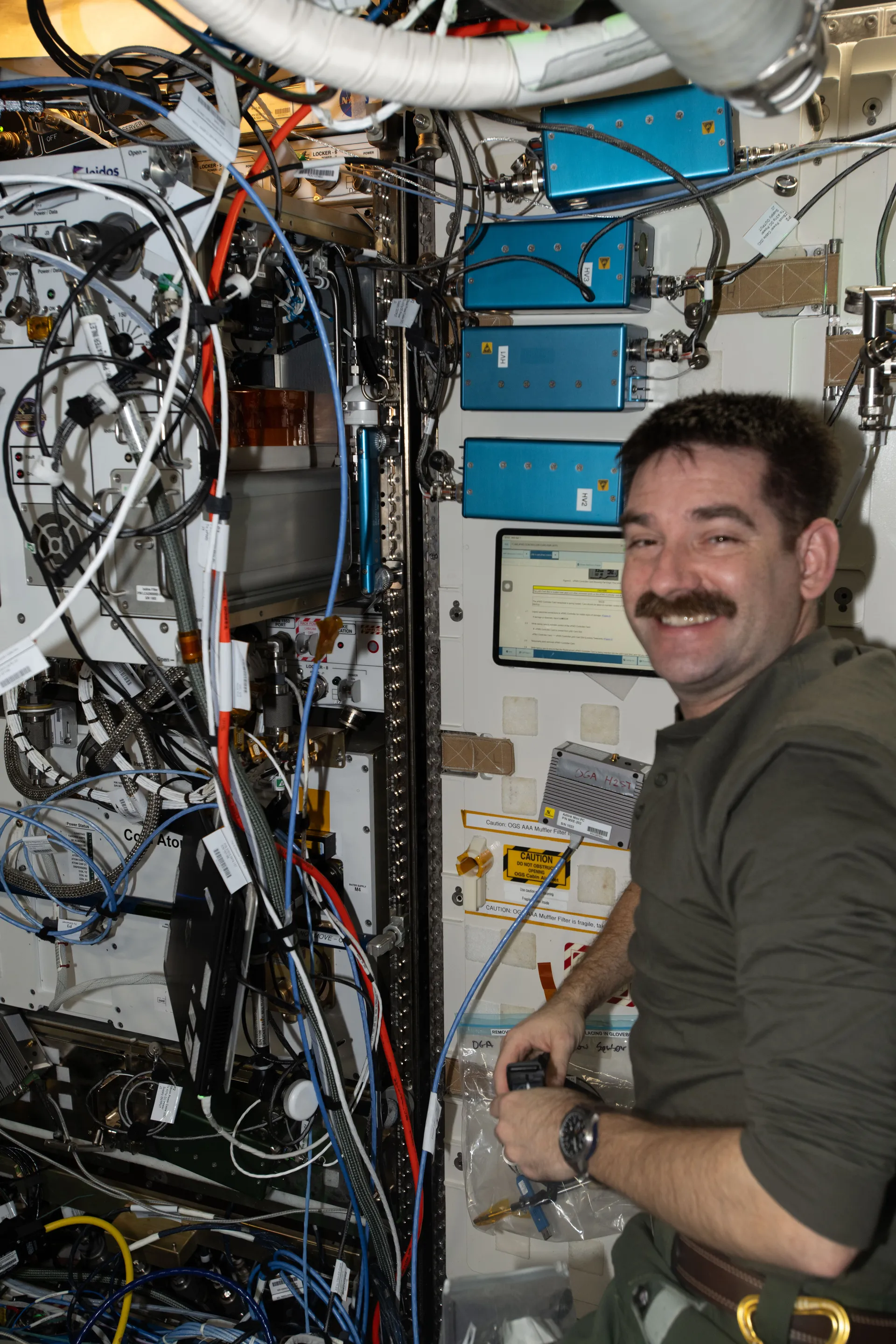
Water launched from Earth is heavy, so the station recycles it. The Environmental Control and Life Support System includes a Water Recovery System that collects wastewater and sends it to the Water Processor Assembly, which produces drinkable water. Dehumidifiers capture moisture released into the cabin air from crew breath and sweat. A Urine Processor Assembly recovers water from urine by vacuum distillation, and a Brine Processor Assembly extracts most of the water left in the brine. In June 2023 NASA reported that the system had reached its goal of recovering 98% of the water, up from 93 to 94% before the brine processor.12
All the collected water is filtered, passed through a catalytic reactor that breaks down remaining contaminants, checked by sensors and dosed with iodine to prevent microbial growth. Each crew member needs about a gallon a day for drinking, food preparation and hygiene such as brushing teeth.12 “When it comes to our urine on ISS,” Jessica Meir said in 2020, “today’s coffee is tomorrow’s coffee!”13
There is no shower and no washing machine. Crew members wash with water squeezed from a drink bag, a towel already holding soap and rinseless shampoo; the water clings to the skin and is wiped off, and a whole wash takes roughly 150 to 200 milliliters. A towel is issued about every five days and an everyday shirt about every seven, and clothing is thrown away when it can no longer be worn. Since 2020 a toilet called the Universal Waste Management System uses airflow to pull waste away from the body; solid waste is compacted into canisters, most of which burn up with departing cargo ships.13,14,29
Four spacewalks in a month to keep the station running
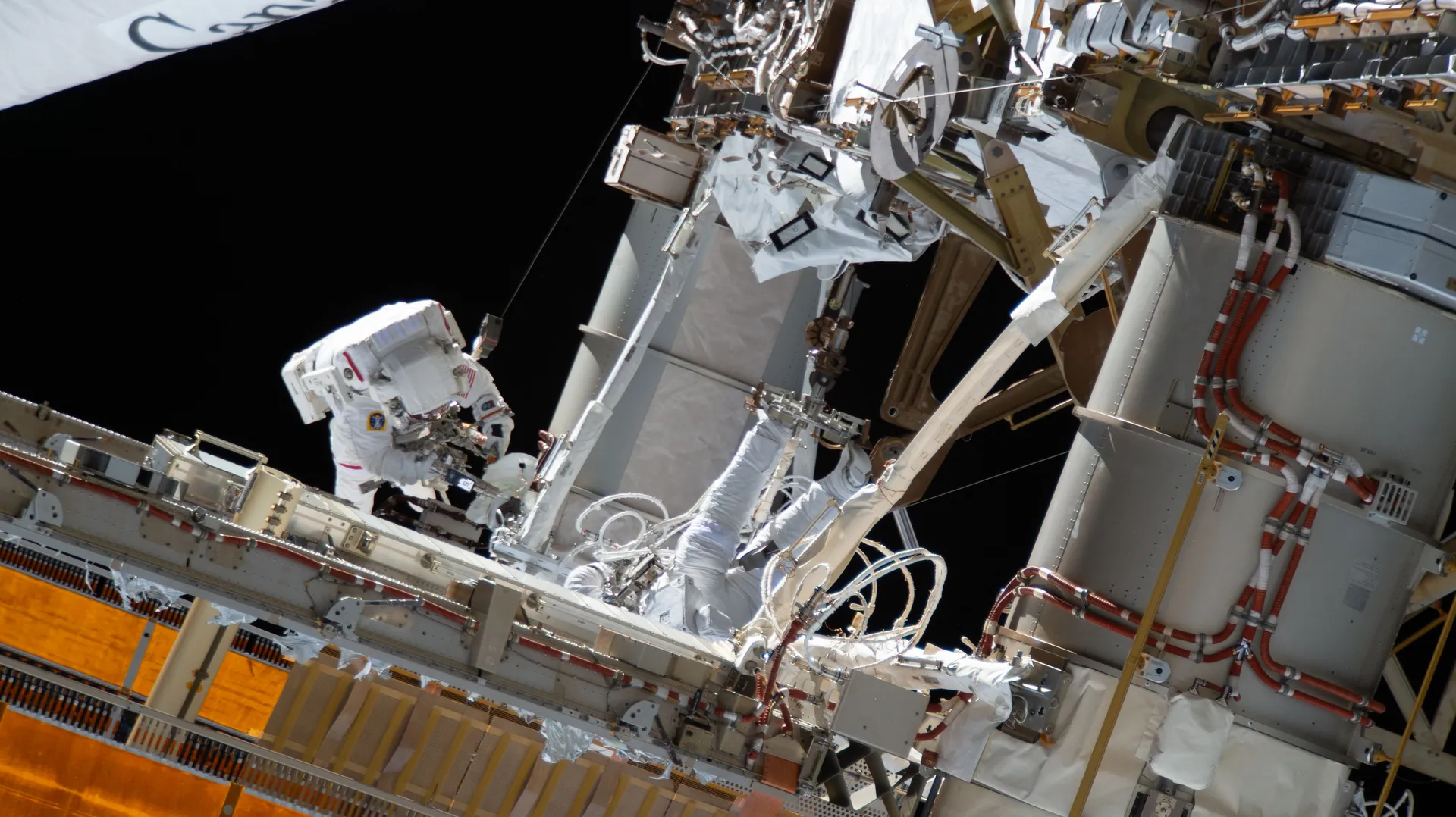
Jessica Meir on the starboard truss on August 6, 2026, preparing the station for a new roll-out solar array.
More than 270 spacewalks dedicated to the station had been accomplished by its 25th anniversary. Assembly and maintenance would not be possible without crew members performing intricate tasks in bulky spacesuits in the harsh environment of space, and spacewalks also test suits and tools for the Moon and Mars.5
Between August 6 and September 1, 2026, Expedition 75 conducted four. On August 6 Meir and Menon spent 6 hours 27 minutes preparing the 3B power channel for a roll-out solar array, power the station will need through its safe, controlled deorbit; it was Menon’s first spacewalk and Meir’s sixth. On August 18 Menon and Adenot removed a failed space-to-ground antenna, a job that ran long when cables and bolts were slow to come free, and Adenot became the first French woman to walk in space. They installed the spare on August 25. On September 1 Meir and Adenot installed a navigation aid on Harmony’s forward port, replaced a camera and swabbed the station’s exterior for microorganisms.18,19,30,20
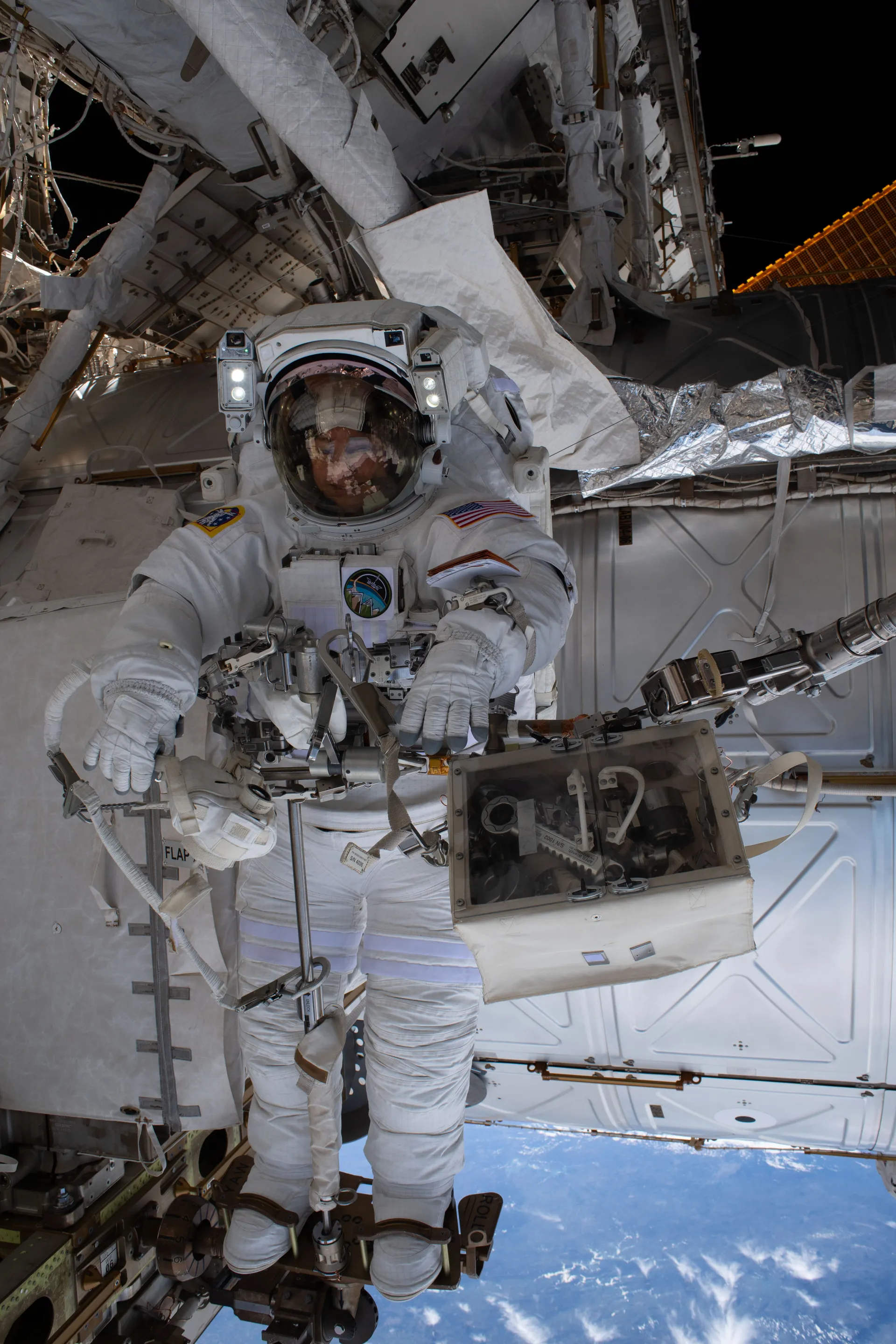
A spacewalk takes days of work inside. Before the August 6 spacewalk, Meir and Menon spent a day in the Quest airlock finalizing tool configurations, staging spacesuits and reviewing procedures, while Hathaway and Adenot, who would help them in and out of their suits and monitor the work, rehearsed with them.23 A spacewalk formally begins when the suits switch to battery power. On September 1 Menon operated the Canadarm2 robotic arm to carry Meir, standing in a foot restraint at its end, to her worksites, while Adenot moved along the truss on her own, tethered to the station.21
The suits need attention during and after every use. Partway through the September 1 spacewalk, Adenot could not move her left arm freely; Meir found that the glove heater harness was likely catching in the shoulder joint, and unzipping the joint seemed to solve it. Afterward the crew refilled the suits’ water tanks, photographed the gloves for inspection and cleaned the suits’ cooling systems, helmets and visors.20,22,4
The suits that replace them are late. NASA’s inspector general reported in April 2026 that Axiom Space, now the only company developing new suits for both the Moon and the station, was at least a year and a half behind schedule, with demonstrations planned for late 2027.24
The crew are subjects, technicians and gardeners
Research on the station depends on the same crew time. NASA performs about 100 research investigations in each six-month increment, and the ISS National Laboratory about 100 more.25 Some run largely from the ground once the crew has installed them; others, like the vein scans and blood counts of September 2026, use the crew as subjects.17,3
Facilities make that work possible in weightlessness. The Microgravity Science Glovebox, in the Destiny module, is a sealed workbench held at lower pressure than the cabin, so that small parts, particles, fluids and gases cannot escape into the crew’s air. Astronauts work through gloves in its doors, and investigators on the ground can operate some experiments through two-way data links and watch through its video cameras.17
Plants show how a chore becomes an experiment. Veggie, a garden about the size of a carry-on bag that typically holds six plants, grows them in “pillows” of clay-based growth medium and fertilizer under LEDs that make the chamber glow magenta. In August 2015 Expedition 44 crew members Scott Kelly, Kjell Lindgren and Kimiya Yui ate red romaine lettuce grown aboard; after overwatering and poor airflow let a fungus kill some of the zinnias, Kelly cleaned the survivors and brought them to flower. The enclosed Advanced Plant Habitat, with more than 180 sensors, needs little day-to-day care from the crew. Crew-13 will test a new, mostly autonomous plant growth system and how plants grow outside dedicated facilities.16,8,1
Research in the crew’s hands
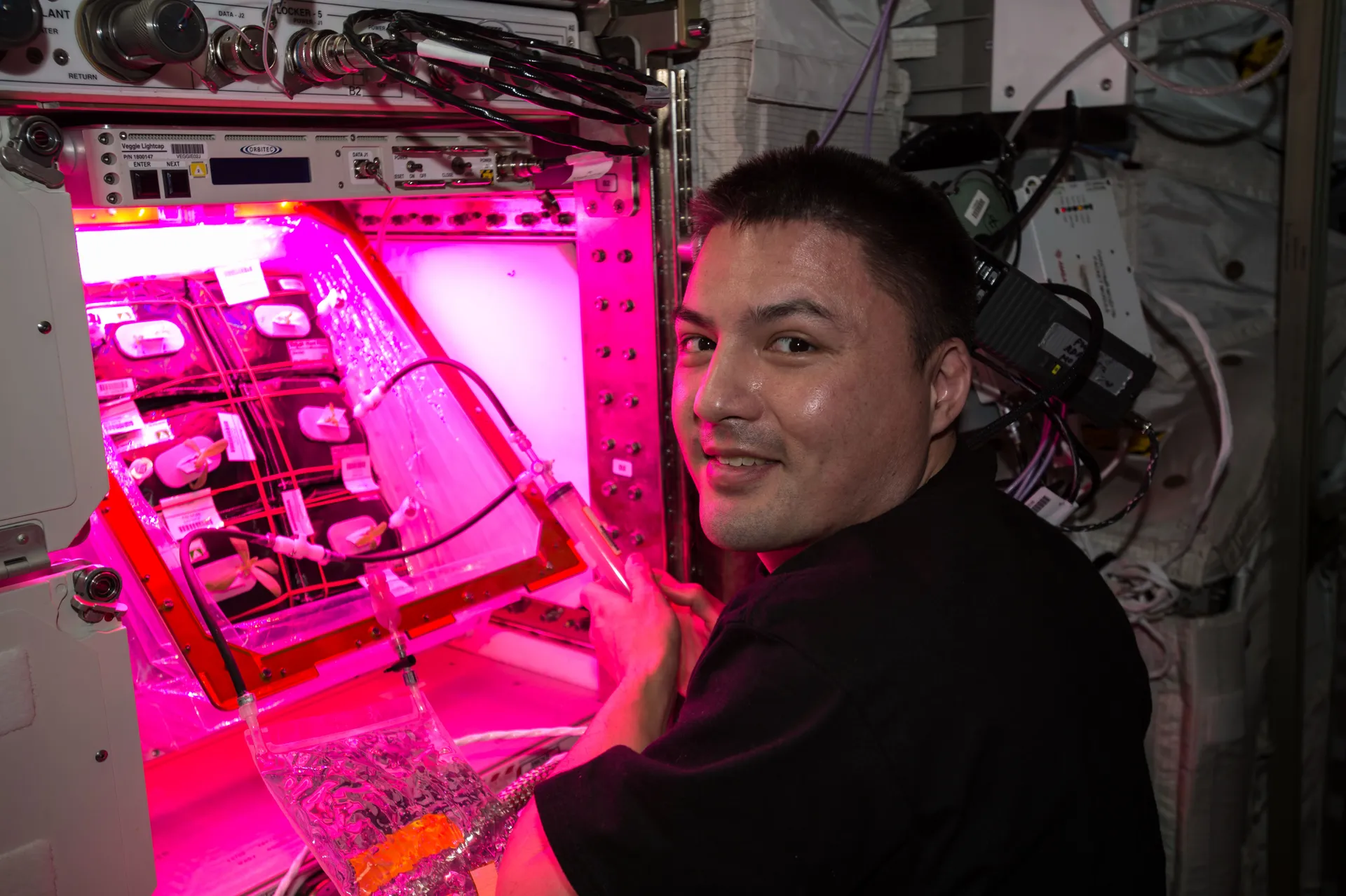
Kjell Lindgren tends zinnias in Veggie, in the Columbus module, December 2015. NASA/Kjell Lindgren
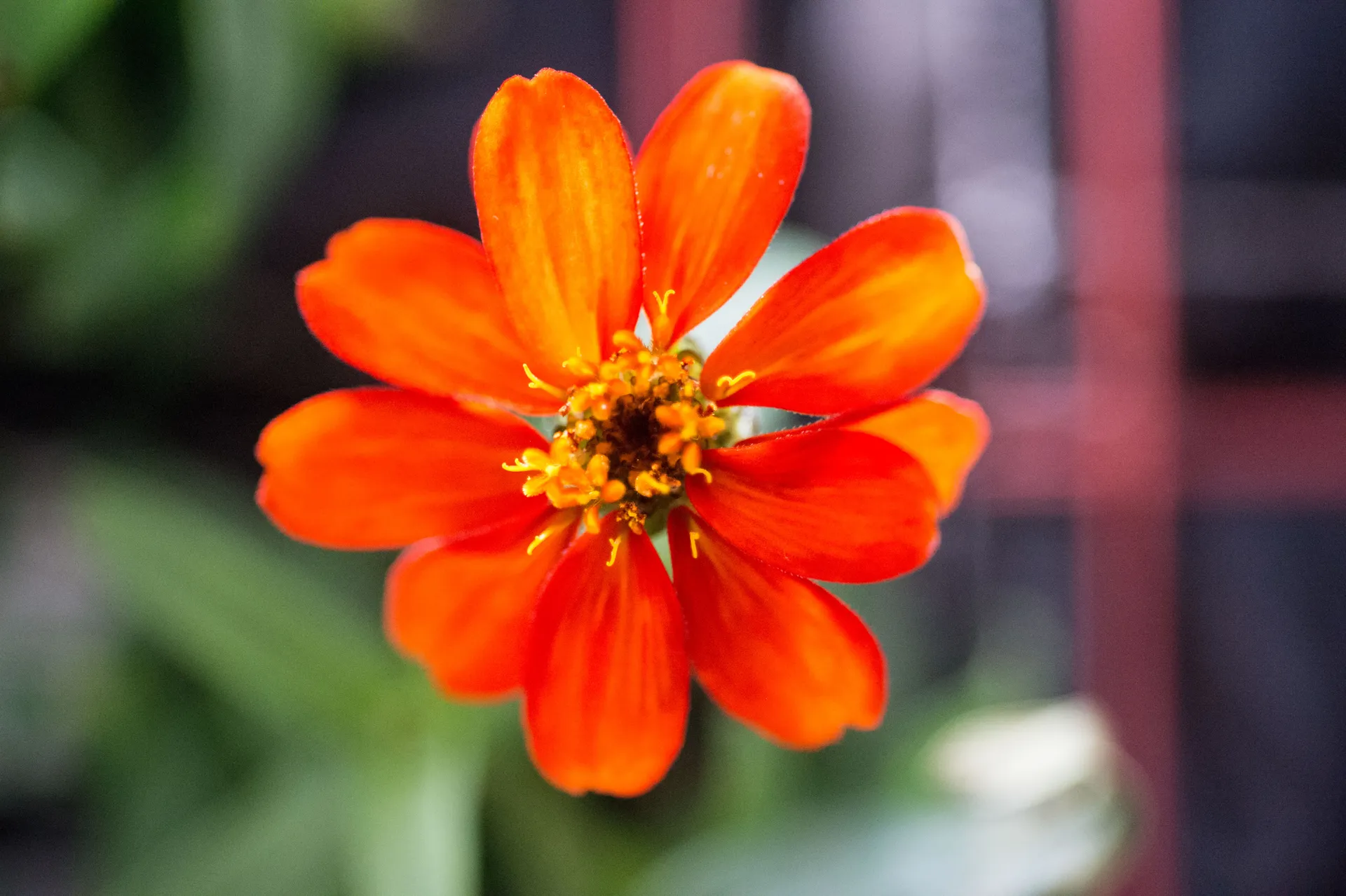
One of the Veg-01 zinnias that Scott Kelly nursed back to health, January 2016. NASA/Scott Kelly
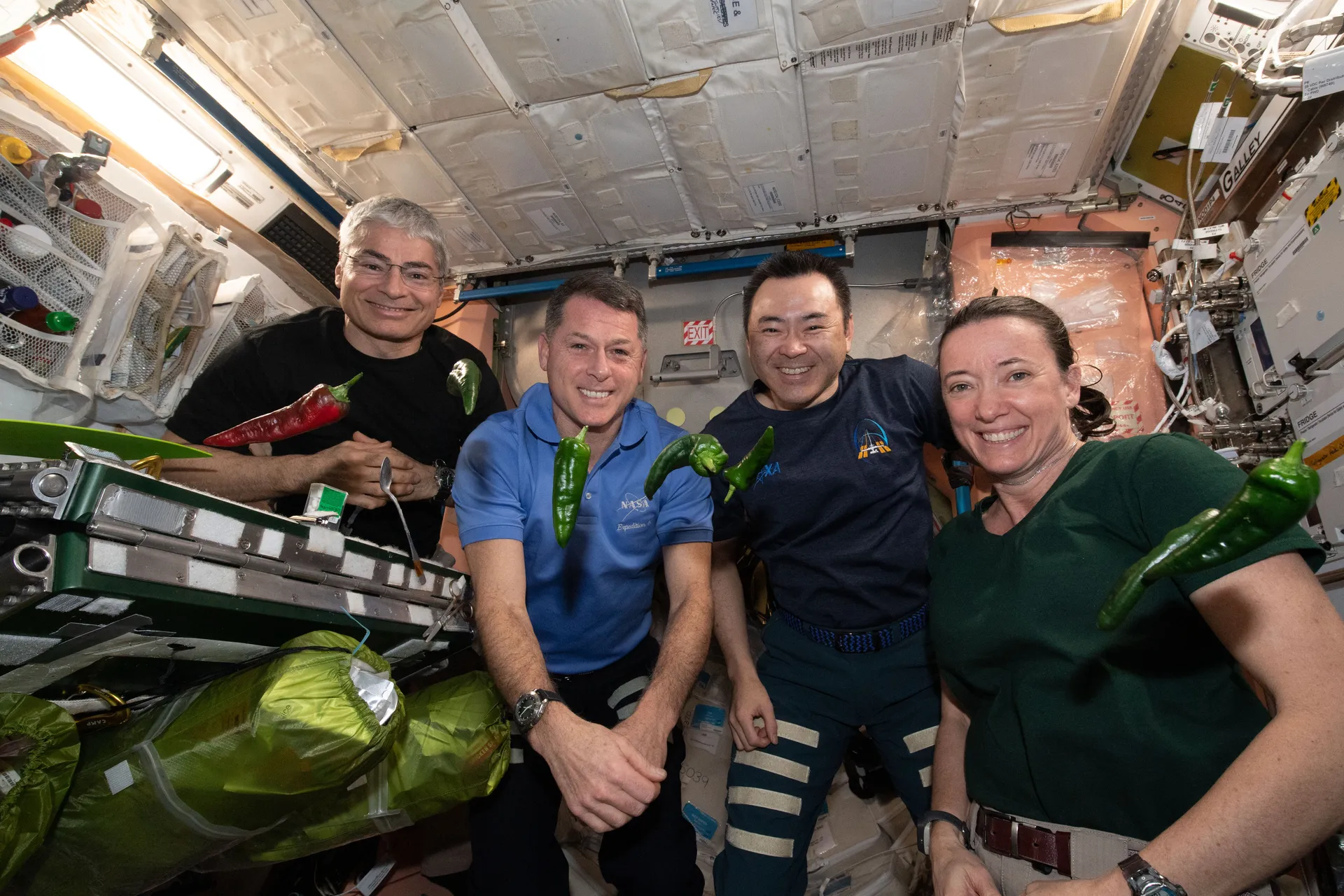
The first chile peppers grown on the station, from the Plant Habitat-04 experiment, October 29, 2021. NASA
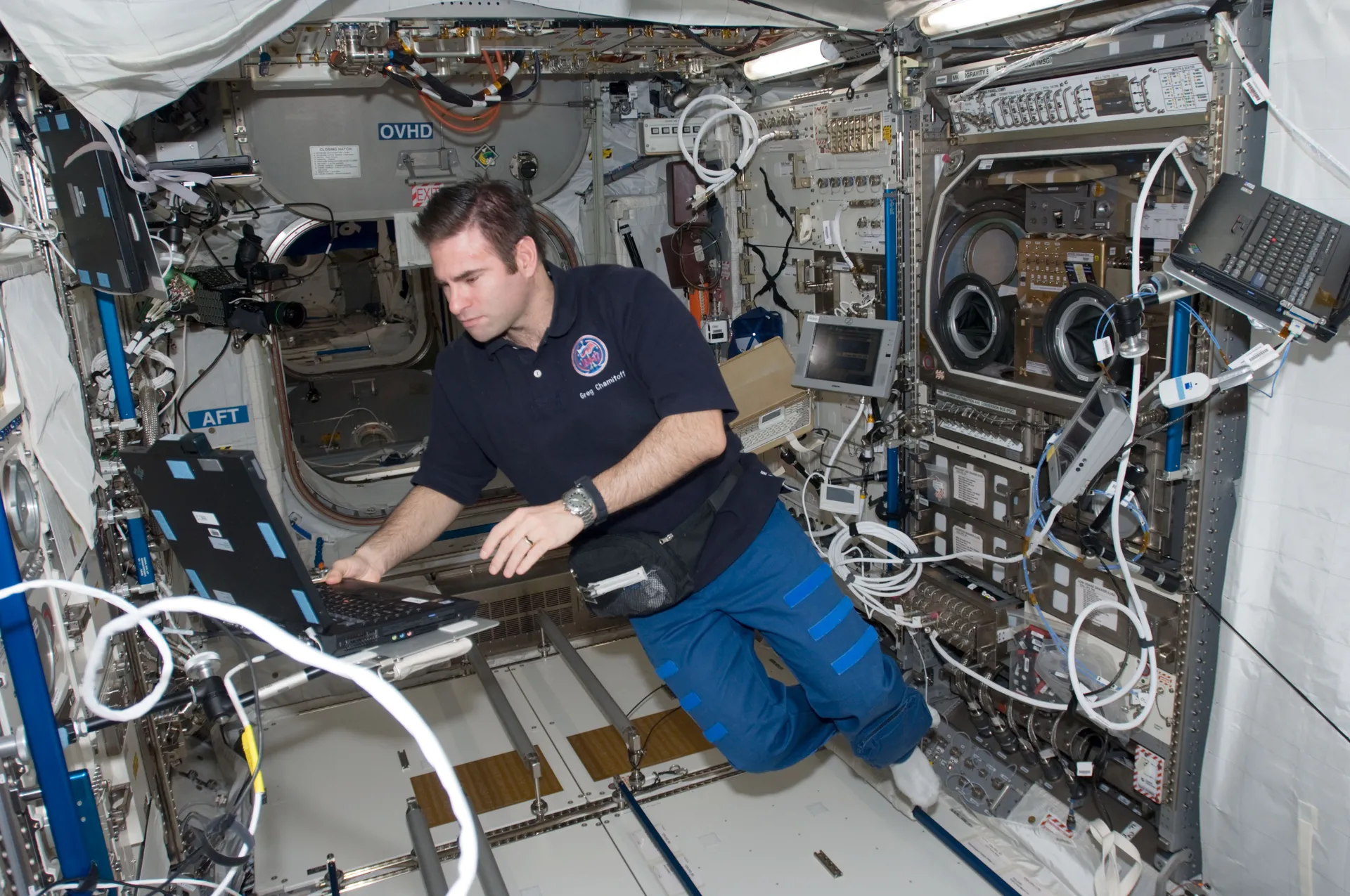
Greg Chamitoff at the Microgravity Science Glovebox, August 2008. NASA
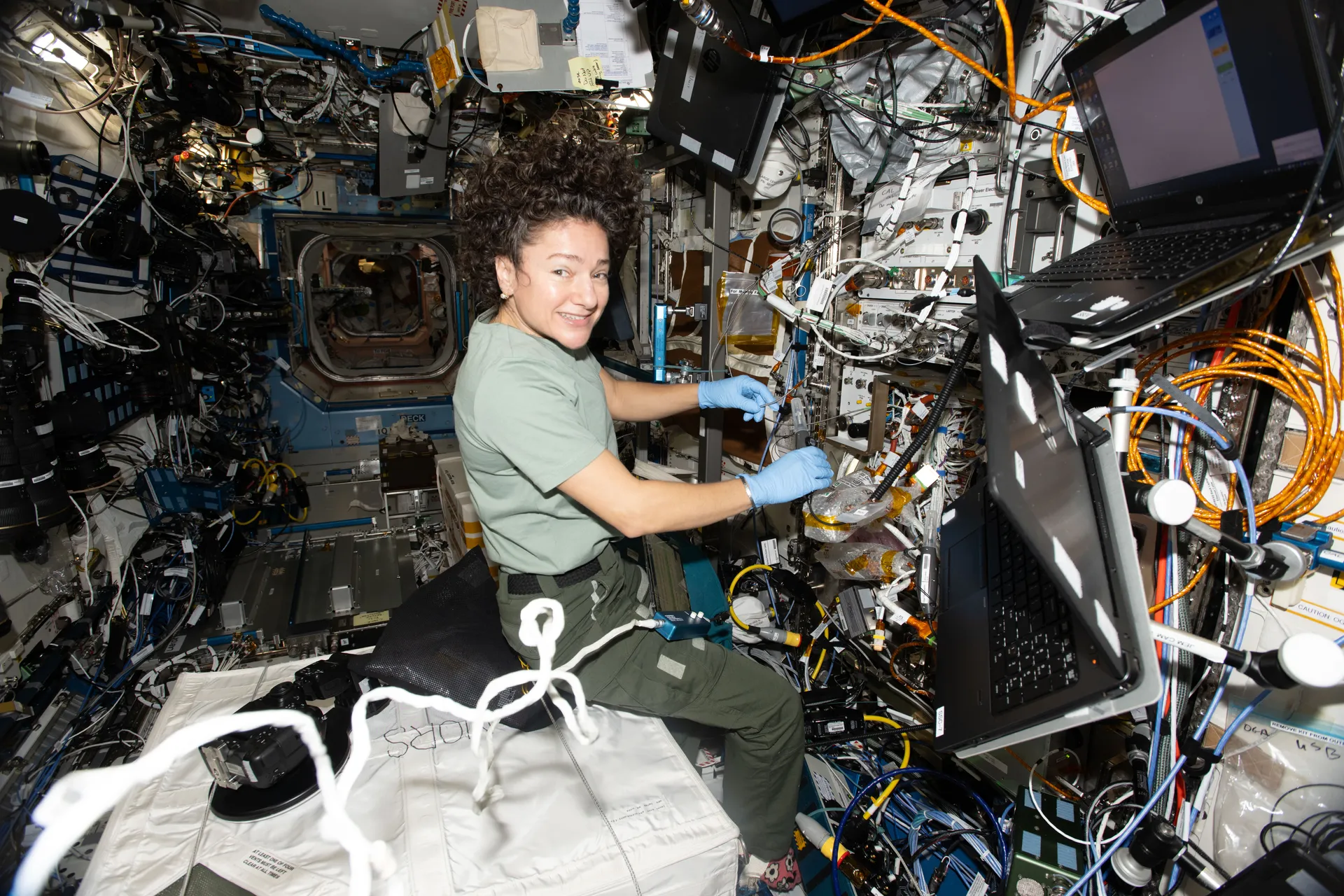
Jessica Meir inspects fiber cables in the Cold Atom Lab, a quantum physics facility that chills atoms to near absolute zero, May 4, 2026. NASA
What a commercial station would have to take over
The station is to be retired around 2030 and replaced by commercial stations from which NASA buys services. GAO reported in June 2026 that NASA expects an initial decrease in research capability compared with the station’s current capability, depending on how many commercial stations are certified and when they launch. The minimum NASA asks of a commercial station’s crewed demonstration is four crew members for 30 days. An ISS program official told GAO that it took time to build up all of the station’s capabilities and that it will take time to build them up again.25
Every new station will need the same list before its first experiment: sleep stations, a pantry, exercise machines, a toilet and water recycling. On the International Space Station that list took years to mature. Water recovery did not reach its 98% goal until 2023, with the help of the brine processor, in the station’s 23rd year of continuous occupation.12,5
Sources
The text above is drawn from these 30 sources. Government works are adapted closely; company and press material is summarized. Numbers in the text point here. Last checked October 1, 2026.
Show all 30 sourcesShow fewer
- 1Back to the text
- 2Back to the text
- 3Back to the text
- 4Back to the text
- 5Back to the text
- 6Back to the text
- 7Back to the text
- 8Back to the text
- 9Back to the text
- 10Back to the text
- 11Back to the text
- 12Back to the text
- 13Back to the text
- 14Back to the text
- 15Back to the text
- 16Back to the text
- 17Back to the text
- 18Back to the text
- 19Back to the text
- 20Back to the text
- 21Back to the text
- 22Back to the text
- 23Back to the text
- 24Back to the text
- 25Back to the text
- 26Back to the text
- 27Back to the text
- 28Back to the text
- 29Back to the text
- 30Back to the text
Continue
Related stories
- ISSHow five space agencies assembled the largest structure ever flown, what it has cost the United States, why its oldest Russian tunnel leaks, and how NASA plans to bring it down after 2030.
- Commercial stationsSince 2020 NASA has paid companies to design stations it could rent after 2030. In 2025 and 2026 the plan changed three times, the money stayed short, and GAO warned of a gap in U.S. crew presence.